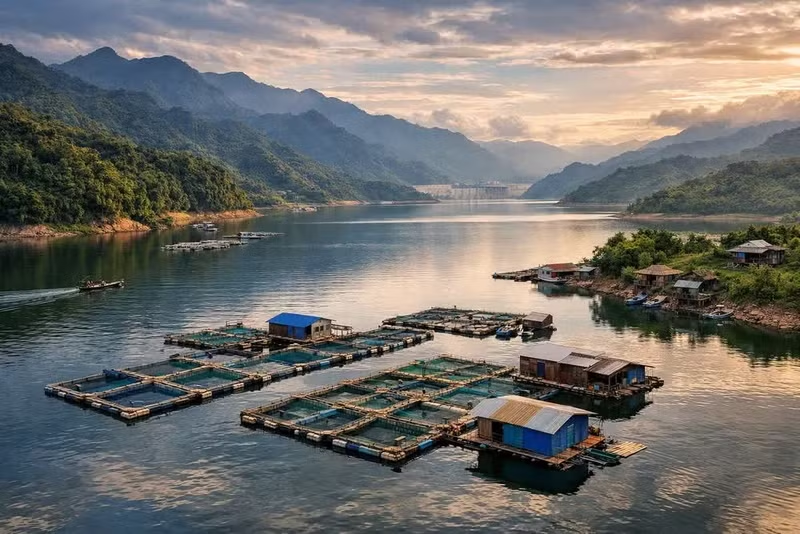
However, to transform this advantage into a growth driver, this industry must still overcome a series of challenges, such as fragmented production, inconsistent infrastructure, overexploitation, and bottlenecks in management mechanisms.
The “floating economic space” is opening up
Viewed from above, Viet Nam’s reservoir system resembles a network of giant “water mirrors,” stretching from the northern mountainous regions to the Central Highlands.
The country currently has approximately 6,750 irrigation reservoirs and over 700 hydropower reservoirs, with a total capacity of over 50 billion cubic meters, creating about 400,000-450,000 hectares of water surface. Many large reservoirs are fully capable of serving the development of commercial-scale aquaculture.
In this picture, the North emerges as a “development core.” This area is home to a large concentration of large-scale reservoirs such as Hoa Binh, Son La, Thac Ba, Na Hang, and Lai Chau.
Notably, reservoirs with an area exceeding 5,000 hectares account for a significant proportion, forming interconnected water bodies — a rare advantage for large-scale aquaculture development.
These figures, when placed within the context of the agricultural economy, represent not simply resources, but a vast “production space.” In fact, a “floating production system” has formed on these reservoirs.
Currently, cage and raft fish farming is the dominant form of aquaculture in the large reservoirs of northern Viet Nam. The total number of cages has reached over 22,000, yielding approximately 50,000 tonnes annually. These figures demonstrate that the reservoirs have become a genuine source of livelihood for tens of thousands of households.
Not only has the scale expanded, but the productivity of aquaculture is also gradually approaching that of intensive farming models. In some cases, the yield of fish per cubic meter of water is quite high compared to many other inland aquaculture areas, with carp reaching approximately 50 kg/m³, black carp 30–35 kg/m³, and catfish 25–30 kg/m³.
These results provide a basis for the management agency to set more ambitious targets. According to the Ministry of Agriculture and Environment’s plan for the development of aquaculture in reservoirs for the period 2026–2030, by 2030, the expected production will reach over 260,000 tonnes per year, with a total value of approximately 16 trillion VND.
At the same time, more than 50% of aquaculture facilities will participate in cooperatives or supply chains, and 100% of facilities will be updated in the national aquaculture database.
The “bottlenecks” beneath the lake’s surface
However, alongside these bright spots lies a different reality with multiple layers of difficulty, where each link has problems, collectively creating significant obstacles.
The aquaculture sector in the northern region is still in the process of transitioning from small-scale production to commercial production. The majority of farming activities are carried out by households or individuals, scattered, and lacking integrated supply chains. As a result, while production has increased, the added value remains low and is not commensurate with the vast potential of the water surface.
This reality also explains why, despite tens of thousands of cages, aquaculture in the lake has not yet formed a clearly structured economic sector but remains only a collection of scattered bright spots.
From a policy perspective, Dr Le Thanh Luu, of the Viet Nam Fisheries Association, frankly pointed out a long-standing problem that has persisted for more than two decades: “The issue of aquaculture in reservoirs has been discussed since the 2000s, but to date, there has been little significant progress.
The first bottleneck lies in the unclear mechanism for allocating water surface area. When access to resources is not clearly established, businesses find it difficult to invest long-term, while people are still struggling with short-term production.
Next is the problem of market access and production organisation. The lack of a clearly defined main aquaculture species to ensure a stable market makes it very difficult to persuade investors to participate.”
A vicious cycle has formed: Without a large market, there are no large investors; and without large-scale production, it is impossible to create a sufficiently attractive market.
Another major bottleneck is finance: Large-scale production requires significant capital, but in the context of unclear mechanisms and unstable output, businesses have difficulty accessing credit. Simultaneously, infrastructure and support services remain a clear weakness.
From transportation connecting the reservoir, water supply and drainage systems to services such as breeding, feed, and consumption, everything is lacking and not synchronised. With an absence of fishing ports, specialised transportation systems, and processing plants, the value chain is therefore “broken” from the outset.
The lack of a database on aquaculture zoning and environmental carrying capacity leads to spontaneous development in many areas, posing ecological risks. Meanwhile, a reservoir often involves multiple management units, leading to overlapping responsibilities and creating difficulties in organising production and attracting investment.
Not only does this industry lack mechanisms and infrastructure, but it also suffers from a shortage of human resources at all levels, from scientists and managers to professional production organisers.
Furthermore, destructive fishing practices in some areas, such as electric shock fishing and small-mesh nets, deplete resources and directly impact the aquaculture environment.