At the same time, households and businesses are encouraged to apply scientific and technological advances and digital transformation to enhance the value chain of aquatic products.
Currently, around Thac Ba Lake there are two enterprises, five cooperatives, 13 cooperative groups, and more than 300 households engaged in cage fish farming and net-enclosure fish farming. The main fish species raised include lang fish, red tilapia, tilapia, ngan fish, grass carp, among others. Total annual aquatic output reaches 8,500 tonnes.
In 2025, the aquaculture and exploitation area of the lake region was about 800 hectares, with a stable development of 2,500 fish cages. Total aquaculture and exploitation output reached more than 9,200 tonnes, of which aquaculture output accounted for 8,000 tonnes and natural capture output reached 1,200 tonnes. From this foundation, many Thac Ba fish processing facilities have developed, supplying the market with quality products favored by consumers.
Right at the boat pier on Thac Ba Lake, Nguyen Thi Ha (born in 1975, residing in Hamlet 13, Yen Binh Commune), together with her husband Vu Van Tien, is busily transferring freshly harvested fish from the cages to customers. Black lang fish weighing up to 3 kg and tilapia weighing more than 2 kg, fresh and glistening, are loaded onto trucks in time for delivery to restaurants in the area. Holding a mobile phone in livestream mode, Ha informs customers of fish varieties, prices, and contact numbers. Within minutes, several regular restaurants place orders for the newly harvested fish.
Ha shared that after nearly 10 years of being engaged in cage fish farming, her family currently has 14 fish cages on Thac Ba Lake, with an annual output of about 30 tonnes of various fish. With detailed guidance from provincial fisheries extension officers, the family boldly applied technology in cage fish farming, including HDPE plastic cages, nano sensor systems, and anti-fouling nets. The nano sensor system automatically monitors water quality (temperature, oxygen, pH) and provides timely warnings, helping farmers better control the living environment of the fish. The application of digital technology in cage fish farming, combined with traditional fish farming and disease treatment methods using garlic, lime, and oxygen aeration, has helped fish grow rapidly and minimized disease outbreaks.
Sharing further about digital transformation, Ha said that she only completed grade 5 before getting married and making a living buying fish caught on the lake for daily sale at the market. Now that her family raises cage fish on the lake, whenever fish arrive at the pier—fresh and with clear origins—she uses her phone to post information on Facebook, TikTok, and Zalo, enabling customers with demand to place orders without having to sit at the market all day as before. Through these social media platforms, more customers contact her directly every day to buy fish. Products from natural lake fish raised by other cage-farming households have also sold better than before. In the coming time, the family plans to learn and apply product traceability processes to help customers feel secure when making purchases.
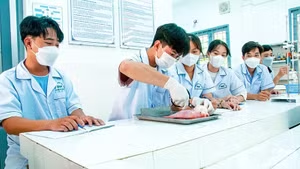
Beside an industrial fish grinder, wearing a face mask and rubber gloves, Vu Thi Thu Huong (born in 1984, residing in Group 13, Yen Binh Commune) is completing the packaging stage of Thac Ba Lake lang fish sausages. Huong said that she began participating in cage fish farming on Thac Ba Lake in 2016, but consumption was often subject to price pressure from traders due to simultaneous harvest periods. By 2020, when the Covid-19 pandemic caused farmed fish to be unsold, she attended a seafood processing training course and proactively developed output channels with products such as sausages, rolls, fish paste, and floss made from cage-farmed fish.
As the owner of Tam Duc food business household, Huong was facilitated by the Lao Cai provincial Department of Science and Technology and the Department of Agriculture and Environment to participate in start-up training courses, trade fairs, and to list products on e-commerce platforms such as Shopee, Lazada, and Tiki. As a result, she successfully developed three products certified with OCOP 3-star ratings, including green pepper fish cake, green pepper fish roll, and green pepper sausage. Combined with promotion on her personal Facebook page, she sells more than one tonne of processed fish products per month, with an average annual profit exceeding 300 million VND. To ensure consumer confidence, in the coming time she plans to research and apply technologies such as blockchain, AI, and RFID for product traceability. This is considered the right direction in aquaculture, processing, and consumption of aquatic products associated with digital transformation.
With the motto “easy first, difficult later,” the commune focuses on digital government, digital economy, and digital society, including the development of smart agriculture and e-commerce for advantage products from Thac Ba Lake (fish, shrimp, resort tourism).
Chairman of the Yen Binh Commune People’s Committee Nguyen Duy Khiem
Chairman of the Yen Binh Commune People’s Committee Nguyen Duy Khiem assessed that, with the motto “easy first, difficult later,” the commune focuses on digital government, digital economy, and digital society, including the development of smart agriculture and e-commerce for advantage products from Thac Ba Lake (fish, shrimp, resort tourism). In the coming time, the commune will continue to maximize the exploitation of water surface areas to develop aquaculture suitable for each locality in a sustainable manner, protecting the ecological environment; focusing on improving productivity, quality, added value, and competitiveness of products. During the farming process, some households have prioritized investment in HDPE plastic cage technology with high durability, strong load-bearing capacity, and adaptability to climate change. Anti-fouling net technology is also used to reduce biofouling, enhance water and oxygen circulation, and limit environmental pollution inside the cages.
Local leaders will continue to integrate investment funding programs and encourage the socialization of resources from organizations and individuals to build facilities serving fry incubation and aquaculture, thereby promoting the application of intensive farming measures to improve productivity and product quality.
Implementing Politburo Resolution No. 57-NQ/TW on breakthroughs in developing science, technology, innovation, and national digital transformation, the commune Party Committee encourages households engaged in cage fish farming to associate production with the application of science, technology, and digital transformation in aquaculture combined with natural fishing. Processing facilities are stepping up the application of technology in fish product processing and using social media platforms and e-commerce in product consumption.