More importantly, the project clearly demonstrates the role of businesses as partners and their sense of social responsibility in working with local authorities to care for workers’ livelihoods, thereby laying the foundation for sustainable development.
Social housing aligned with urban development
The effective implementation of social housing policies is one of the key solutions to ensuring social welfare and stable lives for workers. In Lao Cai province, the social housing project in the Northwest Reserve Area, developed by a consortium of BVB Joint Stock Company and Minh Dien Vital Real Estate Joint Stock Company, a member of BB Group, has been rolled out in a synchronised manner. The project helps address housing demand among low-income earners while meeting the requirements of the sustainable development of Sa Pa as a tourism city in a new phase.
As a national tourist area with rapid urbanisation and tourism growth, Sa Pa is attracting an increasing number of workers, officials and civil servants to settle and work long term. The strong expansion of tourism, services and trade has made the demand for stable, affordable housing an urgent requirement in the urban development process.
In response to this practical need, the investor consortium behind the social housing project in the Northwest Reserve Area has proactively implemented the project in strict accordance with the approved master plan and legal regulations on social housing.
The Sa Pa Social Housing Project therefore not only addresses immediate housing needs but also clearly reflects the enterprises’ responsibility and long-term commitment to accompanying the sustainable development of Sa Pa.
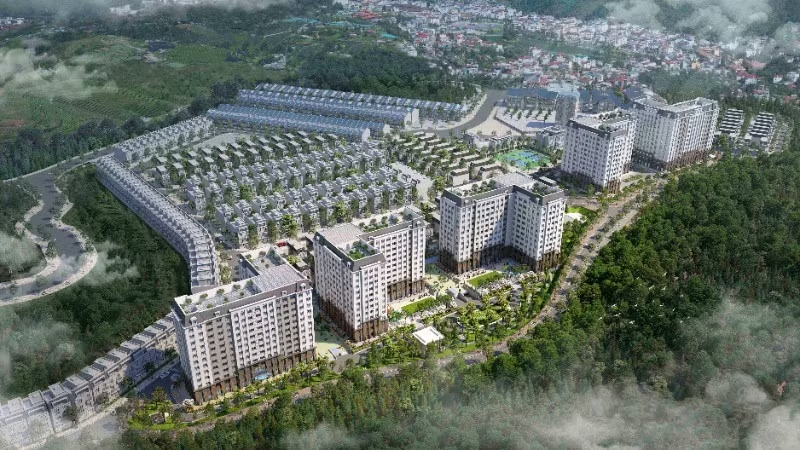
According to the plan, the project comprises five high-rise buildings, each featuring 13 above-ground storeys and one basement level, fully meeting technical standards for structural safety and fire prevention and control.
The project has a total construction area of approximately 6,727 square metres, with a total gross floor area of around 90,593 square metres and a building density of about 26.5%, reflecting a balanced development orientation between residential buildings and supporting infrastructure, transport and green spaces.
The entire project includes 917 apartments: Building A has 181 units, Building B 182 units, Buildings C and D 185 units each, and Building E 184 units. Besides focusing on the number of apartments, the project features comprehensive investment in technical and social infrastructure. The buildings are conveniently connected to existing roads, enabling residents to easily access administrative centres, schools, medical facilities and workplaces across Sa Pa.
Power supply, water supply and drainage, lighting, parking facilities and waste collection systems have been developed in an integrated manner from the outset. The inclusion of basement levels in the buildings helps meet parking demand, reduce infrastructure pressure during operation and enhance the quality of the living environment for residents, which is an especially important factor for social housing projects in tourism-oriented cities like Sa Pa.
Contributing to social welfare goals in a new phase
Sharing insights into the project’s implementation, Dang Manh Cuong, Chairman of the Board of Directors of BVB Joint Stock Company, said that Lao Cai province’s proactive planning and its call for investors already operating in Sa Pa to participate in social housing development is an innovative and effective approach. It helps prepare a ready housing stock for workers, officials and civil servants amid rapid urbanisation and tourism growth.
“We have identified this as a project serving the genuine housing needs of workers and eligible beneficiaries. Therefore, the company is allocating all necessary resources to ensure on-schedule implementation, construction quality and the early handover of homes, enabling residents to stabilise their lives and settle long term in Sa Pa,” said Cuong.
From the public’s perspective, many workers in Sa Pa’s tourism and service sectors have expressed strong support for and high expectations for the project.
Dao Van Ha, currently living in Sa Pa Ward, and one of the project’s first customers, said that in the past, most workers had to rent accommodation, which was unstable and costly, making long-term commitment difficult.
“Having social housing right in Sa Pa gives us peace of mind at work, reduces the burden of rental costs and allows us to be more proactive in caring for our family lives,” he said.
Ensuring accommodation not only has social welfare significance but also creates conditions for workers to confidently improve their skills and remain committed to their enterprises and the locality, particularly in tourism and services, one of the locality’s key economic strengths.