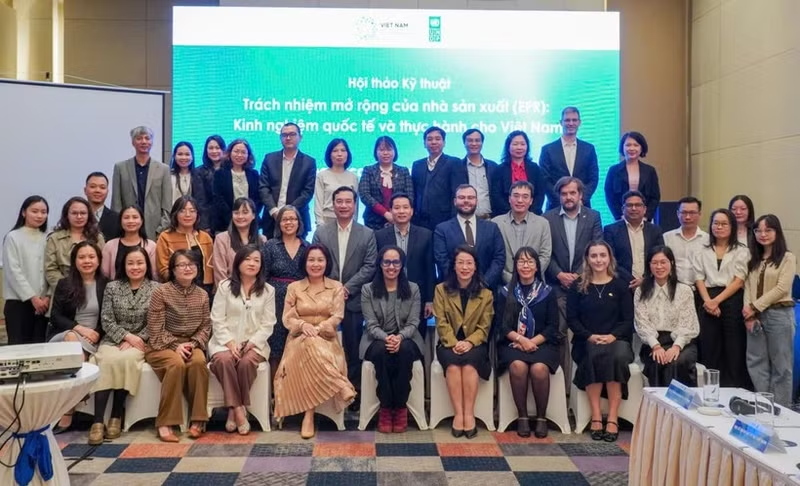
The event brought together nearly 200 delegates from state management agencies, businesses, associations, non-governmental organisations, embassies, and development partners. It took place as Viet Nam revises and supplements provisions of the 2020 Environmental Protection Law under the 2026 legislative building programme.
The EPR mechanism, stipulated in the 2020 Environmental Protection Law, requires producers and importers to recycle or make financial contributions for the collection and treatment of waste generated from products and packaging they place on the market. This mechanism is expected to promote the circular economy, reduce pressure on waste management systems, and mobilise private sector resources for environmental protection.
Speaking at the event, Vu Thai Truong, Head of the Climate Change, Energy, and Environment Unit at UNDP Viet Nam, noted that practical implementation has revealed numerous challenges. Gaps remain between policy design and the realities of the domestic recycling market; monitoring and data transparency capacities are still being refined; business readiness levels vary; and implementation mechanisms need strengthening to fully realise their role.
According to Ho Kien Trung, Deputy Head of the Environment Department, the Ministry of Agriculture and Environment will continue to comprehensively review and assess the EPR policy implementation process to propose suitable improvements. He expressed hope for closer, long-term support from UNDP and NPAP in policy refinement, technical guidance, capacity building for stakeholders, and promotion of public–private dialogue.
At the workshop, international experts shared experiences on effective EPR governance models in various countries, focusing on financial mechanisms and linking responsibilities to verifiable outcomes. Delegates were introduced to global practices in operating Producer Responsibility Organisations (PROs).
Participants engaged in in-depth discussions on revising regulations related to producers’ and importers’ responsibilities for product and packaging recycling and waste treatment. Many highlighted difficulties and challenges encountered during implementation, while proposing solutions to improve policy feasibility.