Gathering clues to locate martyrs’ remains
The war has long passed and green vegetation now blankets the former battlefields, yet beneath that cover lie more than 1,200 martyrs still unlocated. The mission of searching for and repatriating their remains is not only a political duty but also, as many describe it, a “command from the heart”.
Tuyen Quang province has mobilised the entire political system to implement the “500‑day campaign to intensify the search, repatriation and identification of martyrs’ remains”.
Colonel Nguyen Minh Khoi, Deputy Political Commissar of the Provincial Military Command, explained that the current search focuses on mountain slopes and high points along the border, where the terrain is especially vast, treacherous and difficult.
To meet these challenges, the command has reinforced personnel, upgraded technical equipment and organised intensive training for the search teams.
The war has long passed and green vegetation now blankets the former battlefields, yet beneath that cover lie more than 1,200 martyrs still unlocated. The mission of searching for and repatriating their remains is not only a political duty but also, as many describe it, a “command from the heart”.
The unit is divided into five sub‑teams. Three operate directly at seven key sites, including high points 685, 300, 772 and A5 in Thanh Thuy commune; high points 1,688, 1,800A and 1,800B in Lao Chai commune; and high point 1,030 in Minh Tan commune. The remaining two sub‑teams accompany sapper units clearing mines along the border to identify suspected burial sites.
Lieutenant Colonel Tran Quang Huy, leader of the search team, emphasised that gathering information about where martyrs fell is the core task. The team has worked with local authorities to reach out to veterans who fought on these battlefields and to residents living in border areas. Since the campaign began, they have received 22 pieces of information and surveyed 19 of them.
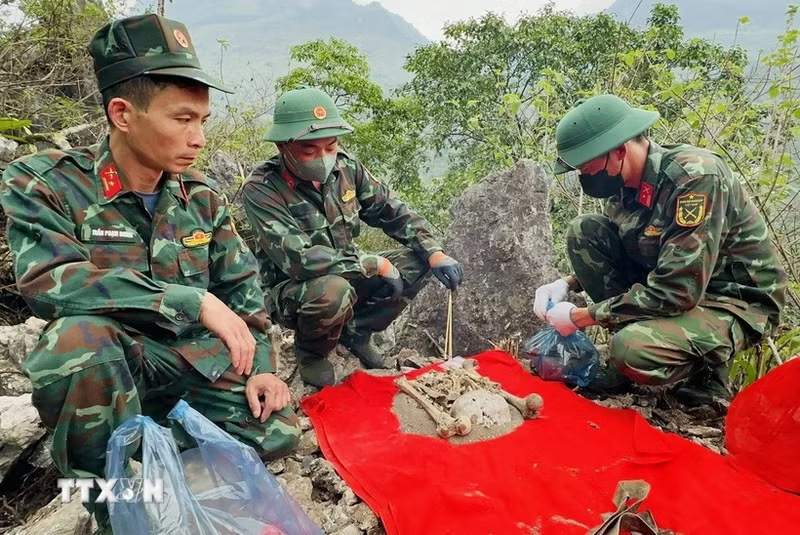
In Minh Tan and Tung Vai communes, many tips have come from local people. Sub‑team No.3 conducted field surveys, cross‑checked with historical battle records and verified the leads as credible. In early May, the unit deployed a search at one such site. After nearly a week, officers and soldiers recovered martyrs’ remains along with artefacts.
Confronting rugged landscapes in repatriation mission
Most suspected sites lie on rugged, rocky high points with difficult access, where mechanised vehicles cannot reach. Many martyrs fell in trenches, caves or mountain crevices later collapsed and buried by shelling, making the search arduous and hazardous.
One example is high point A5 in Giang Nam hamlet, Thanh Thuy commune. Acting on a tip from veterans, the team in early May had to use drilling machines, sledgehammers and expansion powder to break rock.
Major Mac Van Can, a team member, described the conditions: limited oxygen, cramped spaces and constant risk of landslides. Yet the team persevered, using hand tools to patiently break rock and clear a path to the remains. “Despite the hardships, everyone rejoiced when they recovered the remains of three martyrs,” he said.
In Hoang Ly Pa hamlet, Minh Tan commune, sub‑team No.3 searched nearly 4,000 sq.m. of hillside. Because of the complex terrain, they manually dug trenches 1.5 to 1.8 metres deep, each spaced one metre apart. Only after the sixth trench—having shifted around 200 sq.m. of earth and rock—did they uncover martyrs’ remains.
Lieutenant Colonel Hoang Vu Dung, deputy head of the team, recalled the harsh border weather: days of blistering heat when members worked continuously, their clothes drenched in sweat, their hands bloodied by shovels. Yet morale never faltered. “Each time a scrap of cloth, a button or a fragment of belt emerges from the soil, everyone’s hope of finding fallen comrades rises,” he said.
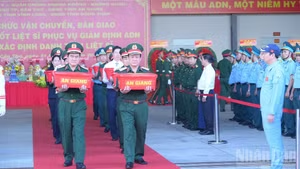
Across Tuyen Quang province, 170 martyr graves require DNA sampling, scheduled in two phases from 2026 to 2030. The province aims to recover and repatriate about 600 martyrs’ remains by the end of 2026.
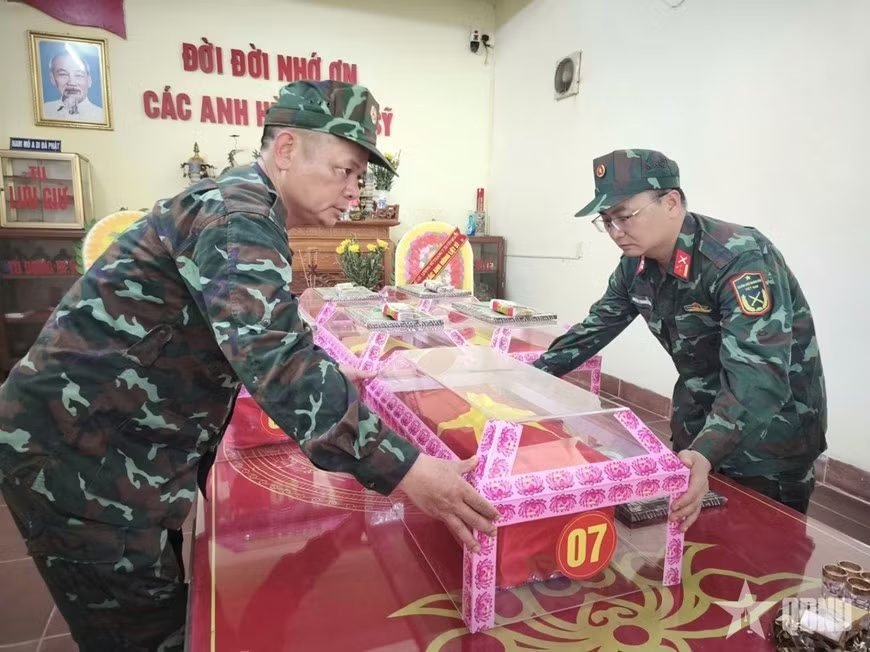
Since the campaign began, the team has searched across roughly 410 hectares, excavated more than 4,000 cubic metres of earth and rock, and repatriated 10 martyrs’ remains along with two collective graves.
Across Tuyen Quang province, 170 martyr graves require DNA sampling, scheduled in two phases from 2026 to 2030. The province aims to recover and repatriate about 600 martyrs’ remains by the end of 2026.
Vuong Ngoc Ha, Vice‑Chair of the Provincial People’s Committee, said authorities have urged departments, sectors and localities to raise their sense of responsibility and coordinate closely in implementing the campaign.
This includes accelerating mine clearance, verifying information, conducting DNA sampling and encouraging people to provide information to support the search and repatriation work, striving to meet the set goals.