Implementing the Party and State's policy and the National Steering Committee's direction to step up the search for, collection, and identification of the remains of fallen soldiers whose information remains incomplete, Ha Noi City has assigned its Steering Committee and the Ha Noi Capital Command to coordinate with the Department of Home Affairs and local authorities in collecting samples.
According to statistics, Ha Noi has 340 fallen soldiers' cemeteries, including three city-level cemeteries and 337 commune- and ward-level cemeteries, with a total of 54,200 graves, including 54,191 individual graves and nine collective graves.
There are 8,059 graves whose information has not yet been identified, making them a key group targeted for excavation and biological sample collection in the next phase of the campaign to match the samples with DNA data from relatives. All cemeteries have been surveyed and assigned identification codes.
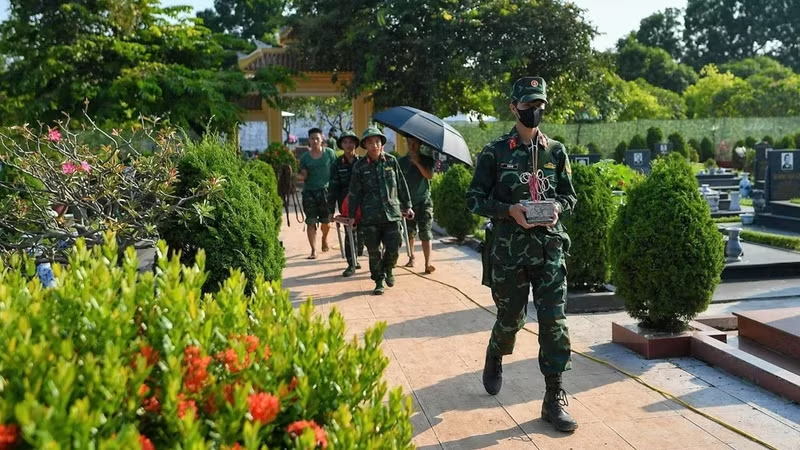
The three cemeteries managed by the city, including Ngoc Hoi, Nhon, and Mai Dich, contain 555 graves of fallen soldiers whose information has not yet been identified. Under the "500-day-and-night campaign to step up the search for, collection, and identification of fallen soldiers' remains", the Ha Noi Capital Military Command and localities began collecting samples on June 27.
At Ngoc Hoi Fallen Soldiers' Cemetery, Major General Dao Van Nhan, Commander of the Ha Noi Capital Command, told soldiers: "I always hope that when the remains of fallen soldiers are excavated, they will still be in a condition that allows samples to be collected. Despite erratic weather and difficult working conditions, you must recognise that this is both a responsibility and an honour, helping to bring fallen soldiers back to their families who have been waiting for them."
To date, Ha Noi has completed sampling the remains of 48 unidentified fallen soldiers at Ngoc Hoi Fallen Soldiers' Cemetery and 38 unidentified graves at Nhon Fallen Soldiers' Cemetery.
Mai Dich Cemetery is the resting place of 1,227 fallen soldiers and two collective burial areas, including 1,221 fallen soldiers who died during the resistance war against the French colonialists, five who died during the resistance war against the US, and one who died during the period of the defence of the southwestern border.
It is also the resting place of 492 former Party and State leaders and senior officials. There are 469 graves whose information has not yet been identified, making it the cemetery with the largest number of unidentified graves in the city at present. The collection of samples from fallen soldiers' remains at Mai Dich Cemetery began on August 7.
This sacred task has been assigned by the Ha Noi Capital Military Region to the 301st Infantry Division and the 544th Engineer Battalion, with the goal of excavating and collecting samples for DNA testing from all 469 graves of fallen soldiers whose identities have not yet been identified. For nearly a week, personnel and soldiers of the Ha Noi Capital Command have been carrying out the work in an urgent manner.
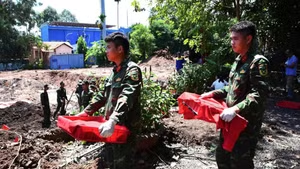
Amid the intense August heat accompanied by unusually heavy rain, work at the site remains highly serious and urgent. Under the scorching sun, personnel and soldiers continue working tirelessly; when rain comes, they build barriers to prevent flooding, and once it stops, they use pumps to drain water from the deep pits and resume the search.
As the remains have been buried for too long, accurately locating and excavating them requires meticulous and painstaking work which relies entirely on human effort. In some places, military engineers have had to conduct exploratory drilling and dig down 2.5 to 2.8 metres before reaching small bone fragments. A young soldier standing knee-deep in mud at the bottom of a nearly three-metre-deep pit looked up with unmistakable emotion when a ceramic burial container was uncovered after more than half a century underground.
Lieutenant Colonel and doctor Nguyen Dang Thang of the Ha Noi Capital Command, who directly supervises the work and takes samples alongside the soldiers, said the sampling personnel are divided into two teams of five members each. Two members, including a forensic officer and a military medical officer, directly collect the samples; one records the relevant documents and minutes, one washes the equipment, and one is responsible for cleaning and disinfection.
Local medical personnel also assist with preparing sampling records. Sampling standards are extremely strict, with priority given to collecting long bones measuring 5 to 7.5cm, so that they fit standard 9cm storage containers. If the bones are no longer intact, the team makes every effort to collect all remaining teeth of the fallen soldier for testing.
During the work, every movement by the soldiers must be extremely gentle and careful. One young soldier said that because the pits are deep and filled with mud and water, any carelessness that chips the burial container or mixes up specimens, making them difficult to locate, would be deeply distressing, so everyone works with great caution. When remains are mixed with large amounts of mud and soil, the team must bring all the soil and mud from the burial container to a table covered with disinfected plastic sheeting, spread it out, and carefully search through it for every bone fragment and tooth.
Senior Lieutenant Colonel Tran Minh Tu, Deputy Political Commissar of the 301st Infantry Division under the Ha Noi Capital Command, said most of the young soldiers are new recruits who have just joined the military and have never undertaken similar work, so they were somewhat unfamiliar with the task at first.
The unit organised training and provided thorough ideological guidance at the site, helping all personnel and soldiers understand the profound significance of this work of paying tribute. With a strong sense of responsibility, gratitude, and utmost solemnity, they have overcome psychological obstacles and harsh weather conditions to successfully complete their task.
Immediately after DNA samples are collected, the remains of fallen soldiers with recorded information are moved to a designated waiting area according to their positions on the site map. The graves are rebuilt to ensure durability and solemnity in accordance with standards, ready to receive the fallen soldiers back at their original positions and ensure accurate identification once DNA testing results are available.
Lieutenant Colonel Nguyen Dang Thang said the results so far have been encouraging. Except for a small number of samples that were difficult to extract, the remaining samples have all met quality requirements. When a good-quality sample is obtained, everyone feels delighted and encouraged as they believe there is up to a 99% chance of identifying the fallen soldier and helping them return to their families and loved ones.