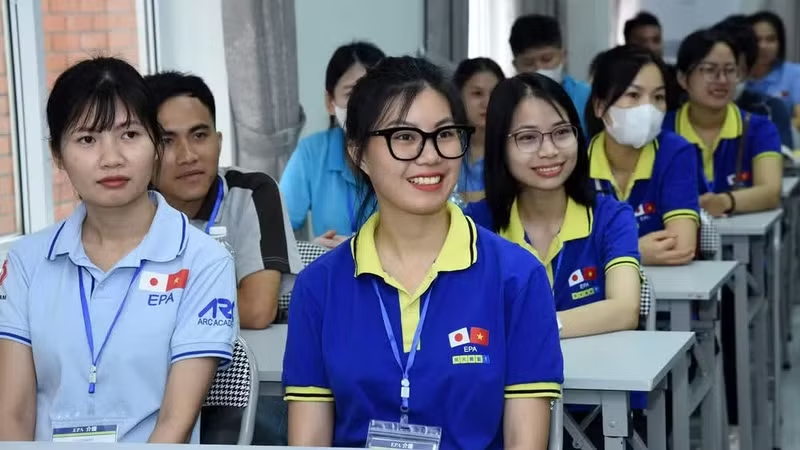
Implementing the Viet Nam-Japan Economic Partnership Agreement (VJEPA), since 2012, the Department of Overseas Labour Management (formerly under the Ministry of Labour, Invalids and Social Affairs, now under the Ministry of Home Affairs) has coordinated with the Japanese side to recruit and provide Japanese-language training for nursing and care worker candidates from 13 intakes of the programme sending Vietnamese nurses and care workers to work in Japan under the Viet Nam-Japan Economic Partnership Agreement (EPA programme).
To date, 2,071 nurses and care workers from the 13 EPA programme intakes have been sent to work at receiving institutions in Japan. This is a non-profit programme designed for graduates majoring in nursing who wish to work in Japan.
Candidates of the 14th intake who meet the prescribed standards and are selected will participate in an online Japanese-language training course, expected to run from mid-July 2026 until the end of March 2027. The expected departure time for work in Japan is June 2027. During the training period, trainees will receive living expense support. At the end of the course, candidates will take the Japanese-Language Proficiency Test at N3 level.
Priority will be given to children of war invalids and wounded soldiers, relatives of people with meritorious services, and candidates residing in especially disadvantaged communes and villages, as well as ethnic minority and mountainous areas.
The Department of Overseas Labour Management will coordinate with the Japanese focal-point agency to introduce candidates who achieve N3 level in the Japanese-Language Proficiency Test to Japanese hospitals and healthcare facilities recruiting nursing and care worker candidates for selection.
Nursing candidates will reside temporarily in Japan for three years (with annual extensions) and perform nursing support work at hospitals in order to obtain Japan’s national nursing qualification certificate, enabling them to work long-term in Japan.
Care workers will reside temporarily in Japan for four years (with annual extensions) and provide care services at healthcare facilities in order to obtain Japan’s national care worker qualification certificate, enabling them to work long-term in Japan.
Candidates selected for the 14th EPA programme intake will enjoy the following benefits: receiving living expense allowances during the online Japanese-language training course from mid-July 2026 until the end of March 2027 in Viet Nam (8.5 USD per person per day); return air tickets (one time) when travelling to Japan and upon completing the contract and returning home, visa fees and health check costs covered; and participation in a free advanced training course in Japan for two months before being assigned to receiving institutions.
Candidates will also combine study and work for a maximum period of three years for nursing candidates (renewed annually) and a maximum of four years for care workers (renewed annually) at Japanese healthcare facilities and hospitals. During the period of study and work in Japan, candidates will receive salaries in accordance with Japanese law. Receiving institutions in Japan will support part or all of the accommodation costs during the candidates’ study and work period in Japan.
During the period of study and work in Japan, candidates will be permitted to take the examinations for Japan’s national nursing and care worker qualification certificates. If they pass the national qualification examinations, nurses and care workers will receive salaries equivalent to those of Japanese nurses and care workers; they will also be allowed to remain and work long-term in Japan and may sponsor family members to join them in Japan.