EU Regulation 2025/40 on packaging and packaging waste (PPWR) officially came into force across EU member states on August 12, 2026. Although it is an intra-EU regulation, its scope of impact extends to the export sectors of many countries. It is among the green measures under the European Green Deal and the EU’s Circular Economy Action Plan (CEAP) that are currently being implemented.
The regulation applies to all types of packaging appearing on the EU market, regardless of whether the packaging comes into direct contact with goods or is used for transportation. The regulation also clarifies that responsibility for issuing the Declaration of Conformity (DoC) for packaging lies with the manufacturer — understood as the producer or the owner of the brand printed on the packaging. However, in order to obtain a DoC, the manufacturer must prepare technical documentation in accordance with EU regulations. Any non-compliant documentation is considered a violation and results in the loss of import eligibility, meaning that the goods will also not be approved for circulation on this market.
Thus, packaging and specialised wrapping for Vietnam’s key export products, such as agricultural products, seafood, food, leather and footwear, garments, and others, all fall within the scope of this regulation. Specifically, for packaging used for food products, the regulation sets limits on the threshold levels of substances of concern (SoC) used in packaging materials. In addition to inspecting packaging for imported goods, the EU also requires businesses exporting goods to this market to declare the content and composition of packaging in their technical documentation. From August 12, all packaging must also clearly display waste-sorting information in accordance with unified EU standards. The regulation also sets a roadmap towards 2030, under which packaging for goods entering this market must contain identification information on substances of concern, use recyclable production materials, and reduce the weight and volume of packaging to the lowest possible levels.
In response to the new regulations, which could have a major impact on Vietnam’s exports of food and seafood products to the European market, the Vietnam Association of Seafood Exporters and Producers (VASEP) has recommended that its member businesses study the regulations early and implement appropriate adaptation plans. At the same time, many associations representing sectors that export to the European market have also issued recommendations to their member businesses.
According to Nguyen Thi Dieu Phuong, a researcher at Research Institute for Aquaculture No. 1 under the Ministry of Agriculture and Environment, meeting technical standards for packaging may not cause major disruptions for most of the country’s key exporters if they have made suitable preparations. The difficulty, however, lies in whether domestic packaging manufacturers can supply alternative products that meet the requirements for the EU market. When the packaging supply fails to meet the requirements, the goods themselves will also not be eligible for customs clearance.
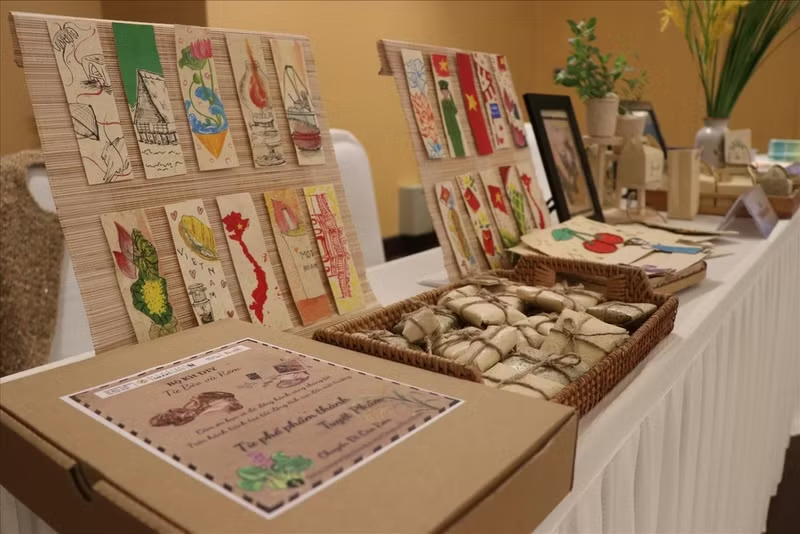
In reality, the number of environmentally friendly packaging manufacturers in Vietnam remains small. The number of businesses capable of meeting EU regulations is even smaller. According to a report by the Ministry of Industry and Trade, there are around 4,000 packaging manufacturing enterprises and establishments nationwide. Environmentally friendly packaging manufacturers account for only a very small proportion, and currently almost none fully meet the EU’s requirements for controlling substances of concern in packaging. According to Than Van Hong, Director of Green Smile Packaging Co., Ltd. in Bac Ninh, the company’s environmentally friendly products currently only meet domestic requirements. As with other businesses, the reasons are limitations in technology and capital, as well as market demand. No business will invest in replacing its technology with new technology when it is not yet certain about market demand.
A leader of a seafood-exporting business said that, in order not to lose market share in the EU market, the company has been forced to import packaging products from overseas to package goods for export. This process not only increases costs but also takes away opportunities from domestic packaging manufacturers.
Nguyen Thi, a senior lecturer at the Hanoi University of Natural Resources and Environment, said that EU Regulation 2025/40 would initially place considerable pressure on exporters. However, from a broader perspective, the EU often takes the lead in establishing standards on the environment, energy, and products, with many regulations later becoming trends in the international market. Therefore, early adaptation will not only help businesses maintain access to this market but also promote innovation in technology, production methods, and supply-chain management, thereby enhancing competitiveness in other markets with stringent requirements.
The transformation process also opens room for development in areas such as sustainable product design, modular design, environmental industries, and the recycling industry. If Vietnamese businesses can take advantage of the pressure created by the new regulations to restructure production, they can increase added value, gradually reduce their dependence on contract manufacturing and basic processing, and participate more deeply in global value chains.




![[In Pictures] Bridge columns and underpasses in Ha Noi begin to turn green](https://en-cdn.nhandan.vn/images/nyM650OGFWrOVWc-xajqN-rTZ68Rlmc1fiGJOhBRYHH_N-Xs0TE8Psnfce7ORTs-KVfoJaEblqjNufFrgeF3e2xFkGtLQVaXm04VcmMKBEkANUyiOkpz4zAuIKgydVrrfBxmGez0E_YJIag0u_Uil0E7jpuJXsIxeMmGjoY1-W4/1791863309074-2994714492692222878-2994714492692222878-adb9ff3f4175c70066ed8bb80cfbead9.jpg.avif)