The document was sent to the People’s Committees of northeastern provinces and cities and Thanh Hoa province; the Ministry of National Defence, Ministry of Public Security, Ministry of Agriculture and Environment, Ministry of Construction, Ministry of Industry and Trade, Ministry of Foreign Affairs, and Ministry of Science and Technology; as well as Viet Nam Television, the Voice of Viet Nam, and the Viet Nam News Agency (VNA).
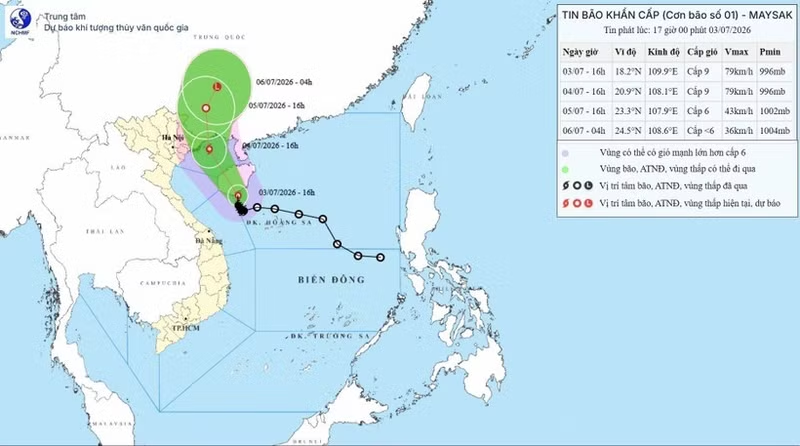
The tropical depression intensified into the first storm to enter the East Sea in 2026, internationally named Maysak, on July 3 morning. At 4:00, its centre was located at 17.3 degrees north latitude and 110.1 degrees east longitude over the northwestern waters of the Hoang Sa (Paracel) area, with winds at level 8 and gusts up to level 10. It is forecast to move into the Gulf of Tonkin and affect northeastern Viet Nam in the coming days.
The northeastern localities and Thanh Hoa province are forecast to experience heavy rainfall of 100–200 mm, with isolated areas exceeding 350 mm, from July 3 night to July 5.
To ensure maritime safety, authorities are instructed to track and inform vessels, guide ships away from dangerous zones, and ensure safe anchorage. Localities are empowered to ban sea operations when necessary, prepare search-and-rescue forces, and ensure safety of tourism activities, aquaculture, and offshore infrastructure.
In lowland areas, authorities are required to review and prepare plans for evacuating residents from unsafe houses and high-risk flood zones; reinforce sea and river dike systems; pump drainage water to prevent urban flooding; trim trees; secure billboards and buildings; and safeguard power and telecommunications systems to maintain uninterrupted services.
In mountainous regions, local authorities are instructed to deploy rapid response teams to inspect and assess conditions, and proactively evacuate residents from riverside and streamside areas, low-lying zones, and locations at high risk of severe flooding, flash floods, and landslides to safe places.
Authorities must also be prepared to set up patrols, control points, and guidance teams to ensure traffic safety at flooded spillways, overflow crossings, submerged roads with strong currents, and areas affected by or at risk of landslides, strictly prohibiting people and vehicles from passing when safety cannot be guaranteed.
Resources must be prepared to quickly repair damaged infrastructure. Authorities must also ensure safety at mines, reservoirs, and hydropower facilities, particularly small and vulnerable ones, with standby personnel ready to operate and respond to emergencies.
National and local broadcasters, including television, radio and news agencies, are tasked with increasing updates on the storm and flood risks, ensuring timely dissemination to authorities at the commune level, vessel operators, and the public.
Relevant ministries are instructed to coordinate closely with localities based on their assigned responsibilities to ensure effective storm response and flood mitigation.