Expanding green capital, yet limited access for businesses
In the green transition process, green finance plays a central role in directing resources towards sustainable development goals. According to Tran Thi Quynh Nga, Deputy Head of the Department for Sectoral Finance and Economics, green finance encompasses instruments such as green credit, green bonds, and green investment funds, aimed at mobilising and allocating resources for environmental protection, the circular economy, and renewable energy projects.
Notably, green finance does not operate independently but is closely linked to the energy transition. A representative of the Ministry of Finance noted that without appropriate capital, clean energy projects are difficult to implement due to high costs; conversely, without qualified projects, green capital also struggles to find effective disbursement opportunities. This interdependent relationship makes green finance a “lifeblood” of the transition.
In recent years, the policy framework for green finance in Viet Nam has gradually taken shape. Regulatory bodies, including the Ministry of Finance of Viet Nam, have coordinated with relevant ministries and sectors to improve institutions, establish development zones, and develop implementation roadmaps at national, sectoral, and local levels. Meanwhile, the banking system and financial institutions have actively introduced preferential credit packages for green energy, production, and consumption projects.
In practice, the scale of this capital has expanded significantly. According to the State Bank of Viet Nam, outstanding green credit in Viet Nam by the end of 2025 was estimated at approximately 780–850 trillion VND, accounting for around 4.1% of total outstanding loans in the economy. Although the proportion remains modest, the average annual growth rate in recent years has reached 20–25%, significantly higher than overall credit growth. The number of participating credit institutions has also increased from 15 in 2017 to 58 by the end of 2025.
However, access to this capital remains a major challenge for businesses, according to Nga.
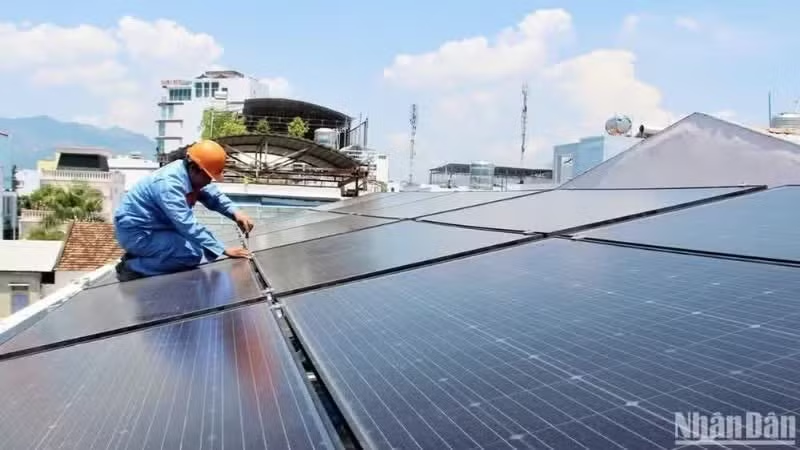
The primary reason lies in the nature of green projects. These often require high initial investment and have long payback periods, such as solar power and renewable energy projects. Given the limited financial capacity of many enterprises, accessing low-interest loans is difficult, particularly for those pioneering the transition.
In addition, corporate governance and implementation capacity, especially among small and medium-sized enterprises, remain significant constraints. According to a Ministry of Finance representative, this directly affects access to capital, as financial institutions are increasingly imposing higher requirements on transparency, risk management, and capital efficiency.
Market developments also show that green finance is closely associated with environmental, social, and governance (ESG) standards and has become a key criterion in assessing corporate capacity.
Mac Hoang Anh, Chief Financial Officer of OSI Holding Joint Stock Company, noted that green finance is not only an environmental issue but also directly affects the cost of capital, access to funding, and corporate valuation. Companies with transparent governance and efficient energy use have clear advantages in attracting resources.
To Quoc Hung, Country Director of the Association of Chartered Certified Accountants (ACCA), said that investors are increasingly concerned about companies’ ESG roadmaps, particularly their impact on capital costs and fundraising capacity. This indicates that green finance is no longer merely a trend but has become a market standard.
It can be seen that the paradox of green finance does not lie in a shortage of capital, but in the gap between capital requirements and corporate capacity. The difficulty in accessing available green capital clearly reflects this bottleneck.
Improving institutions to promote green capital flows
To unlock green capital, Tran Thi Quynh Nga emphasised that the key factor is improving the institutional framework, with policies needing to take the lead in building market confidence and guiding development.
In recent years, many important policies have been issued to promote green finance development. Resolution No. 68-NQ/TW on private sector development and Resolution No. 198/2025/QH15 of the National Assembly on special mechanisms and policies for private sector development have introduced support mechanisms for green projects, the circular economy, and ESG standards. These are considered important foundations for deeper private sector participation in the transition.
Notably, Decision No. 21/2025/QD-TTg on environmental criteria and the certification of projects under the green classification list has helped standardise the definition of “green projects”, helping reduce assessment risks and facilitating businesses’ access to capital.
At the same time, the issuance of Decree No. 29/2026/ND-CP on the domestic carbon market is opening up a new market-based tool, contributing to emissions pricing and creating economic incentives for emissions reduction activities. The Ministry of Finance is currently coordinating with relevant ministries to bring this market into operation in the near future.
Beyond developing instruments, regulatory bodies are also completing guidance systems to provide clear criteria, enabling businesses to self-assess their eligibility and access to green capital. This is an important step towards narrowing the gap between policy and implementation.
Going forward, the green finance market will continue to be developed in a more synchronised manner, including the issuance and trading of domestic green bonds linked to integration with international capital markets, the development of the carbon market, and the standardisation of information disclosure and environmental and social impact reporting in line with international practices.
In addition, environmental tax and fee policies are being reviewed and adjusted to encourage green transition. Financial mechanisms for public-private partnership projects in green infrastructure and renewable energy are also being promoted to mobilise social resources.
Another key direction is strengthening access to international capital. Integrating funding from climate funds, concessional loans, and aid with the domestic private sector through co-financing and technical support mechanisms will help expand the space for green finance.
However, as emphasised by the Ministry of Finance, for these policies to be effective, businesses must proactively improve governance capacity, enhance transparency, and gradually meet international standards. This is not only a prerequisite for accessing capital but also a foundation for deeper participation in global value chains.
In an increasingly competitive environment shaped by sustainable development standards, green finance is no longer merely a supporting tool but is becoming a factor reshaping the market. Unlocking this capital flow will therefore not only help businesses overcome transition barriers but also contribute to building a foundation for long-term, sustainable economic growth.