With the established foundation, along with strong political will, determination, and the unity of the entire Party, people, and armed forces, we firmly believe that the development goals and aspirations set out in the Resolution of the 14th National Party Congress will soon become reality, ushering the country into a new phase of faster, more sustainable, and more comprehensive development.
Party General Secretary and State President To Lam
This is a strategic target set out in the Resolution of the 14th National Party Congress, requiring Viet Nam to renew its growth model and unlock resources.
A more clearly defined “substantive” mindset
Maintaining strategic goals reflects a high level of consensus within the Party Central Committee on major issues of the Party and the country. This consensus goes beyond awareness, demonstrating a determination to establish substantive operational foundations for breakthrough and sustainable development throughout the term.
Previously, the Resolution of the 14th National Party Congress set out a consistent vision: maintaining a peaceful and stable environment; achieving rapid and sustainable development; comprehensively improving people’s living standards; while ensuring strategic autonomy and strengthening national standing in the new era. For the 2026–2030 period, economic targets are set at high levels, reflecting clear political determination. Average GDP growth is targeted at 10% or higher per year. Notably, total factor productivity (TFP) is expected to contribute over 55%, indicating a strong shift towards a growth model based on quality, efficiency, and innovation.
According to many economic experts, the “substantive” mindset has been more clearly and deeply specified, particularly in economic development and national governance. First, the Party Central Committee emphasises that low growth is not acceptable; instead, it is necessary to persist in achieving high, sustainable, and substantive economic growth. This is an objective requirement stemming from the country’s development needs in the new phase and the nation’s aspiration to rise.
The Party Central Committee has also outlined four core principles for achieving double-digit growth: substantive growth; steadfast adherence to macroeconomic stability, inflation control, and major economic balances; effective utilisation of all available resources, prioritising key projects and promoting public-private partnerships to enhance investment efficiency and national competitiveness; and ensuring that high economic growth serves the people’s interests, improves living standards, and guarantees social equity.
The first principle — “substantive growth” — sets a high requirement, meaning that every percentage point of GDP growth must contain higher knowledge content and added value, without harming future development foundations or depleting resources for future generations. Substantive economic operations must remain smooth, resources must be unlocked, and the system must operate efficiently, focusing on real value rather than achievements.
Removing bottlenecks to accelerate economic engine
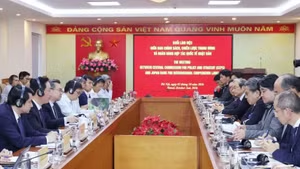
Thoroughly grasping the Party’s major orientations, the Government’s management from the beginning of the 2026–2031 term has demonstrated clear consistency between awareness and action. In speeches at the first session of the 16th National Assembly and meetings of the Government Standing Committee, Prime Minister Le Minh Hung repeatedly emphasised the overarching goal of achieving double-digit growth, while calling for urgent translation of the Central Committee’s conclusions into concrete action programmes and practical solutions.
This determination is reflected in clear timelines and non-deferrable goals. In 2026, institutional barriers will be addressed, from a comprehensive review of the legal system to the formulation of a strategy for institutional improvement in the new era. In particular, resolving bottlenecks in the two-tier local government model is seen as the key to ensuring smooth and effective administrative operations.
This aligns with the directive to “promote the synchronous development of institutions for creation and sustainable development, and promptly and thoroughly remove bottlenecks” stated in Conclusion No. 18-KL/TW of the second plenum of the 14th Party Central Committee.
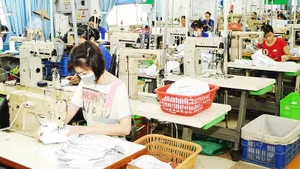
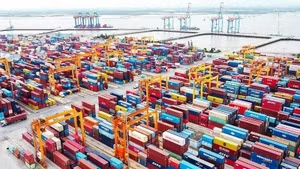
With a solid macroeconomic foundation, Viet Nam’s economy is entering a phase of acceleration. However, current growth acceleration is not based on excessive monetary expansion or resource exploitation, but on productivity breakthroughs, the strength of the digital economy, and the full mobilisation of resources from both state and private sectors. Strong positions in key markets such as the US and China have reinforced growth momentum, demonstrating resilience and adaptability in the new era. Meanwhile, foreign direct investment (FDI) is becoming more selective, prioritising projects with technology transfer commitments and stronger linkages with domestic enterprises. These are key drivers for achieving sustainable double-digit growth on a foundation of stability and sustainability.
Shifting rapidly towards quality-based growth model
Regarding future development orientation, the second plenum of the 14th Party Central Committee emphasised establishing a new growth model driven by science and technology, innovation, and digital transformation. The development of growth poles, key economic regions, urban areas, and new-generation special economic zones is seen as crucial for enhancing Viet Nam’s position in global value chains.
Viewing growth as a long-term process, Dr Can Van Luc, Chief Economist of BIDV and member of the National Financial and Monetary Policy Advisory Council, noted that 2026 marks the beginning of a new development cycle, where double-digit growth targets reflect not only quantitative goals but also deep transformation of the growth model to ensure sustainability.
As traditional growth drivers weaken while new ones have yet to fully emerge, Professor, Dr Pham Hong Chuong, Chairman of the Economics Professorial Council and former President of the National Economics University, identified the digital economy as the “locomotive” of technological and innovation transformation. Thus, developing the digital economy is not merely about applying technology or expanding digital sectors, but fundamentally about restructuring the growth model to create new drivers for Viet Nam’s economic growth.
In this context, enterprises are identified as the central force leading the transformation of the growth model. Beyond generating economic value, they shape development trends and spread innovation across the ecosystem. According to Nguyen Thi Tra My, General Director of The PAN Group, the double-digit growth target presents both opportunities and challenges. While growth previously relied on scale expansion, it must now shift towards improving quality, optimising value from the same resources to produce higher-value products that meet stringent international standards.
From practical experience, Nguyen Thi Tra My emphasised that achieving desired outcomes requires the courage to restructure growth models when they are no longer effective. This is the core mindset of the new growth model.
With clear direction from the Resolution of the 14th National Party Congress, strong reform determination, and support from the business community, the double-digit growth target is no longer a distant ambition. It represents a “window of opportunity” for Viet Nam to accelerate, reposition itself in global value chains, and move closer to its aspiration of becoming a high-income developed country by 2045 — entering a new phase of broader, higher-quality growth and gradually realising the vision of a strong and prosperous nation.
Viet Nam’s digital economy is growing impressively, but its spillover effects have yet to match the requirements of the new development stage. Digitalisation in traditional sectors, especially smart manufacturing, still faces challenges. Therefore, to achieve growth of over 10% during 2026–2030, the development of the digital economy must be regarded as a key driver for restructuring the economy, improving productivity, and creating new growth space.
Dr Nguyen Duc Hien
Deputy Head of the Party Central Committee's Policy and Strategy Commission

![[Infographic] GRDP growth scenarios for 34 provinces and cities in fourth quarter of 2026](https://en-cdn.nhandan.vn/images/nyM650OGFWrOVWc-xajqN-rTZ68Rlmc1fiGJOhBRYHFSa4DhrHNDxEFdnz313Vk5dNJuxdkHglPA3rLeaPeiaUheNuCI723k2lNssd-YLJuKR58epWq7s21lV5WjM-HR2-Qpbi4MwAzqt9wRjL4WjGkfEz7RO9qhcwg8o8LQFK8/grdp-growth-scenarios-for-34-provinces-and-cities-in-q42026-anh-dai-dien.jpg.avif)