Quang Ngai has advantages in terms of natural conditions, climate, soil, and abundant genetic resources of medicinal plants, including many rare species with high economic value that are suitable for commodity-oriented development associated with deep processing and brand building.
Diverse and abundant medicinal plant resources
Over the past five years, Quang Ngai Province has stepped up investment in and development and processing of medicinal plants in communes and wards in highland areas. The province has planted more than 3,220 hectares of Ngoc Linh ginseng and more than 11,555 hectares of other medicinal plants.
Medicinal plants with high economic value can be grown under the forest canopy and are suitable for the production conditions of ethnic minority people in mountainous areas. Expanding medicinal plant cultivation areas helps local people increase their incomes while also contributing to the protection of forest resources.
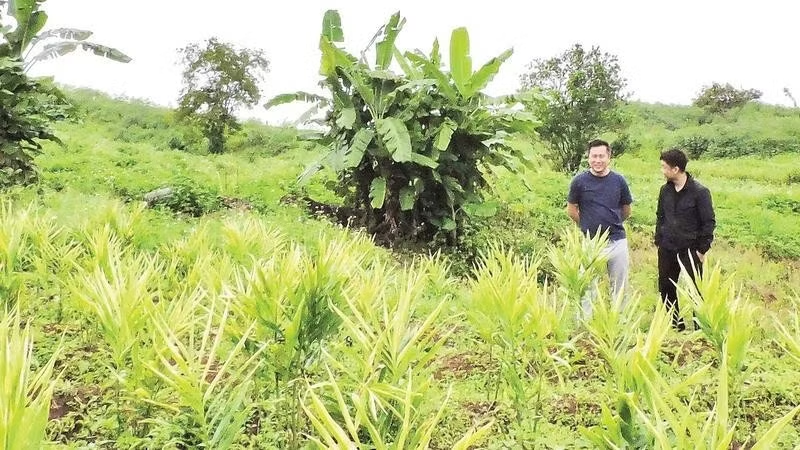
After many years of inefficient cassava and rubber cultivation, A Dinh and his wife in Dak To Commune have gradually switched to growing codonopsis, ginger, and turmeric. Having initially achieved positive results from a pilot area of more than one hectare, he boldly converted an additional 1.2 hectares to specialised cultivation of codonopsis and sẻ ginger.
A Dinh said that the local climate and soil are more suitable for medicinal plants. Although they require considerable care, medicinal plants provide weekly and monthly income; traders and shops also purchase them more quickly, making farmers less dependent on outlets than when growing cassava.
In the communes of Tra Bong and Minh Long, cinnamon and ginger have been restored and developed on a large scale by local authorities. Cinnamon remains a key crop and has long been closely associated with the lives and livelihoods of people in the highland areas of Quang Ngai. Many cinnamon products are processed into essential oils, pharmaceuticals, and handicrafts for export.
A number of facilities for the preliminary processing and processing of medicinal plants have been established, laying the groundwork for building value chains from production to consumption. Dinh Van Hoi, from Tra Bong Commune, said that indigenous cinnamon in Tra Bong was increasingly becoming scarce, so his family had expanded its cultivation to restore it. According to him, indigenous varieties are better suited to the local weather conditions and produce higher-quality essential oils than cinnamon varieties brought in from other areas.
Conserving biodiversity in mountainous areas
To become a national key medicinal plant-growing region and a major medicinal plant production centre of the country by 2035, while associating this development with biodiversity conservation and the creation of sustainable livelihoods for people in mountainous areas, Quang Ngai plans to establish concentrated medicinal plant cultivation areas. Priority will be given to planting around 20 million new Ngoc Linh ginseng plants on 2,000 hectares; 900 hectares of codonopsis; 600 hectares of cinnamon; 300 hectares of Ly Son garlic; and 1,000 hectares of ginger, turmeric, and other medicinal plants.
Along with developing medicinal plant cultivation areas, Quang Ngai is implementing measures to protect forest resources, develop a green economy and adapt to climate change. In localities with natural forests, cultivation and intensive farming are carried out in a manner that maintains the existing conditions, without affecting the terrain, land, climate, or soil.
Deputy Director of the Department of Agriculture and Environment Nguyen Quang Trung said the province was building a high-tech medicinal plant propagation centre to produce valuable medicinal plant varieties with medical and economic value, meeting demand for medicinal plant cultivation in the locality. Plant varieties and production and cultivation methods are controlled to protect the biodiversity of natural forests.
At the same time, the province is surveying and identifying medicinal plant cultivation areas for integration into planning; conserving and developing genetic resources and plant varieties; establishing local technical standards for Ngoc Linh ginseng and Tra Bong cinnamon; and applying science, technology, and digital transformation to medicinal plant development, thereby contributing to biodiversity conservation in cultivation areas.
“The agricultural sector is stepping up the application of science, technology, and digital transformation in the production, management, and traceability of medicinal plant products. Solutions for developing medicinal plant cultivation areas are being implemented in association with the goal of conserving biodiversity and sustainably protecting forests,” Deputy Director of the Department of Agriculture and Environment Nguyen Quang Trung affirmed.
The development of medicinal plant cultivation areas in association with biodiversity conservation will create a foundation for Quang Ngai’s medicinal plant industry in the new period. By 2030, the locality aims to harvest around 32,000 tonnes of codonopsis, dong quai, turmeric, Ngoc Linh ginseng, schisandra, wild ginger, cinnamon, and garlic, along with 33,000 tonnes of medicinal plants including Eurycoma longifolia, gynostemma, and wild bananas.
With orientations and strategies for the medicinal plant sector, Quang Ngai Province expects to become a national key medicinal plant-growing region and a centre for the production, processing and export of medicinal plant products nationwide.