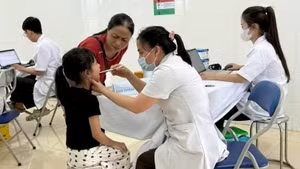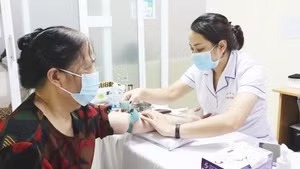
In the new context, with breakthrough mechanisms from Resolution No. 57-NQ/TW and Resolution No. 72-NQ/TW, the institute is facing an opportunity to transform itself into a leading regional centre for science and technology in medicinal materials.
Research based on the value chain
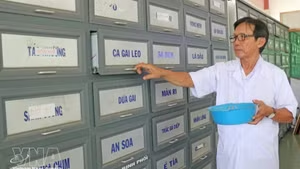
The National Institute of Medicinal Materials was established by the Ministry of Health in 1961 as the leading scientific research and technological development institution in medicinal materials of Viet Nam. Over the past 65 years, the institute has built a comprehensive research system covering the entire value chain of medicinal materials: from resource surveys, genetic conservation, breeding, development of cultivation areas, standardisation of medicinal material quality and products derived from medicinal materials, to phytochemical research, extraction technologies, evaluation of physiological effects, and product formulation.
Several medicinal plant varieties have been successfully imported and acclimatised, such as Ligusticum striatum, Angelica sinensis, Platycodon grandiflorus, Rehmannia glutinosa, Salvia miltiorrhisa, and Scutellaria baicalensis. As a result, a wide range of essential products has been developed to meet the people’s healthcare needs, including Memonimm film-coated tablets derived from Coastal waterhyssop herb to support memory enhancement; Papayup preparations (film-coated tablets and syrup) supporting the treatment of thrombocytopenia; hard capsules containing Schisandra chinensis extract to support liver protection and hepatitis; film-coated tablets containing Herba Phyllanthi amari extract for liver protection, hepatitis, and high liver enzymes; gels and balms from Trung Doan chili extract for pain relief; as well as the modernisation of traditional remedies such as “Thong ta ninh”, “Tan duc dan”, and “Luong phu hoan”.
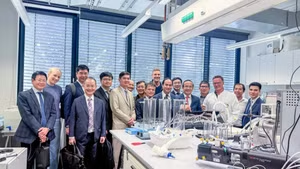
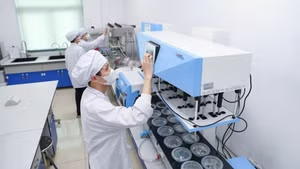
According to Dr. Tran Minh Ngoc, Head of the NIMM, in recent years the institute has been equipped with a synchronised infrastructure system, including advanced research equipment and modern laboratories for standard analysis, pharmacology, formulation, and biotechnology. Statistics show that, on average, the institute’s scientists lead and participate in nearly 100 scientific projects annually at various levels, contributing to improving research quality in line with international standards. Surveys of medicinal material resources have been conducted systematically nationwide, recording and conserving more than 5,000 medicinal plant species.
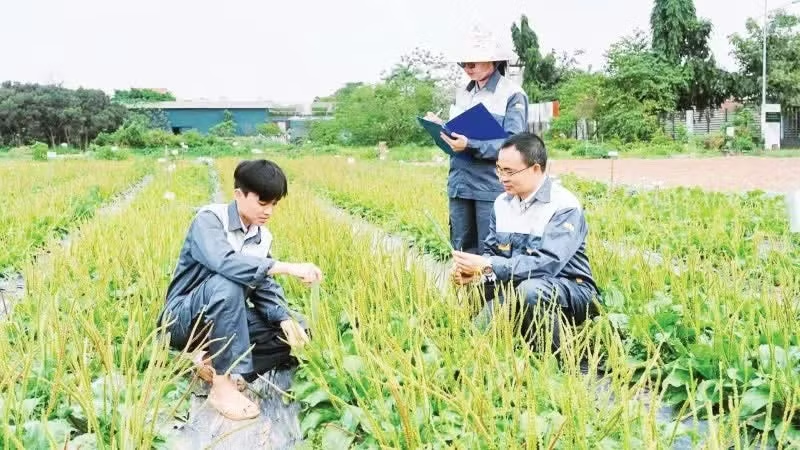
Staff from the National Centre for Genetic Resources and Medicinal Plant Varieties under the NIMM have conducted field research on medicinal plants and preserved about 964 genetic resources belonging to 642 species, nearly 1,000 breeding seed samples, and many endemic and rare genetic resources, aimed at building a comprehensive database of Viet Nam’s medicinal material resources.
Along with conservation, the institute has promoted the restoration of indigenous varieties, imported and evaluated around 60 medicinal plant samples with high economic value, successfully selecting 15 varieties; and issued 97 technical procedures for propagation, cultivation, and standards for medicinal materials in line with GACP-WHO standards. Technology transfer to localities and enterprises has contributed to the establishment of concentrated medicinal material cultivation areas.
A distinctive strength of the institute is the effective development of a closed-loop value chain research model, helping control over the entire process from raw materials to final products. The institute has built gene banks and developed conservation gardens across various ecological regions from the northern mountainous areas to the Central Highlands and southern provinces.
In particular, the institute has surveyed and collected traditional knowledge on the use of medicinal plants and remedies from ethnic minority communities such as Thai, H’Mong, Muong, Dao, Churu, Jrai, and Khmer. The institute’s research direction is increasingly aligned with current disease patterns, especially non-communicable chronic diseases (cardiovascular diseases, diabetes), metabolic disorders, cancer, immune deficiency, and memory improvement.
Breakthroughs from strategic resolutions
According to Dr. Tran Minh Ngoc, the NIMM still faces many challenges. In-depth research fields and clinical trials require significant investment while resources remain limited; commercialised products are still few, and a national brand for Vietnamese medicinal materials has not been established. Linkages between research and enterprises also remain weak.
In this context, Resolution No. 57-NQ/TW of the Politburo on breakthroughs in science, technology development, innovation, and national digital transformation; Resolution No. 72-NQ/TW of the Politburo on a number of breakthrough solutions to strengthen the protection, care, and improvement of the people's health; Directive No. 25/CT-TTg of the Prime Minister on promoting the development of Vietnamese traditional medicine in the new period; and Decision No. 376/QD-TTg and Decision No. 1165/QD-TTg on the development of the Vietnamese pharmaceutical industry and pharmaceutical sector until 2030, with a vision to 2045, provide opportunities for the institute to create a foundation for breakthrough development in the coming period.
The implementation of these resolutions and decisions helps the institute shift from a purely research-based model to one closely linked with the market, gradually forming a large-scale medicinal product system. The synchronous application of biotechnology, modern analytical methods, and the construction of digital databases has helped strict control from raw materials to finished products.
Beyond research, the institute is strengthening technology transfer to enterprises, forming link chains from cultivation areas to research, production, and consumption. Hundreds of medicinal material samples have been standardised and their information digitised, laying the foundation for traceability, a key step for medicinal products to participate in the market sustainably.
Under the impact of Resolution No. 57-NQ/TW and Resolution No. 72-NQ/TW, medicinal material products will no longer be isolated research outputs but will gradually become complete products, contributing to enhancing trust in herbal medicine for the people’s healthcare, as well as helping traditional medicine to integrate step by step with modern medicine.
Standing Deputy Minister of Health Vu Manh Ha emphasised that, based on the new mechanisms, the NIMM should restructure, promote complete value chain-based research, create high value-added products with international competitiveness, and develop into a leading regional centre for medicinal material science and technology; accelerate digital transformation, build a national database on medicinal materials; and prioritise large-scale, breakthrough research projects in science, technology, and innovation. In particular, it must continue to uphold the core values outlined in Resolution No. 72-NQ/TW: placing the people’s health at the centre, taking traditional knowledge as the foundation and modern science and technology as the driving force, while closely combining traditional medicine with modern medicine in training, disease prevention, and treatment.