From policy to practice
Under Plan No. 462/KH-BYT issued by the Ministry of Health, response activities were rolled out nationwide, with a peak week from April 4 to 10, 2026. The focus is on providing free medical examinations, consultations and screenings for the public, particularly the elderly, the poor and high-risk groups.
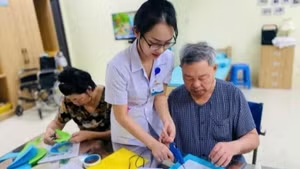
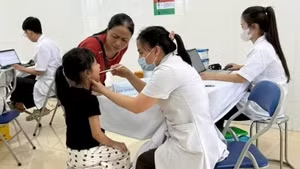
In many localities such as Ha Noi, Ho Chi Minh City, Hai Phong and Can Tho, thousands of residents have accessed healthcare services within their communities. New models, such as “community-based healthcare teams” and mobile medical units, have brought healthcare closer to the people.
According to a summary report by the Viet Nam Young Physicians Association, within the framework of the rally launching National Health Day held at Thong Nhat Park, Ha Noi, on April 5, 324 doctors, physicians and healthcare workers from central-level hospitals and reputable medical institutions, including Bach Mai, Viet Duc, the National Hospital of Obstetrics and Gynaecology, the National Children’s Hospital, K Hospital and Medlatec, took part.
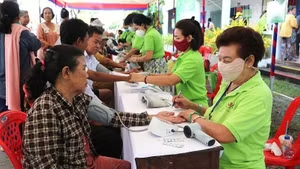
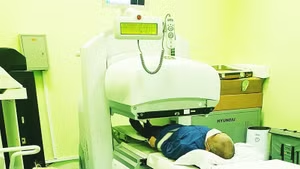
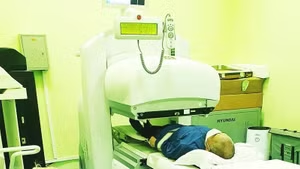
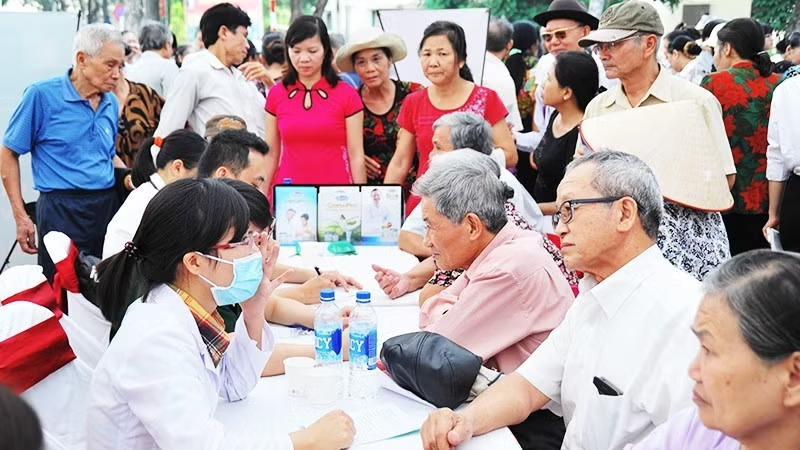
More than 7,800 people received free health check-ups and consultations at the event. A highlight of the programme was the on-site implementation of modern paraclinical techniques, enhancing the accuracy of screening and diagnosis. Specifically, doctors conducted 859 ultrasound scans (thyroid, abdominal, cardiac and joint), 641 chest X-rays and more than 400 electrocardiograms. Advanced procedures were also carried out, including over 1,500 bone density measurements, 1,380 prescribed blood tests, 300 ear–nose–throat endoscopies and 200 FibroScan liver screenings.
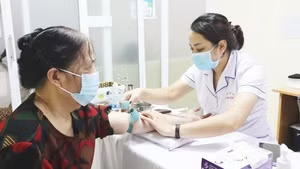
Subsequently, still in Ha Noi, the city organised free health check-ups for approximately 5,000 elderly people at multiple locations. Residents not only received clinical examinations but also underwent tests, ultrasounds and X-rays on-site.
In Ho Chi Minh City, the scale was even larger, with 58 simultaneous examination sites across 64 wards and communes, serving around 16,000 residents in a single day. Notably, screening extended beyond common illnesses to include breast, cervical and thyroid cancer detection, as well as specialised examinations in ophthalmology, otorhinolaryngology and dentistry, and even congenital heart screening for children.
Early detection, lower costs, improved quality of life
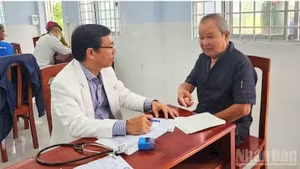
At a screening site in Vinh Hung Ward (Ha Noi), Le Van H (62) attended a health check despite having no obvious symptoms. However, screening revealed that he had dangerously high blood pressure accompanied by arrhythmia. “If not detected in time, the risk of stroke or heart failure would be very high, leading to costly treatment and potential disability. Early consultation allows the condition to be controlled at a lower cost and prevents serious consequences,” said Dr Ngo Thi Hieu Minh, Head of the General Planning Department at Duc Giang General Hospital.
Another case at a screening site run by Thanh Nhan Hospital (Ha Noi) further demonstrated the value of early detection. Tran Thi M (45), a freelance worker, participated in a free breast cancer screening programme for the first time and was diagnosed with an early-stage tumour. According to doctors, timely intervention makes treatment simpler, significantly reduces costs and offers a favourable prognosis. If detected at a later stage, patients would have to undergo complex treatments such as prolonged chemotherapy and radiotherapy, with high costs and serious impacts on health and quality of life.
Associate Professor Dr Tran Dac Phu, a preventive medicine expert, noted that large-scale free health check-ups carry not only immediate benefits but also clearly reflect the strengths of healthcare welfare policies. First and foremost, they provide a practical solution for people—especially the elderly and low-income groups—to access medical services without financial concern. In a context where many still only seek medical care when ill, community-based free check-ups have helped change perceptions and foster the habit of regular health monitoring.
Nguyen Van Hoa, Deputy Director General of Viet Nam Social Security, stated: “When free health check-up policies are implemented in a coordinated manner, combined with expanded health insurance coverage, people will not only benefit from early disease detection but also from long-term treatment security. This is a crucial foundation for achieving healthcare equity.”
Practical implementation has demonstrated clear effectiveness. During the programme serving 7,800 residents, screenings identified nearly 2,830 cases with abnormal signs, accounting for almost 36%, mainly related to hypertension, cardiovascular conditions, lung diseases and suspected cancers. These figures not only reflect the substantial demand for health check-ups within the community but also highlight the tangible value of early detection.
Without such initiatives, these conditions could progress silently, leading to severe complications and significantly higher treatment costs. In the long term, this policy helps reduce the burden on central hospitals while improving the population’s quality of life.
Grassroots healthcare taking action
To effectively implement nationwide health check-up programmes, the grassroots healthcare system has been making thorough preparations.
In Ha Noi, for the programme providing free check-ups to 5,000 elderly residents, the Department of Health established five examination sites with seven synchronised service lines. Major general hospitals such as Duc Giang, Saint-Paul, Thanh Nhan, Ha Dong and Van Dinh directly provided professional support to local health stations and clinics. This is considered an important “trial run” towards implementing regular health check-ups for all residents across the city.
In Ho Chi Minh City, the coordination model has been expanded on a broader scale. In wards such as Xuan Hoa, Ba Ria and Bac Tan Uyen, local health stations have collaborated with city-level and specialised hospitals—including Dermatology Hospital, Eye Hospital and Oncology Hospital—to provide general check-ups, cancer screenings, tests and ultrasounds locally. As a result, residents, particularly the elderly, women and vulnerable groups, can access high-tech services previously available only at higher-level facilities.
At Tang Nhon Phu Ward Health Station (Ho Chi Minh City), doctors from the Oncology Hospital and Pham Ngoc Thach Hospital directly conducted examinations and screenings for diseases such as tuberculosis, asthma, chronic obstructive pulmonary disease and cancer. Bringing doctors to grassroots facilities not only improves convenience for patients but also enhances the professional capacity of local healthcare staff through collaboration and technology transfer.
According to the Ministry of Health’s roadmap through 2028, periodic health check-ups will be implemented in phases, prioritising vulnerable groups such as the elderly, people with chronic diseases and residents in remote areas, before gradually expanding to cover the entire population. Notably, this model goes beyond one-off examinations, aiming instead for continuous, long-term health management through electronic health records and ongoing monitoring by grassroots healthcare providers.
Importantly, this coordination is evolving from a temporary initiative into a regular operational mechanism within the healthcare system. According to Ho Chi Minh City’s health sector, mobilising dozens of hospitals to conduct screenings across 64 wards and communes not only meets immediate needs but also helps build a “multi-tier healthcare system”, where grassroots healthcare forms the foundation, specialised care serves as the driving force and citizens remain at the centre.
At the same time, preparations in infrastructure and management have been strengthened. Electronic health records are being updated after each screening round, enabling continuous health monitoring; many localities are planning to establish “community-based healthcare teams” ready to visit households for examinations and consultations when necessary.
Minister of Health Dao Hong Lan emphasised: “Healthcare must begin with prevention. When every citizen receives regular health check-ups, along with continuous consultation and monitoring, we can build a strong preventive healthcare system and reduce the disease burden on society.” In the coming period, the health sector will focus on solutions including: refining mechanisms and policies to sustain free or subsidised health check-ups; increasing investment in grassroots healthcare, especially in remote areas; promoting digital technology in health management; and integrating periodic check-ups with non-communicable disease management and health insurance.