Viet Nam is a nation boasting high biodiversity, with more than 5,100 species of medicinal plants and fungi, together with hundreds of animal and mineral species used in traditional medicine. From the idea of “Southern medicine for Southern people” of the great physician Tue Tinh to the contributions of Hai Thuong Lan Ong Le Huu Trac, Viet Nam has developed a rich repository of traditional medical knowledge and a relatively synchronised traditional medicine network from central to local levels.
In recent years, the genetic resource conservation network in many ecological regions across the country has been preserving 964 genetic resources belonging to 642 medicinal plant species, including many precious species such as Ngoc Linh ginseng, Lai Chau ginseng, red fleeceflower root, and golden camellia.
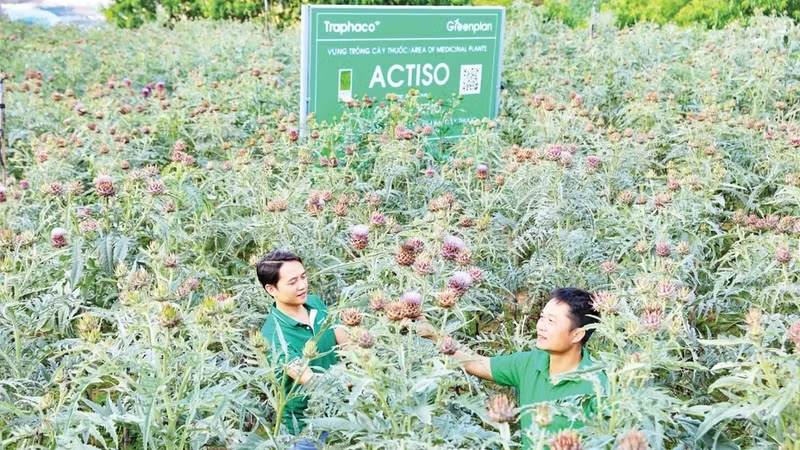
At the same time, heightened attention is being paid to research on restoration and propagation, with around 70 species and groups of species identified as having exploitation potential and estimated reserves of 18,372 tonnes per year, including 45 species with major potential for exploitation. The total area for medicinal plant development nationwide is estimated at 357,178 ha, with around 150 species cultivated. The Northeast region has more than 46 ha; the South-Central region has 15,498 ha; the Central Highlands has more than 13,000 ha; and the remaining regions have more than 11,000 ha.
In reality, Viet Nam does not lack raw materials and has also established a solid foundation in conservation, varieties, and growing areas. However, according to general assessments, inputs are robust, yet outputs remain incommensurate. At present, only 58 medicinal herb species are cultivated to GACP-WHO standards, covering around 375 ha and with a projected output of 1,400 tonnes per year. Compared with the total area of more than 357,000 ha, the standardised area remains very small; most medicinal herbs are still exploited, cultivated, harvested, and preliminarily processed using traditional methods.
According to Dr Nguyen Minh Ngoc, Director of the National Institute of Medicinal Materials under the Ministry of Health, for medicines, raw materials must not only derive from the correct plant and plant part, but must also be stable in terms of chemical composition, active ingredient content, purity, and safety. When input material quality lacks uniformity, it becomes exceedingly difficult to create medicines of stable quality. Meanwhile, the highest value of medicinal herbs lies in active ingredient research, determining mechanisms of action, extraction, purification, standardisation, preparation, and proving product efficacy and safety.
In other words, Viet Nam has many medicinal plants, but has not yet created many good medicines from them. It still largely plateaus at the stages of cultivation, harvesting, and supplying raw materials, while stages that create high added value, such as extraction technology, modern preparation, scientific evidence, intellectual property, and product branding, remain limited.
The application of standards such as GACP-WHO, GMP (Good Manufacturing Practice), GLP (Good Laboratory Practice), and GSP (Good Storage Practice) has not been implemented synchronously across the entire chain; research, innovation, and commercialisation capacity for research results has yet to meet requirements. Many scientific tasks still culminate merely in publication or experimental models.
According to Nguyen Viet Hung, General Director of Gia Dinh Medicinal Materials Company, a primary cause of this situation is that the medicinal herb industry has not been fully recognised as part of the digital economy, green economy, and circular economy. In many cases, medicinal herbs are still mainly approached as medicinal plants or products of traditional medicine. Meanwhile, the world has placed medicinal herbs in connection with biotechnology, the medicinal herb industry, functional foods, smart agriculture, and the healthcare market.
Resolution No. 57-NQ/TW of the Politburo identifies science, technology, innovation, and digital transformation as breakthrough drivers for rapid and sustainable national development in the new era. Alongside Resolution No. 66-NQ/TW and Resolution No. 68-NQ/TW, this forms an important institutional foundation for knowledge-intensive economic sectors, including the medicinal herb industry, to shift from resource-based development to development based on technology and innovation. Accordingly, in seeking solutions for the medicinal herb sector, science and technology need to be applied throughout the entire process, from genetic resources, varieties, and growing areas to extraction, preparation, testing, and medicine production.
Dr Nguyen Minh Ngoc further emphasised that science and technology are the most important foundation for developing the medicinal herb industry in a modern, sustainable, and internationally competitive direction. Therefore, it is necessary to promote the application of science, technology, and innovation across the entire medicinal herb value chain, from research, cultivation, and processing to medicine production. Scientific research must be linked to production practice, effective application, and the creation of specific, valuable products.
Furthermore, it is imperative to formulate and execute a national programme for the development of the medicinal herb industry and medicines from medicinal herbs to 2035, with a vision to 2045, linked to the national strategy on science, technology, innovation, and digital transformation.