Transitioning to environmentally friendly vehicles
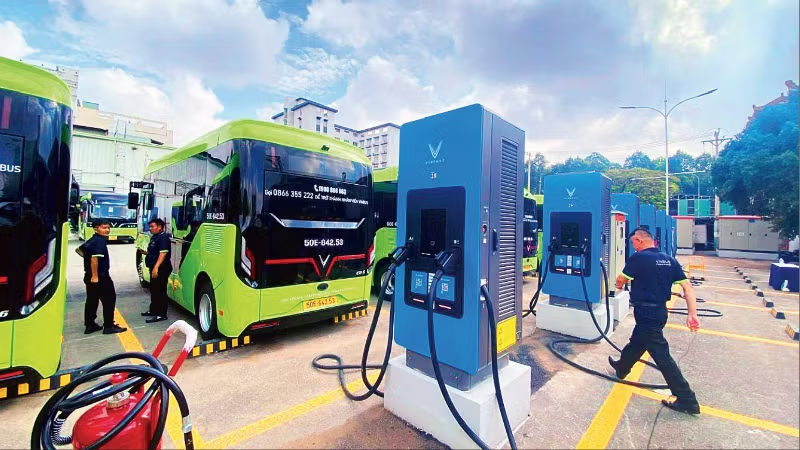
Ho Chi Minh City currently operates 2,432 vehicles on its bus routes. Of these, 1,185 are electric buses and 182 run on Compressed Natural Gas (CNG), accounting for more than 56% of buses in service.
Thanks to the city’s determination to convert public transport to environmentally friendly vehicles, the shift from petrol buses to electric ones accelerated in early 2026, raising the share of electric buses from 40% to nearly 57%. The city will continue tendering projects to expand its electric bus fleet so that, by 2030, public transport will run entirely on clean, green energy.
According to Pham Ngoc Dung, Director of the Ho Chi Minh City Public Transport Management Centre under the municipal Department of Construction, the city has drawn lessons from industrialised countries: first converting public transport (metro, buses), then commercial transport, and finally private vehicles. Beyond buses, the city has set targets and a roadmap to electrify ride‑hailing fleets, delivery vehicles and state agency cars to cut emissions.
Statistics from the Ho Chi Minh City Department of Construction show that in the past year the city announced 4,000 locations for battery swap cabinets, of which around 1,200 have been installed to meet electric motorbike charging needs.
Hai, a local resident, has been using an electric motorbike for nearly two years. He noted that the bike both supports the transport sector’s Net Zero goal and saves substantial costs — about 70% on average compared with a petrol bike.
However, he pointed out that the main concern for most motorbike owners switching to electric is the lack of charging infrastructure, such as public battery swap cabinets or home charging facilities.
Statistics from the Ho Chi Minh City Department of Construction show that in the past year the city announced 4,000 locations for battery swap cabinets, of which around 1,200 have been installed to meet electric motorbike charging needs. The Department aims to complete planning and launch 20,000 battery swap locations by the end of 2026.
Meanwhile, forecasts indicate that by 2030 the city will have about 1.2 million electric motorbikes in circulation, requiring more than 25,000 public charging points and battery swap cabinets.
Implementing the emissions reduction roadmap

As the country’s major economic centre with 14 million residents and travel largely dependent on private transport, Ho Chi Minh City faces mounting pressures of congestion, environmental pollution and greenhouse gas emissions.
Following administrative mergers, the city has more than 11 million motorbikes and scooters subject to emissions inspection. Experts estimate that rigorous emissions control could reduce the city’s carbon emissions by over 56,000 tonnes and hydrocarbons by nearly 5,000 tonnes annually, making a significant contribution to improving air quality.
Bui Hoa An, Deputy Director of the municipal Department of Construction, said that green transport development in Viet Nam is not merely a mandatory requirement but an important breakthrough. It is not just a matter of applying technology; it is a comprehensive revolution in institutions, human resources, national governance and the drive to build a domestic industry capable of technological autonomy.
According to him, supporting infrastructure is the “key” determining the success of the transition roadmap.
In Ho Chi Minh City, several investors are installing electric vehicle (EV) charging points for cars and battery swap cabinets for motorbikes to meet the green transition roadmap, while developing a coherent network of chargers and swap stations. However, ensuring convenient access to charging infrastructure for electric vehicles still requires comprehensive solutions.
Associate Professor Dr Dam Hoang Phuc, a senior UNDP expert, pointed out that the core bottleneck lies in the ecosystem, operating models and, in particular, the lack of a synchronised charging system to bring the green transition to fruition. Users need fast, flexible solutions rather than long waits at chargers. Therefore, charging models must be deeply decentralised into residential areas and destinations, optimised for electric motorbikes and short journeys.
Ho Chi Minh City, as a megacity, should diversify its emissions reduction pathways. The green transport transition requires flexible combinations of low‑emission vehicle technologies suited to high‑density urban traffic and the city’s practical conditions.
To implement the transport sector’s emissions reduction roadmap, Ho Chi Minh City is finalising financial support policies, including subsidies, favourable credit and risk‑sharing mechanisms for green vehicle investment projects. Alongside the electric bus fleet, the operation of Metro Line 1 (Ben Thanh–Suoi Tien) will contribute to a higher share of public transport, easing pressure on private vehicles.
For emissions control, the Department of Construction has recently asked associations, manufacturers, importers and warranty/maintenance networks to proactively review and upgrade facilities to be ready to participate in emissions testing for motorbikes and scooters under the new national technical standards, effective from 30 June 2026.
The city is also rolling out low emission zones (LEZs) in the central area, Can Gio area and the Con Dao special zone. Measures include restricting fossil fuel vehicles that fail emissions standards from entering core central areas, operating fully electric buses, and studying restrictions on certain private motorised vehicles on specific routes at designated times to match the capacity of transport infrastructure and public transport systems.
Urban experts recommend that Ho Chi Minh City, as a megacity, diversify its emissions reduction pathways. The green transport transition requires flexible combinations of low‑emission vehicle technologies suited to high‑density urban traffic and the city’s practical conditions.