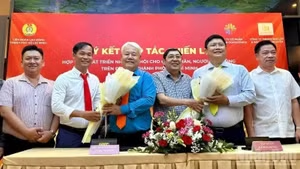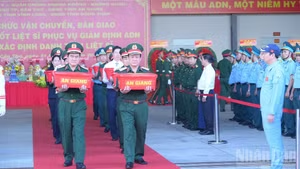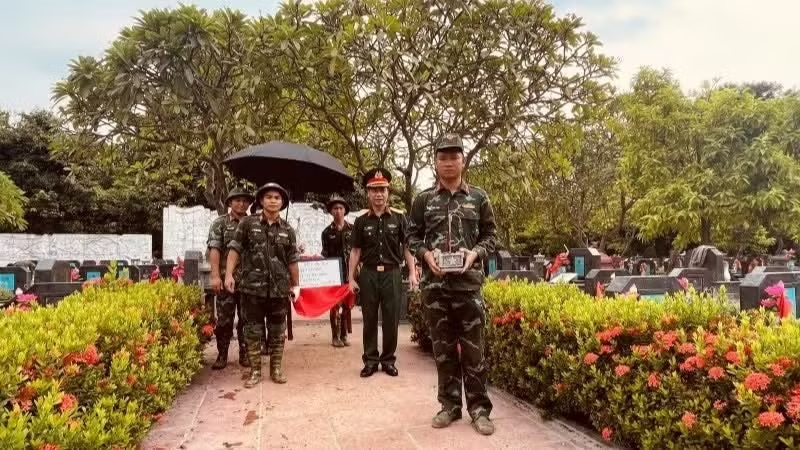
Currently, at Mai Dich Cemetery, officials and soldiers from the Ha Noi Capital High Command are urgently carrying out the task of collecting samples from the remains of fallen soldiers.
Captain Cao Huy Hiep of the 301st Infantry Division (Ha Noi Capital High Command) — who personally participated in sample collection at Ngoc Hoi and Nhon Martyrs’ Cemeteries — explained the challenges involved. Because the soldiers were buried long ago and the graves have undergone multiple renovations and solid structural reinforcements, the grave layouts are complex.
The remains lie at depths of 2 to 3 metres. At Ngoc Hoi Martyrs’ Cemetery, the remains were buried beneath three layers of concrete, requiring a very cautious dismantling process. At Mai Dich Cemetery, the remains are not aligned in straight rows, necessitating precise location identification. Notably, the soil here is weak and sandy; digging deep exposes groundwater, causing frequent cave-ins and making the excavation process arduous and repetitive.
Mai Dich Cemetery is the final resting place of 1,227 fallen soldiers and includes two mass grave sections; among these, 469 graves remain unidentified.
This cemetery holds the highest number of unidentified fallen soldiers’ graves in Ha Noi. Most of the soldiers fell during the resistance war against French colonial rule and were buried prior to 1956. Their remains may have crumbled or decomposed, posing significant challenges during the sampling process.
Colonel Dinh Van Tien of the 301st Infantry Division (Ha Noi Capital High Command), who maintains a continuous presence at the site to personally direct operations, noted that for this unprecedented campaign, the 301st Infantry Division and the 544th Engineer Battalion have been exclusively tasked with extracting samples from 469 graves containing unidentified remains.
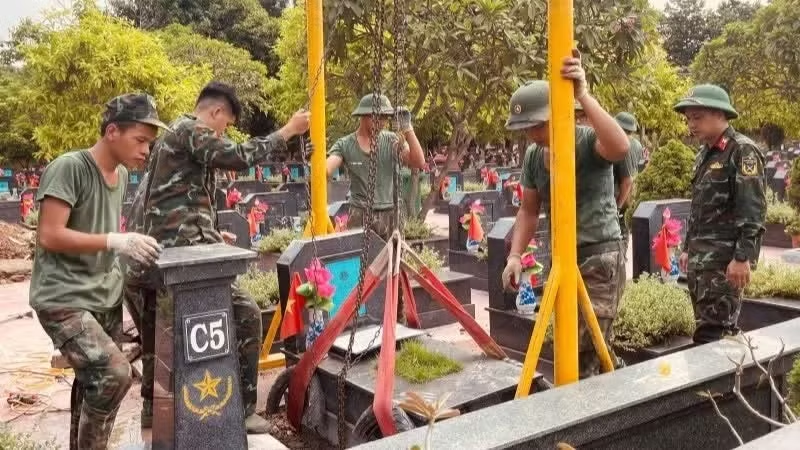
To ensure the operation is executed with absolute speed, precision, and efficacy, over 100 officers and soldiers have been organised into six highly specialised working groups. These teams execute their duties in rigorous accordance with established procedures and regulations, ensuring a process that remains irreproachably solemn, precise, and secure. Despite the gruelling physical and emotional toll of extracting samples from the martyrs' remains, the personnel are driving relentlessly toward the mission’s completion — a profound tribute to the heroes who sacrificed their lives for the Fatherland.
A representative from the Ha Noi Capital High Command detailed that a staggering 4,532 unidentified martyrs' graves across 233 cemeteries in Ha Noi currently mandate urgent sample collection; notably, three cemeteries — directly administered by the city authorities — account for a total of 555 such graves.
Senior Colonel Doan Chi Thang, Deputy Director of the Political Department of the Ha Noi Capital High Command, confirmed that on July 30, units successfully completed sample extraction from 48 graves at Ngoc Hoi Martyrs’ Cemetery. On August 2, sampling was decisively concluded for 35 out of 38 graves at Nhon Martyrs’ Cemetery (three graves deemed forensically unviable). Commencing August 7, specialisedunits began the extraction of samples from 469 martyrs’ graves at Mai Dich Martyrs’ Cemetery, driving toward a hard deadline of October 10, 2026.
Concurrently, communes and wards across Ha Noi are aggressively accelerating sample collection samples from 3,977 martyrs’ graves within their respective jurisdictions. To date, forensic teams have successfully secured 97 vital samples from 106 exhumed martyrs’ graves.
According to a representative from the Ha Noi Department of Home Affairs, the “500-Day-and-Night Campaign” designed to radically asscelerate the identification and repatriation of martyrs’ remains — is a mission of profound political and humanitarian magnitude, mobilising the entire political apparatus — from high-level government authorities and functional forces to local cemetery caretakers, and the broader public.
The campaign confronts formidable logistical hurdles, as the vast majority of martyrs’ graves date back decades, and the surrounding terrain has drastically changed over time. Furthermore, many graves have been subjected to multiple historical renovations and permanent structural fortifications, severely complicating the assessment, classification, and forensic sampling processes required for DNA analysis.
Compounding these difficulties, historical record-keeping and the mapping of cemeteries and grave locations suffer from a severe lack of uniformity in some localities, a direct consequence of decades of administrative unit divisions and mergers. Nguyen Tay Nam, Deputy Director of the Ha Noi Department of Home Affairs, asserted that the agency will forge an even tighter coordination with the Ha Noi Capital High Command, relevant departments, and local authorities to forcefully accelerate the campaign's momentum.
Simultaneously, authorities will execute a comprehensive review and finalisation of all records and databases regarding martyrs’ cemeteries and graves, ensuring that every logistical parameter is optimally secured to conduct the sample collection in a thoroughly solemn, rigorous, and legally compliant manner.
In tandem, state agencies are rapidly expediting the digitisation and assignment of unique identification codes to every grave and martyrs’ cemetery. This strategic initiative aims to forge a universally unified data ecosystem that facilitates highly scientific and synchronised management, while simultaneously enabling the public to seamlessly access critical information via the national portal dedicated to martyrs.