The “panhandle” land and a responsibility to history
On the map, Military Region 4, which currently covers five provinces from Thanh Hoa to Hue City, resembles a “panhandle” — the country’s narrowest strip of land, and also one of the areas that suffered the fiercest bombardment during the resistance war against the United States for national salvation. From Dong Loc Junction, Truong Bon, and Long Dai Ferry Terminal to Xuan Son Ferry Terminal, Routes 12A and 15A, Route 9–Khe Sanh, and the Quang Tri Ancient Citadel, all were “fire coordinates” during the war.
On this same land, hundreds of thousands of officers and soldiers from across the country fought and laid down their lives in major campaigns, particularly during the 81-day battle to defend the Quang Tri Ancient Citadel in the summer of 1972, one of the fiercest battles in the nation’s history of national defence.
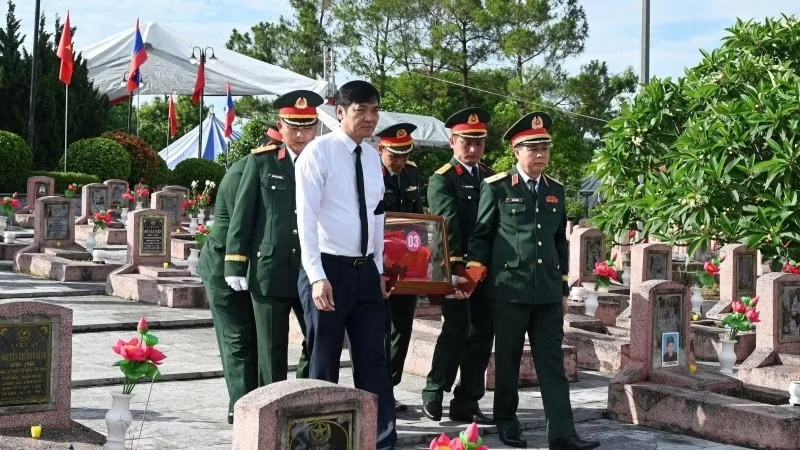
This is also one of the areas with the largest number of fallen soldiers who perished and were buried in the country. Many still lie in dense forests, underground, or on the soil of neighbouring Laos. At many cemeteries, graves still bear only the words ‘Unknown fallen soldier’. This reality reminds today’s generations of their daily responsibility to restore the names of those who gave their lives.
According to Colonel Dinh Xuan Huong, Deputy Director of Political Affairs of Military Region 4, a total of 138,911 fallen soldiers perished and were buried in the region. So far, the remains of 64,613 have been searched for and recovered, while 74,298 have yet to be found or have not been fully identified. These figures reflect the enormous scale of the task undertaken by the armed forces of Military Region 4.
Therefore, as soon as the Ministry of National Defence launched the ‘500-day-and-night campaign to accelerate the search for, recovery, and identification of fallen soldiers’ remains’, the Party Committee and High Command of Military Region 4 designated it a crucial political mission, calling for the coordinated involvement of military agencies, local Party committees and authorities, and relevant forces.
A race against time
As time progresses, traces of the battlefields continue to fade. Under the plan for the ‘500-day-and-night campaign’, Military Region 4 will collect 35,588 samples from the remains of fallen soldiers whose identities have not yet been established at 231 martyrs’ cemeteries. It will also continue searching for and recovering around 1,500 sets of remains both in Viet Nam and in neighbouring Laos. Quang Tri Province, where some of the fiercest battles took place, faces the largest workload, with more than 22,000 samples to be collected from 124 cemeteries.
Alongside DNA sampling, six recovery teams from Military Region 4 continue their missions in 10 provinces of Laos. These are vast mountainous and forested areas, many of which once served as combat bases where Vietnamese volunteer troops and military experts fought and laid down their lives while carrying out their noble international duty.
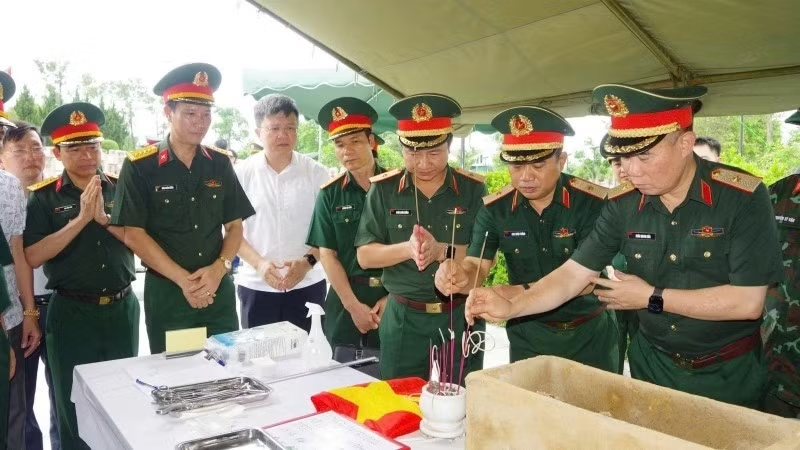
Lieutenant Colonel Che Ngoc Ha, Head of the Recovery Team under the Nghe An Provincial Military Command, noted that every dry season, the team travels through forests and over mountains, working with local authorities, armed forces, and residents to verify every lead and suspected site. Some missions last for months, requiring the team to clear paths through old-growth forests and set up camps in areas lacking electricity or mobile phone coverage.
During the 2025–2026 dry season, Military Region 4 initially recovered 263 sets of remains of fallen soldiers, including 119 in Viet Nam and 144 in Laos, providing further important information for recovery and identification efforts.
Combining collective strength with science
According to Colonel Dinh Xuan Huong, the difficulties stem from changes in the terrain and the lack of consistency in records kept by military units over different periods. Many documents have been damaged, lost, or contain only scant information. Many witnesses are now elderly and in declining health, while others have passed away.
Military Region 4 has therefore determined that it must mobilise the combined strength of the entire political system. Military agencies at all levels, local Party committees and authorities, veterans’ associations, traditional liaison committees, and families of fallen soldiers have all been urged to provide information. Every letter, diary, old map, or recollection of people who once lived in areas where fighting took place can provide a basis for opening up a new search.
In Laos, during the 2025–2026 dry season, the recovery teams made effective use of mass-mobilisation efforts and worked closely with local authorities, armed forces, and residents to recover 80 sets of remains and bring them home, achieving 100% of the target.
As part of the ‘500-day-and-night campaign’, Military Region 4 is simultaneously carrying out excavation and collecting biological samples for DNA testing at martyrs’ cemeteries across the region. At Do Luong Martyrs’ Cemetery and 31 other cemeteries in Nghe An Province, recovery teams are collecting DNA samples from more than 2,254 sets of remains.
Colonel Pham Dinh Trung, Deputy Political Commissar of the Provincial Military Command, asserted: “The collection of samples must be carried out rigorously and scientifically, while ensuring absolute solemnity.”
The province aims to complete sampling at all 32 cemeteries by the end of October 2026. To date, Military Region 4’s task forces have conducted excavations at 76 of the 231 martyrs’ cemeteries; excavated 17,011 graves out of more than 35,718 graves subject to sampling; and collected 9,614 biological samples, of which 6,752 have been handed over to specialised agencies for DNA testing.
At the same time, Military Region 4 is intensifying efforts to review, standardise, and digitise records of fallen soldiers, grave records, recovery results, and other relevant data. Once information from military and local records is connected and cross-checked with DNA testing results on a single system, the ability to identify fallen soldiers will be significantly enhanced, helping shorten the waiting time for their families.
The road ahead remains long. With every passing dry season, every new lead uncovered, and every DNA sample decoded, there comes fresh hope of bringing those who gave their lives home to their families, their homeland, and their comrades.