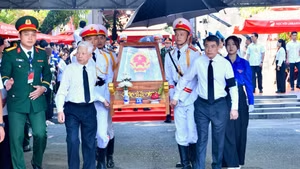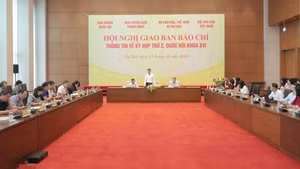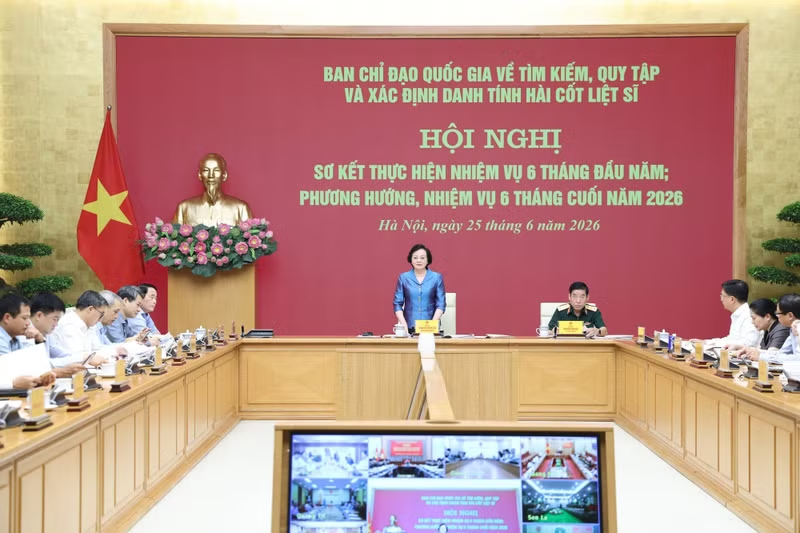
Addressing a hybrid mid-year review conference of the National Steering Committee for the Search for, Recovery and Identification of Martyrs’ Remains, Tra, who is also head of the committee, described the campaign as an urgent and politically significant task that reflects Viet Nam’s long-standing tradition of gratitude toward those who sacrificed their lives for national independence and reunification.
She noted that during the first six months of 2026, the campaign has achieved encouraging results, generating strong public support and fostering a broad spirit of remembrance across society.
According to the Deputy PM, important progress has been made in improving the legal and policy framework. The Government has issued Resolutions No. 26 and 51 on special mechanisms and procedures to facilitate DNA sampling, forensic analysis and identification of martyrs whose remains still lack personal information, providing the necessary foundation and resources for large-scale implementation.
Public communication efforts have also gained momentum. The launch of the 500-day campaign has attracted widespread attention, with major media organidations and local authorities actively promoting awareness and encouraging the public's participation.
Steering committees at all military-region and provincial levels have completed implementation plans. As many as 297 specialised teams involving more than 3,600 personnel have been established to collect samples and support identification work.
As of June 22, authorities had recovered 1,255 martyrs’ remains out of a target of 7,000. DNA-related samples had been collected from 12,127 graves lacking identifying information, out of an estimated 230,000. The Ministry of Public Security had analysed approximately 53,000 DNA samples and integrated nearly 18,000 results into a national database. To date, the identities of 25 martyrs have been successfully confirmed and returned to their families.
Despite the progress, Tra acknowledged shortcomings, including uneven communication efforts in some localities, limited public engagement and technical constraints in campaign management software.
Looking ahead to the second half of 2026, she called on the steering committees, ministries, sectors and localities to intensify efforts with ambitious targets. These include recovering more than 3,000 martyrs’ remains, completing DNA sampling of unidentified graves (excluding pre-1954 graves), collecting over 100,000 biological samples from martyrs’ relatives, and conducting DNA analysis on around 10,000 samples.
She urged completion of mine clearance in key areas of Tuyen Quang and Lang Son provinces, and finalising national databases on martyrs, martyrs’ graves, martyrs’ cemeteries and people with meritorious services, ensuring accurate, complete, clean, up-to-date and shared data.
The Deputy PM also stressed the importance of expanding international cooperation with Laos, Cambodia and partners such as the US in exchanging wartime records, information and belongings that could help locate missing soldiers.
Describing the work as “the most difficult among difficult tasks,” Tra warned that information sources, especially historical witnesses, are decreasing. She urged relevant agencies to make full use of existing archives, documents and eyewitness accounts, noting that within the next 5 -7 years, the search and verification process could become significantly more challenging.