From removing development barriers to creating new drivers and development space
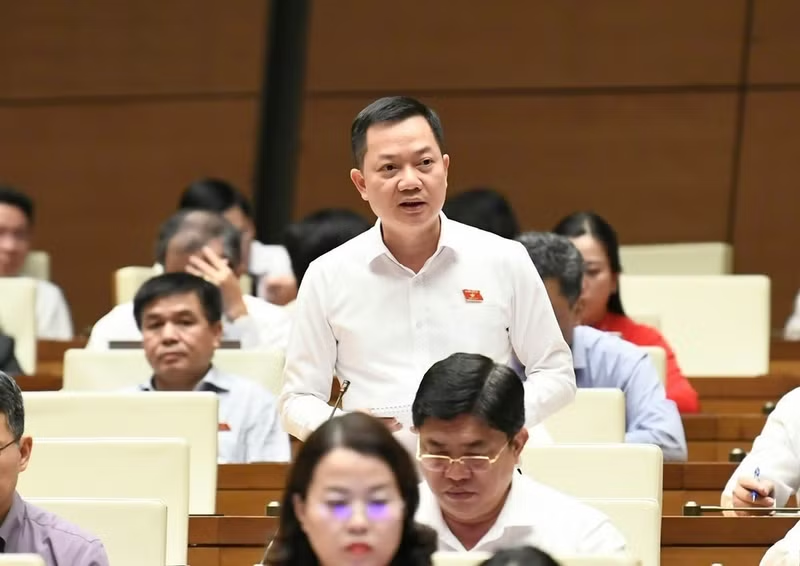
According to National Assembly deputy Trinh Xuan An, full-time member of the National Assembly’s Committee for National Defence, Security and External Affairs, as the country enters a new stage of development, the requirements for law-making no longer stop at completing the legal system or resolving immediate difficulties, but must aim to create a modern, stable and transparent institutional environment with sufficient capacity to guide development.
“Law is not only a tool of state management, but must also become a foundation for creating a stable investment and business environment, promoting innovation, enhancing national competitiveness and expanding development space,” the deputy said. In that context, the first extraordinary session of the 16th National Assembly carries significance beyond that of an ordinary legislative session.
The National Assembly’s consideration and decision on 33 items, including 19 draft laws and legal resolutions, its initial discussion of seven draft laws and its decisions on many important national issues demonstrate very strong determination to quickly institutionalise the Party’s guidelines and meet the country’s development requirements in the new period, “without delay and without missing development opportunities for the country”, as National Assembly Chairman Tran Thanh Man stressed in his opening remarks at the session.
Notably, the session is marked not only by a very large legislative workload, but also by an important shift in law-making thinking: from a National Assembly focused on removing development barriers to one that proactively creates the environment, drivers and space for new development. “The large number of draft laws submitted at this session is not an end in itself. More importantly, each law must truly address practical issues, ensure consistency and feasibility, and generate development value,” deputy Trinh Xuan An affirmed.
Accordingly, the National Assembly is not only concerned with issuing more laws, but also places special importance on the quality of each policy, ensuring that every law, once adopted, can quickly enter life and become a new development resource. The requirement set by the National Assembly is that policies must be fully assessed in terms of impacts, resources and implementation conditions from the drafting stage; legal gaps must be minimised and any “delay” between issuance and implementation must be avoided. Only then can the Party’s guidelines be quickly translated into law, and law truly become a driver of development.
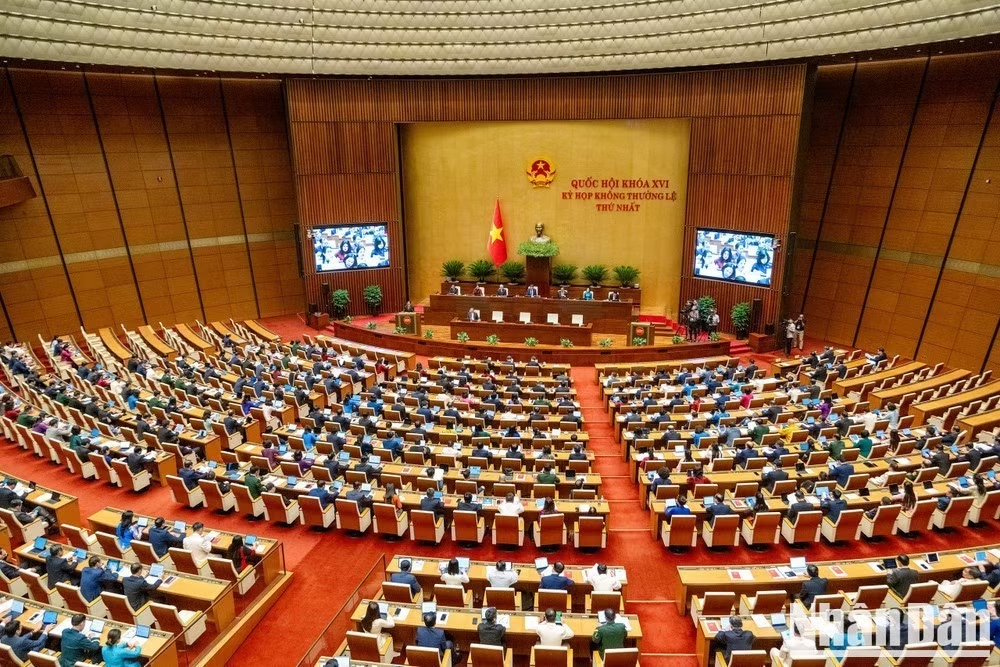
Another notable point mentioned by deputy Trinh Xuan An is that the draft laws submitted to the National Assembly this time all aim at very specific reform goals that can be quantified and verified. The draft revised Customs Law is expected to cut five groups of procedures; the draft Law amending and supplementing Article 6 and Appendix IV of the Investment Law will cut 58 conditional business lines; and the draft Law amending and supplementing a number of articles of 10 laws in the fields of agriculture and environment is expected to cut around 40 administrative procedures and 40 business conditions, saving about 790 working days for people and enterprises.
Together with breakthroughs in administrative procedures, the draft laws at the session also seek thorough decentralisation and delegation of authority, with clear functions and tasks, linked with digital transformation, science and technology to create a shift in governance.
“These figures show that this round of institutional reform has moved beyond broad orientations and been specified through clear, measurable outputs. The success of these laws will not be measured only by the number adopted, but by the extent to which administrative procedures are made easier, compliance costs reduced, the investment and business environment improved, and development resources more effectively unlocked,” deputy Trinh Xuan An stressed.
Institutions increasingly completed in a coordinated manner, effectively removing bottlenecks in practice
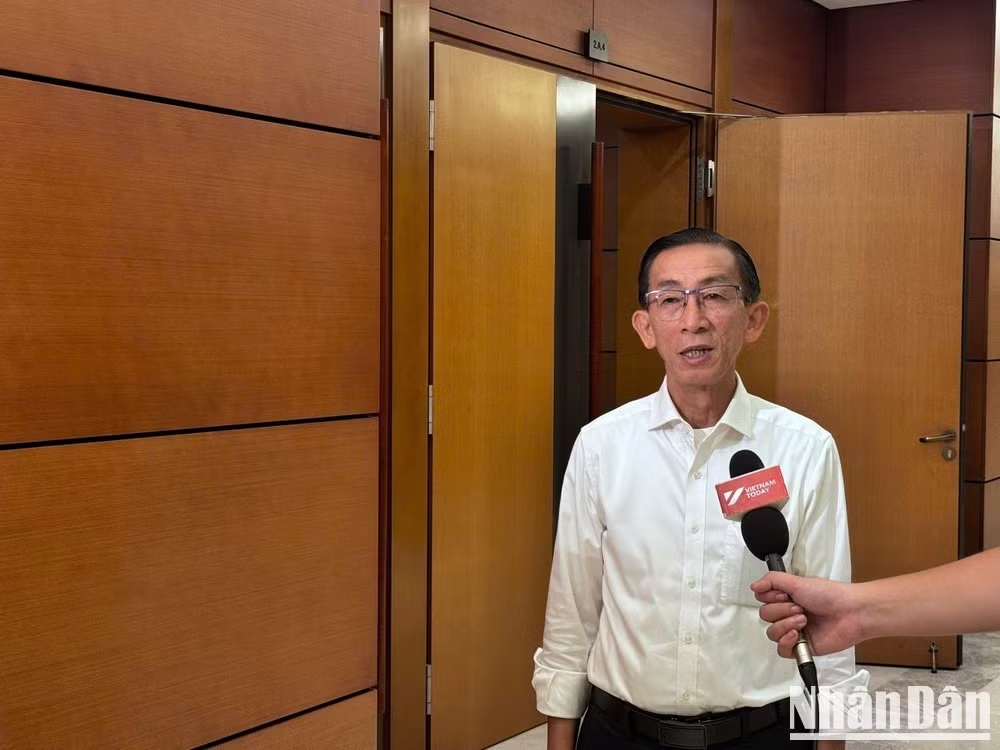
Speaking to Nhan Dan Newspaper, National Assembly deputy Tran Hoang Ngan of the Ho Chi Minh City delegation said that institutions have long been one of the bottlenecks of concern. Less than three months after the conclusion of the first session, the National Assembly has convened an extraordinary session to consider and adopt many important contents.
Specifically, the National Assembly is set to adopt 15 laws and four resolutions, give opinions on seven draft laws and decide on six important national issues. “Clearly, institutions are being completed in an increasingly coordinated manner, removing bottlenecks in practice,” deputy Tran Hoang Ngan said.
He expressed the expectation that institutional improvement will help mobilise resources and promote the country’s potential and advantages, thereby contributing to the realisation of the high-growth target in the country’s new era.
Sharing further on the content of the session, deputy Tran Hoang Ngan said the National Assembly is continuing to consider further cuts to unnecessary administrative procedures and business conditions in order to create a favourable investment and business environment for enterprises and people, while also reviewing long-standing obstacles that have delayed project implementation.
Notably, at the first extraordinary session, the National Assembly will give opinions on the orientation for drafting the State Budget Law (consolidated), on the basis of merging the Public Investment Law and the State Budget Law. This will help avoid situations in which capital is available but projects cannot be implemented, or projects need capital but no funding is available, ensuring the effective use of state budget resources at a time when the country needs resources for development investment.
In addition to institutions and infrastructure, another issue of particular concern to deputy Tran Hoang Ngan is how to narrow the rich-poor gap. Although the country’s GDP per capita has now reached the upper-middle-income threshold, up to 80% of provinces and cities have GRDP per capita below the national average.
To narrow this gap, according to deputy Tran Hoang Ngan, one of the issues requiring attention is the need for stronger policies for agriculture. For many years, although agriculture has generated a trade surplus and brought in large amounts of foreign currency, the sector’s growth rate has remained at only 3-4%, compared with 8-9% for industry and services.
“Viet Nam has strengths in agriculture, and we must find ways to give the sector conditions to accelerate development,” deputy Ngan emphasised. He also said that Vietnamese agriculture now has a major opportunity to break through as connectivity infrastructure is being strongly improved, creating conditions for investors to bring capital to rural areas and implement projects there.
The issue is that strong, bold and breakthrough mechanisms are needed, such as exemptions from taxes and fees, to attract investment into agriculture. This would help achieve multiple goals: narrowing the rich-poor gap, ensuring social security, maintaining macroeconomic stability, and promoting rapid and sustainable growth.






![[Infographic] Key points from General Secretary and President To Lam’s opening remarks at the 14th PCC’S 4th plenum](https://en-cdn.nhandan.vn/images/j0QNt7m_5iy1OXpnUKiwG61aYhTv_B140GWhfriF26JwZbNNJ8LWetfvXUhz4Az6/1-8220.jpg.avif)