This reality requires the city to adopt a long-term strategy that both increases the land available for parks and greenery and mobilises social resources while changing the way urban areas are planned and developed.
Changing mindsets
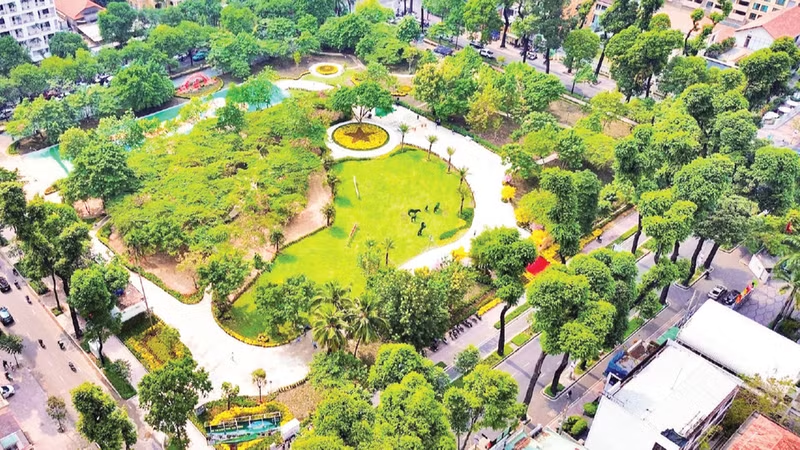
Amid the rapid pace of urban development, with high-rise buildings and busy traffic flows, green spaces are increasingly becoming precious “breathing spaces” for the city. Recognising their importance, Ho Chi Minh City has made considerable efforts in recent years to gradually meet practical requirements.
During the 2020-2025 period, the city developed 237.51 hectares of public parks, achieving 158% of the target; 54.04 hectares of green space, achieving 540% of the target; and planting and renovating 42,534 trees, achieving 140% of the target. Of particular note has been the conversion of “prime land plots” into community spaces.
For example, the 4.3-hectare site at 1 Ly Thai To Street, after being left vacant for many years, has been transformed into a park and a memorial site for Covid-19 victims. More notably, the conversion of the nearly 40-hectare site at Nha Rong-Khanh Hoi into a park and public space is creating high expectations. This was previously a site where plans had been approved for the development of more than 3,000 apartments together with a commercial centre. However, the city chose to prioritise public space rather than maximise the commercial value of the site. This approach demonstrates a new perspective: green spaces are being designed and considered as an essential component of urban space.
At the grassroots level, the “Green Apartment-Bright from the Walkways-Beautiful through Awareness” model at the 277 Hau Giang apartment building in Binh Tay Ward has contributed to increasing green space and building a civilised culture of behaviour within the community. Hoang Ngoc Tuong Vy, Chairwoman of the ward’s Viet Nam Fatherland Front Committee, said that, through the model, the locality seeks to foster a civilised way of life and raise residents’ awareness and sense of responsibility.
On a larger scale, the green-space development model in Phu My Hung urban area is also a highlight. Covering 433 hectares, the urban area was planned with the aim of harmonising greenery and built-up space. The average construction density across the entire area is approximately 26.5%, while 40.9% of the open space is allocated to outdoor activities and parks. These models show that when green space is incorporated into planning from the outset, greenery becomes a connecting component linking residential areas, services, and public spaces.
Despite achieving many positive results, the gap in green space compared with common standards remains very large. Before the merger, Ho Chi Minh City had more than 740 hectares of parks and approximately 312 hectares of public green space, but the average green-space area was only around 0.7 square metres per person, far below the target of 8-10 square metres per person.
Notably, public green spaces are currently located mainly along transport land corridors, such as pavements, medians, traffic islands, and land reserved for transport purposes. This shows that there is still a shortage of sufficiently large parks capable of meeting the needs of community activities.
The development of green space faces even greater challenges as the pace of urbanisation continues to accelerate. Ho Chi Minh City has repeatedly ranked among the world’s major cities with the highest levels of air pollution, with PM2.5 fine particulate matter exceeding safe levels.
From targets to a long-term development strategy
The Ho Chi Minh City Department of Construction believes that increasing public green space requires a combination of synchronous solutions. Projects to renovate or newly construct pavements and streets need to appropriately calculate the proportion of land allocated to green space, while land resources must be managed and transport corridors and protected corridors for infrastructure must be safeguarded so that they can be prioritised for use as public green space. This also requires the selection of tree species suitable for urban conditions.
In response to this urgent requirement, the city has set specific targets for the coming period. By 2030, the city aims to have at least 1 square metre of public greenery per person; develop an additional 10 hectares of public green space; plant and renovate 50,000 trees; and develop at least an additional 450 hectares of public parks. Several large-scale projects have been proposed, including the 485-hectare Saigon Safari Park, the 128-hectare Ecological Forestry Area, the 36-hectare Dong Thanh Nursery, the 13-hectare Go Cat Park, and Thu Thiem Square Park.
To turn these targets into reality, the Department of Construction has requested that localities urgently review the entire land fund planned for parks and public green space that has yet to be developed in order to identify solutions for implementation. Public land, vacant land that does not require site clearance, and land in areas with high population densities will be prioritised for consideration. Meanwhile, the city will review and recover public land currently leased out or used for improper purposes that has been planned for parks; and will require investors of housing projects to complete parks and green spaces in accordance with approved detailed plans.
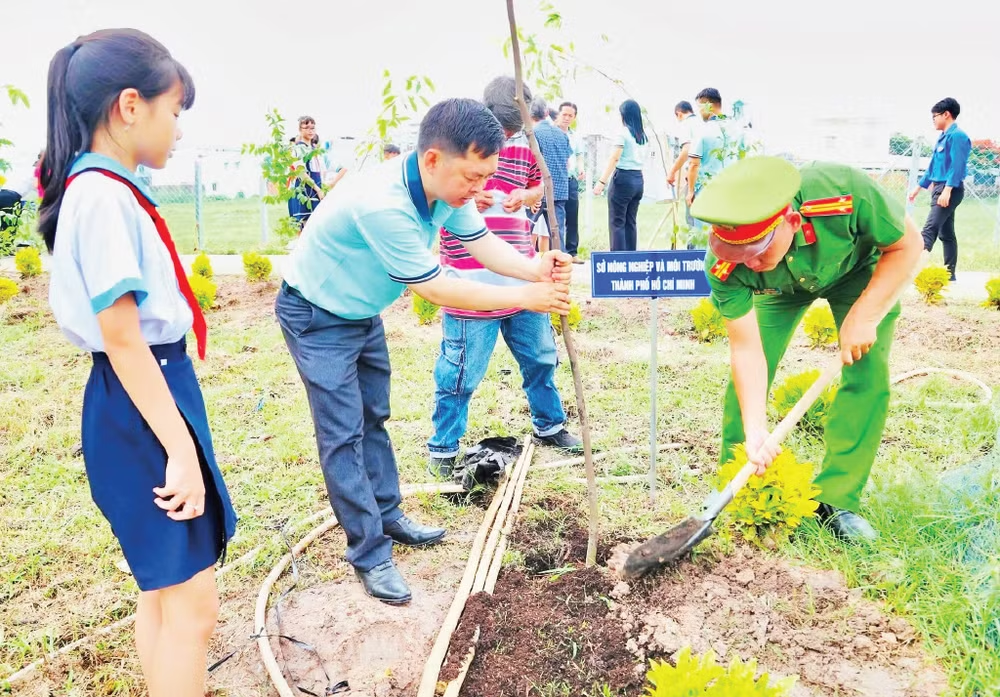
According to experts, Ho Chi Minh City needs to address green-space planning at the scale of the entire urban area rather than focusing only on individual projects. Architect Ngo Viet Nam Son said that if jobs, services, education, healthcare, and housing continue to be concentrated in the centre, the pressure will not decrease. The city should urgently plan and establish new development poles with sufficient appeal to encourage residents and businesses to relocate outwards.
Professor and Doctor Dang Mau Chien, Chairman of the Interdisciplinary Council for Materials Science and Technology, Viet Nam National University Ho Chi Minh City, said that the role of green-space solutions needs to be properly recognised. Green spaces, ecological materials, and water-storage models are only part of the overall solution and need to be implemented synchronously with drainage systems, urban planning, and operational management. Increasing green space is an urgent issue. The city needs to prioritise funding at an early stage and have specific, timely plans to implement integrated planning.
The current situation requires Ho Chi Minh City to adopt more decisive approaches, particularly by completing mechanisms to encourage businesses to participate in park investment through public-private partnerships, while also considering the development of trees and parks as a criterion for assessing the effectiveness of urban management in each locality.
City leaders have repeatedly emphasised that green-space development should be regarded as a major priority for the city. The current situation requires the city to adopt more decisive approaches, particularly by completing mechanisms to encourage businesses to participate in park investment through public-private partnerships, while also considering the development of trees and parks as a criterion for assessing the effectiveness of urban management in each locality.
For a major urban area such as Ho Chi Minh City, green space is no longer an ancillary part of planning but must be regarded as an essential from of infrastructure. Green-space development must be linked to the restructuring of urban space. When new centres are established and population and economic activities are distributed more appropriately, the core area will have greater room to allocate land for parks and public spaces.
![[In Pictures] Bridge columns and underpasses in Ha Noi begin to turn green](https://en-cdn.nhandan.vn/images/nyM650OGFWrOVWc-xajqN-rTZ68Rlmc1fiGJOhBRYHH_N-Xs0TE8Psnfce7ORTs-KVfoJaEblqjNufFrgeF3e2xFkGtLQVaXm04VcmMKBEkANUyiOkpz4zAuIKgydVrrfBxmGez0E_YJIag0u_Uil0E7jpuJXsIxeMmGjoY1-W4/1791863309074-2994714492692222878-2994714492692222878-adb9ff3f4175c70066ed8bb80cfbead9.jpg.avif)