Safeguarding livelihoods rooted in heritage
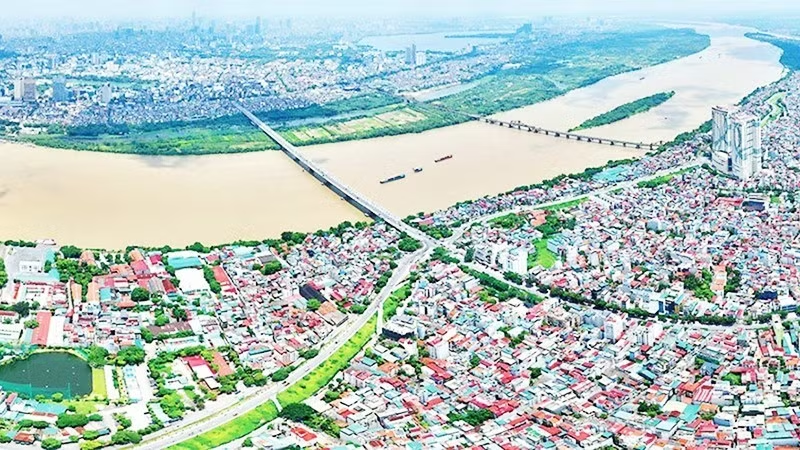
Village culture remains vibrant not only in suburban areas but also in the heart of the inner city, according to Dr Chu Xuan Giao of the Institute for Cultural Studies under the Viet Nam Academy of Social Sciences. It is reflected in craft streets, which were originally formed by people transplanting traditional skills and knowledge from their home villages into the city.
In the new era, urban planning is an inevitable process in building a more modern and civilised capital. Alongside public expectations of a new urban landscape, however, there are persistent concerns that an entire ecosystem of culture and traditional craft knowledge could be disrupted by the pressure of rapid construction.
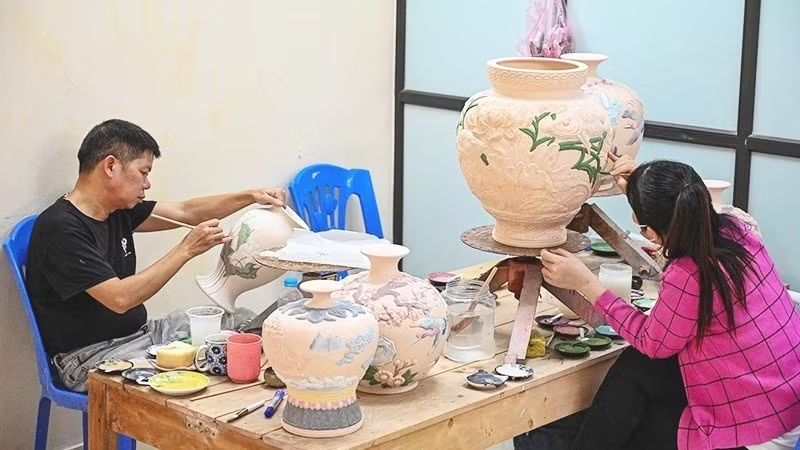
Professor Danielle Labbé of the University of Montréal, Canada, a member of the research project “Ha Noi: A City of Villages”, asserted that the survival of each craft village does not depend solely on where its residents are relocated. More importantly, when residents are relocated, the challenge is how to preserve the traditional craft ecosystem in its entirety. Traditional crafts depend on closely interconnected networks, ranging from raw material supplies and production spaces to community ties and the transmission of skills across generations.
Labbé noted that heritage value lies not only in physical structures, but is also closely linked to local livelihoods. Without livelihoods, heritage will gradually fade away. If residents choose new occupations because they see better opportunities, that is a natural process of adaptation. However, if they are forced to abandon traditional crafts because planning eradicates production spaces or disrupts the conditions needed for those crafts to survive, this would amount to the disappearance of a living cultural entity.
Many planning projects often seek to address livelihood issues through financial compensation. Architect Tran Huy Anh, Standing Member of the Ha Noi Architects’ Association, observed that residents are often initially pleased to receive large compensation payments. Yet without thorough research and a well-designed roadmap, no matter how large the compensation may be, people will find it difficult to adapt immediately to a completely new way of life once their production space is gone.
Anh expressed concern that livelihood transitions cannot take place overnight. Handicrafts are built on techniques accumulated over a long period, passed down through generations, and supported by established markets.
Anchoring the spiritual soul within the modern city
Alongside traditional crafts, the architectural complexes of communal houses, temples, pagodas, and shrines have long formed the core of the spiritual life of Vietnamese people across generations, according to Dr Chu Xuan Giao. However, Anh expressed concern that modern planning schemes appear to be overlooking these long-standing values. In long-term planning schemes, clearly designated areas for heritage protection are becoming increasingly difficult to discern. Instead, sprawling urban developments and piecemeal railway projects are encroaching on these spaces, leaving the city’s historical legacy without a meaningful place in its future.
Anh warned that the consequence of this planning gap is the gradual erosion of community ties, a trend clearly visible as newcomers settle among long-established residents in existing ancient village spaces. In the past, communal houses were sustained by a strong sense of shared responsibility among family clans over generations. Today, newly arrived residents have not yet had time to develop the same deep sense of reverence and attachment.
Meanwhile, new urban developments often focus primarily on building apartments for sale, while neglecting shared spaces for spiritual and community activities, further weakening social bonds.
In the current planning context, Giao emphasised that the core solution to urbanisation lies in careful dialogue and consultation between authorities and residents. To preserve the underlying cultural continuity of a community, planners must listen to and understand the aspirations of those who live within the heritage itself.
Sharing this view, Labbé argued that local residents, who best understand the history and social relationships of the area, should be regarded as an invaluable source of indigenous knowledge rather than merely as people to be consulted when plans are almost complete.
Practical experience shows that involving local communities in discussions from the outset helps build broad consensus. More importantly, it creates an urban environment with deep roots, where modern development and traditional identity can coexist and evolve together.
Labbé pointed out that the identity of a village is shaped by neighbourly bonds, mutual support, festivals, shared memories, and everyday interactions. If planning disperses residents, the emotional ties built over generations can easily be severed. Conversely, if residents are resettled together in a new location with shared community spaces, village identity has a chance to be preserved and renewed. The most important task is not to rebuild a new communal house, but to preserve the community itself — the people who give that space its soul and meaning.