Proactive measures at the local level
In the first eight months of 2026, Hue City has experienced no major storms or floods, though it recorded 12 heatwaves and three episodes of thunderstorms, tornadoes, lightning, and strong winds. These extreme weather events injured one person, blew the roofs off 22 houses, and damaged 56 hectares of fruit trees and 18 hectares of other crops.
City meteorological forecasts indicate that between September and November, three to five storms or tropical depressions are likely to form in the East Sea/South China Sea, with one or two potentially affecting the mainland. In light of this, the city has instructed local authorities not to be complacent and to review response plans tailored to their specific areas.
Thuan Hoa Ward is traversed by a section of the Perfume River, making it particularly vulnerable to flooding. Truong Dinh Hanh, Chairman of the Ward People’s Committee, stated that the city has provided additional watercraft to low-lying wards and communes — including Thuan Hoa — to enable proactive access to areas cut off by deep floodwaters.
The ward is also coordinating with local universities to provide timely information and warnings to students during natural disasters. “This group presents complex challenges, as they are unfamiliar with the local terrain and lack the experience in responding to heavy rains and floods that lifelong Hue residents possess,” Hanh emphasised.
In Hoa Chau Ward, response plans have been developed for specific residential areas. Phan Trong Nghia, Chairman of the Ward People’s Committee, explained that due to the ward’s large size, authorities have stationed personnel at high-risk locations and prioritised the evacuation of vulnerable groups.
Households capable of relocating on their own are encouraged to formulate evacuation plans and inform their neighbourhood group leaders of their intended destinations and the number of people seeking shelter.
Residents in flood-prone areas are already accustomed to stockpiling supplies at the start of the rainy season. Local authorities are urging residents to prepare a 3-to-7-day supply of essentials while also establishing local stockpiling points tailored to specific area conditions.
Phan Hung Son, Deputy Director of the Department of Industry and Trade, stated that in addition to the reserves held by residents and local authorities, the city has increased its own stockpiles compared to the previous year.
At a meeting held by the Hue City Civil Defence Steering Committee to review disaster response plans for the final months of 2026, Senior Lieutenant Colonel Nguyen Manh Tuan, Deputy Chief of Staff of the City Military Command, reported that localities and agencies have developed plans based on their specific functions, jurisdictions, and disaster types.
Projected evacuation figures include: 12,462 households (over 40,000 people) for storms; over 10,000 households (nearly 31,000 people) for floods; nearly 2,100 households (around 7,600 people) for flash floods and landslides; and 2,041 households (7,055 people) for storm surges.
Search and rescue operations are organised to suit the specific conditions of each locality. Tailored response scenarios have been developed for rivers, streams, low-lying areas, and locations at risk of flash floods or landslides. Local armed forces will play a core role, coordinating with the administration and on-site forces.
Stepping up information dissemination and response drills
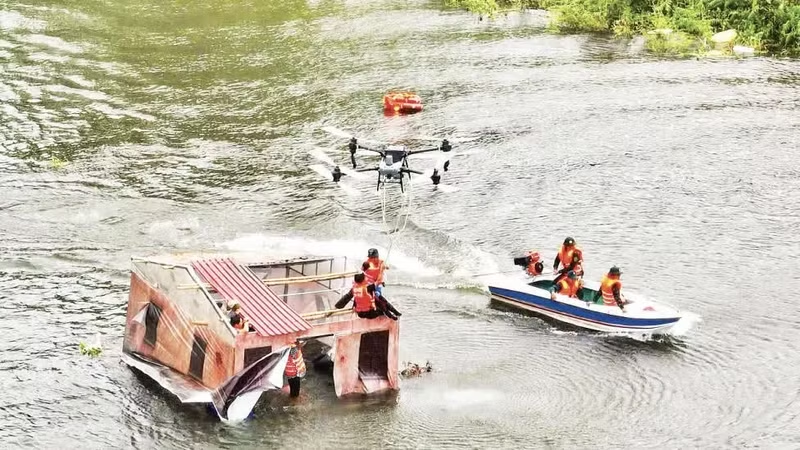
Since early July, various units and localities have been conducting drills to ensure readiness for natural disaster responses. On the Huong, An Cuu, and Bo rivers, waterway police and military forces have trained local commune and ward-level teams in operating watercraft; exercises also covered scenarios such as water rescues and assisting residents in traversing low-lying areas or fast-flowing waters.
In areas at risk of flash floods and landslides, armed forces have collaborated with local authorities and on-site teams to develop and practice response scenarios. Specialised vehicles, drones, militia forces, and civilian volunteers have been mobilised for joint training exercises.
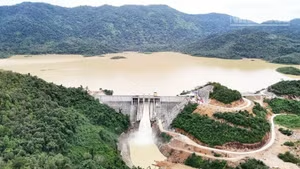
Le Tri Thanh, Chairman of the Hue City People’s Committee, stated that Hue is not merely drafting plans on paper but is also conducting field assessments. The city has continued to review inter-reservoir operation plans in coordination with relevant localities while organising evacuation and rescue drills for scenarios that could impact downstream areas.
Lessons learned from the heavy rains and flooding in late October 2025 serve as a basis for localities to further refine their response plans. During that event, water levels on the Bo River at Phu Oc reached 5.25 meters and on the Huong River at Kim Long reached 5.05 meters, 32 communes and wards were flooded, numerous roads were cut off, and there were prolonged power outages and communication disruptions.
These realities demonstrate that technology cannot yet replace on-site response strategies. The science and technology sector is currently working on real-time flood simulation trials, flood mapping, smart warning systems, and the gradual development of a “Digital Twin” for Hue City to support forecasting and the selection of evacuation plans and safe routes.
Provisions for maintaining communication have also been factored in to address potential power outages or telecommunications network failures. Telecommunications companies are preparing contingency plans for network roaming and backup SIM cards; radio communication systems, satellite phones, and specialised equipment remain operational, alongside public loudspeaker systems, warning sirens, and on-site response teams.
Le Tri Thanh noted that natural disaster patterns vary from year to year, so past outcomes cannot guarantee the situation for the current year. Each family should prepare necessary medications, communication devices, lighting sources, and power banks; households with the elderly, young children, the sick, or individuals with limited mobility need to establish support plans in advance. Upon receiving a warning, residents should elevate their belongings and relocate people and vehicles to safety before water levels rise rapidly.
When households are capable of sustaining themselves during the initial days of a disaster, it helps alleviate the burden on rescue forces. Relief efforts remain essential for isolated areas and households lacking necessities or the ability to sustain themselves.
However, spontaneous relief groups arriving immediately after a disaster strikes can pose risks and create coordination challenges on the ground. If every household proactively stocks enough food, water, and essential supplies for 3–7 days, social resources can be better focused on cases of severe deprivation or prolonged isolation.