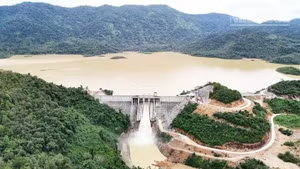
According to the Department of Dike Management and Disaster Prevention and Control (Ministry of Agriculture and Environment), in the period 2020-2025, natural disasters will occur nationwide with increasingly serious damage.
On average, each year, natural disasters cause more than 300 deaths and disappearances, resulting in economic losses of over 45 trillion VND, an increase of approximately 167% compared to the period 2015-2019.
In particular, 2024 is expected to see 519 deaths and disappearances due to natural disasters, the highest number since 2007; in 2025, estimated economic losses are expected to reach over 104.7 trillion VND, the highest level ever.
In response to the immense loss of life and property caused by natural disasters, the Law on Disaster Prevention and Control of 2013, effective from May 1, 2014, and amended and supplemented in 2020 and 2025, along with its implementing guidelines, has created a crucial legal foundation for disaster prevention and control.
After nearly 12 years of implementation, this legal system has contributed to shifting the mindset from passive response to proactive prevention, improving the effectiveness of state management and mobilising social resources in disaster risk reduction.
However, practical experience in disaster prevention and control also reveals many difficulties, obstacles, and emerging issues that require further research and adjustment.
According to Pham Duc Luan, Director of the Department of Dike Management and Disaster Prevention, the coordination mechanism between agencies is currently not truly synchronised, especially in compiling damage data and advising on support policies.
Without clearly defining the lead agency responsible for compiling information, it is easy for inconsistent data to occur, affecting guidance, management, and the process of assisting people in overcoming the consequences of natural disasters.
Furthermore, ensuring disaster prevention requirements in planning needs to shift from an “integration” mindset to a “guarantee” approach, incorporating disaster prevention elements into the planning, appraisal, and approval process. It is necessary to prevent situations where some infrastructure projects, urban areas, or development projects inadvertently increase the risk of flooding and natural disasters due to insufficient assessment of impact factors.
In disaster prevention efforts over the past years, four key issues have emerged that require urgent attention.
Firstly, state management and inter-sectoral coordination still have shortcomings; there is no specific mechanism or policy for the forces directly involved in this work.
Secondly, the determination of authority for compiling damage assessments and relief and support needs after natural disasters is still inconsistent.
Thirdly, regulations related to the authority and responsibility for soliciting and receiving emergency international aid in emergency natural disaster situations are not yet fully synchronised.
Fourthly, the requirement to ensure disaster prevention and control in sectoral development plans, socio-economic development, and flood drainage management needs to be further improved to suit current development realities.
In addition, many other difficulties are also arising, such as the limited resilience of disaster prevention and control structures and infrastructure; the means and equipment for rescue and relief operations do not meet the requirements, especially in remote areas.
Although significant progress has been made in forecasting and warning, early prediction of extreme weather events such as localised heavy rainfall, flash floods, landslides, thunderstorms, or historically high floods remains challenging.
To further improve disaster prevention and control, according to Deputy Minister of Agriculture and Environment Nguyen Hoang Hiep, the Law on Disaster Prevention and Control needs to be further refined in all three aspects: political basis, legal basis, and practical basis.
This law has a broad scope of application, closely related to many fields such as planning, construction, water resources, and socio-economic development; therefore, any amendments need to be carefully reviewed to avoid overlaps and ensure the consistency of the legal system.
Furthermore, disaster prevention and control efforts need to be closely integrated with socio-economic development planning, population stabilisation, and the construction of multi-functional public facilities capable of serving as safe shelters for the people.
Given the increasingly complicated and unpredictable nature of natural disasters in recent years, the urgent amendment and supplementation of the Law on Disaster Prevention and Control is crucial for enhancing the effectiveness of state management, mobilising social resources, strengthening resilience to natural disasters, and fulfilling all international commitments that Viet Nam has participated in.
The ultimate goal is to minimise damage, protect the lives and property of the people, and ensure the sustainable development of the country in the context of increasing climate change.


![[In Pictures] Bridge columns and underpasses in Ha Noi begin to turn green](https://en-cdn.nhandan.vn/images/nyM650OGFWrOVWc-xajqN-rTZ68Rlmc1fiGJOhBRYHH_N-Xs0TE8Psnfce7ORTs-KVfoJaEblqjNufFrgeF3e2xFkGtLQVaXm04VcmMKBEkANUyiOkpz4zAuIKgydVrrfBxmGez0E_YJIag0u_Uil0E7jpuJXsIxeMmGjoY1-W4/1791863309074-2994714492692222878-2994714492692222878-adb9ff3f4175c70066ed8bb80cfbead9.jpg.avif)