However, with sustainable development becoming increasingly important and environmental standards growing more stringent, many experts argue that the country needs to shift towards managing the entire life cycle of plastics, viewing this as a pathway to advancing the circular economy and enhancing national competitiveness.
Viet Nam generates around 3.1 million tonnes of plastic waste each year, nearly half of which is not properly managed. Meanwhile, single-use plastics and non-biodegradable plastic bags remain widely used in households, commerce and the service sector.
This situation shows that plastic pollution is no longer simply an environmental issue but has become a challenge to sustainable development, requiring a more comprehensive approach to resource management.
In response, the government has introduced a range of important policies, including the 2020 Law on Environmental Protection, the Extended Producer Responsibility (EPR) mechanism, the National Action Plan on Marine Plastic Waste Management to 2030, and the Circular Economy Development Project.
Together, these policies provide a foundation for promoting sustainable production and consumption while gradually reducing the use of single-use plastic products.
However, implementation continues to face numerous obstacles. Systems for waste sorting, collection, and recycling remain fragmented, treatment technologies are still limited, the recycled materials market is developing slowly, and replacing virgin plastics continues to be hindered by high costs and commercialisation challenges.
Dr Nguyen Thi Hong Lieu of the Waste Management Division under the Environmental Department of the Ministry of Agriculture and Environment noted that, for many years, plastic waste policies have focused mainly on collection, recycling, and post-consumption treatment.
Meanwhile, economic instruments to reduce the use of virgin plastics remain inadequate, and no mandatory roadmap has been established for the minimum recycled content of plastic products. Both infrastructure for waste sorting, collection, and recycling and data systems tracking plastic material flows have yet to meet practical needs.
According to Dr Nguyen Trung Thang, Deputy Director of the Institute of Strategy and Policy on Agriculture and Environment, effectively addressing plastic pollution requires a shift from a waste management mindset to one that manages the entire life cycle of plastics.
He noted that this cannot be achieved through a single policy instrument or technological solution alone but instead requires a comprehensive approach that combines stronger policies, advances in science and technology, and greater innovation.
“The shift from waste management to full life-cycle management of plastics is being adopted by many countries to reduce dependence on virgin plastics and promote the circular economy. Rather than focusing solely on collection and treatment after use, new policies seek to control every stage, from product design and material selection to manufacturing, consumption, and recycling,” Dr Thang emphasised.
In the European Union, the Packaging and Packaging Waste Regulation (PPWR) has introduced a roadmap to increase the proportion of bio-based materials used in packaging from 2027-2028 onwards, creating incentives for the development of alternative materials and reducing carbon emissions.
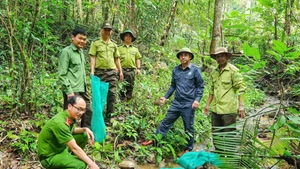
In Viet Nam, this approach is already being implemented in a number of localities. Alongside improvements to the Extended Producer Responsibility (EPR) mechanism, many provinces and cities have introduced roadmaps to reduce plastic waste and limit the use of single-use plastic products.
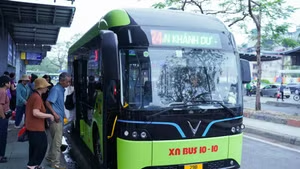
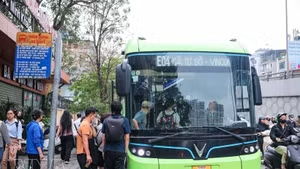
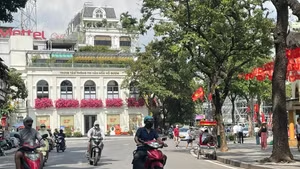
Ha Noi has emerged as one of the leading localities, adopting a resolution on measures to reduce plastic waste across the city alongside a plan to strengthen plastic waste management.
These initiatives aim to gradually phase out single-use plastics in public agencies and organisations while encouraging the use of environmentally friendly materials.
To ensure an effective transition, Dr Thang argues that three pillars must be advanced simultaneously: policy, science and technology, and innovation.
Policy should provide incentives for sustainable production and consumption; science and technology should drive the development of alternative materials and improve recycling efficiency; and innovation should foster new business models and circular supply chains.
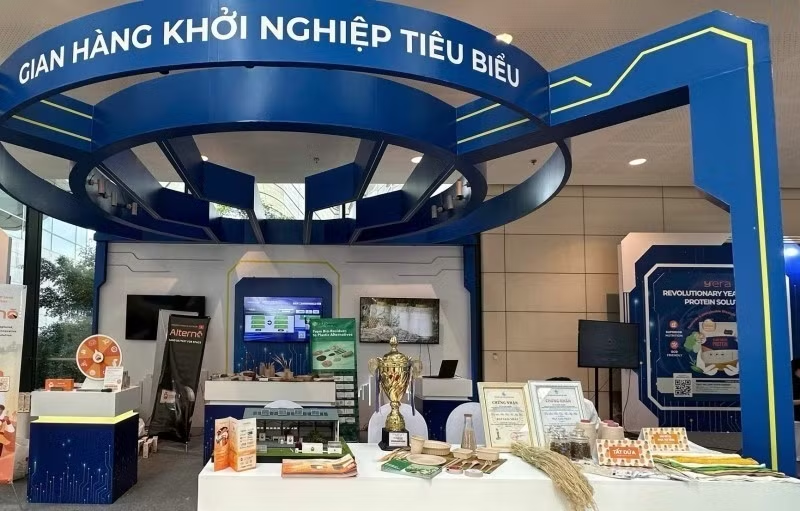
Alongside policy, technology is regarded as the decisive factor in turning the transition into reality. Do Hong Hanh, Director of BUYO Technology Solutions Company (BUYO Bioplastics), said that agricultural and industrial by-products such as spent grain and sugarcane bagasse can be used as raw materials for producing bioplastics.
This approach not only reduces dependence on petroleum-based plastics but also makes productive use of by-products and creates added value throughout the circular economy.
Nevertheless, significant barriers remain. Companies developing bio-based materials and recycling technologies continue to face difficulties relating to technical standards, green product certification, and access to finance.
From the business perspective, Nguyen Tien Huy, Director of the Office for Business Sustainability under the Viet Nam Chamber of Commerce and Industry, said that with the global economy shifting rapidly towards low-carbon development, businesses that rely heavily on virgin plastics will face increasing market risks and stricter ESG requirements.
He therefore called not only for further policy improvements but also for the creation of an ecosystem that supports innovation through regulatory sandboxes, improved technical standards, and measures to accelerate the commercialisation of bio-based material technologies.
Experts from the Ministry of Agriculture and Environment have also recommended introducing a mandatory roadmap for the use of recycled plastics in selected product categories, completing the system of standards and technical regulations and providing tax incentives and green credit mechanisms to encourage businesses to invest in recycled and alternative materials.
Plastic pollution is not only an environmental challenge but also a test of Viet Nam’s development model. When policy creates incentives, technology provides solutions and businesses create markets, the transition to a circular economy will help reduce environmental pressures while strengthening Viet Nam’s competitiveness as global green standards become increasingly demanding.

![[In Pictures] Bridge columns and underpasses in Ha Noi begin to turn green](https://en-cdn.nhandan.vn/images/nyM650OGFWrOVWc-xajqN-rTZ68Rlmc1fiGJOhBRYHH_N-Xs0TE8Psnfce7ORTs-KVfoJaEblqjNufFrgeF3e2xFkGtLQVaXm04VcmMKBEkANUyiOkpz4zAuIKgydVrrfBxmGez0E_YJIag0u_Uil0E7jpuJXsIxeMmGjoY1-W4/1791863309074-2994714492692222878-2994714492692222878-adb9ff3f4175c70066ed8bb80cfbead9.jpg.avif)