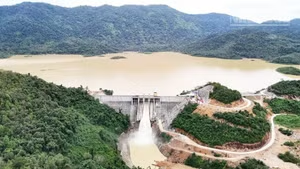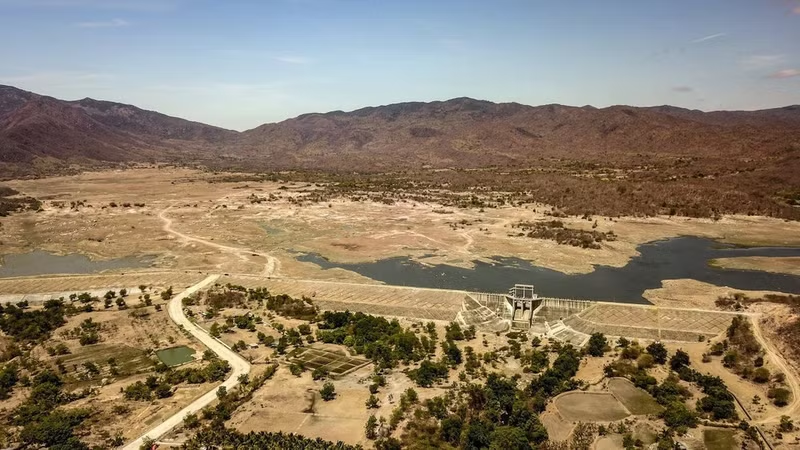
Significant impact on agricultural production
Speaking at the Ministry of Agriculture and Environment’s regular press briefing in June, Nguyen Manh Hung, Head of the Infrastructure Operations and Irrigation Management Division under the Department of Irrigation Works Management and Construction, said that water storage levels in reservoirs, together with upstream flows into the Mekong Delta during this year’s rainy season, would largely determine the impact of El Niño on agricultural production during the coming winter-spring crop.
More detailed forecasts are expected to be available in September. By October and November, the likely impacts on individual regions and production areas should be identified with reasonable accuracy, enabling local authorities to implement appropriate response measures in a timely manner.
Le Nang Hung, from the Ho Chi Minh City Association for Nature and Environment Protection, noted that climate change is accelerating, with the global average temperature already having risen by 1.5-1.7°C above pre-industrial levels – a level of warming that has raised serious concerns among scientists worldwide about exceeding critical thresholds.
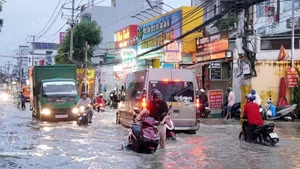
Against this increasingly bleak climate backdrop, agriculture remains the sector most severely affected. Extreme weather events, including drought, saltwater intrusion, sea-level rise, abnormal rains and storms, are becoming both more frequent and more severe.
“The consequences include degraded and cracked farmland, with a sharp decline in agricultural productivity. At the same time, climate change is fuelling outbreaks of pests and harmful pathogens affecting both crops and livestock,” Hung said.
In reality, climate change is no longer merely an environmental risk but has become a defining factor in business competitiveness, particularly in the Mekong Delta.
The 2025 Mekong Delta Annual Economic Report warns that between 29% and 54% of the delta could lie below sea level by the end of this century, depending on future scenarios. Such risks not only threaten agricultural livelihoods but also drive up the costs of infrastructure, logistics, storage, insurance, credit and compliance with quality standards.
Towards sustainable agriculture
Drawing on experience from previous El Niño episodes affecting the North Central region in 2019-2020, as well as the South Central Coast, the Central Highlands and the saltwater intrusion experienced in the Mekong Delta during 2015-2016, the irrigation sector has developed baseline response scenarios for different production regions to address varying levels of drought, water shortages and salinity intrusion.
In the Mekong Delta, these scenarios are based on medium water availability (2025-2026), low water availability (2015-2016) or extremely low water availability (2019-2020). By monitoring actual water conditions across river basins, specialists can quickly assess risk levels in individual areas and issue appropriate warnings and response measures.
Similarly, in the Central region and the Central Highlands, assessments are based on end-of-rainy-season reservoir storage, rainfall forecasts, heatwave projections and evaporation rates to determine drought risks for each locality.
“With forecasts pointing to the emergence of a ‘super El Niño’ later this year, the immediate priority is to finalise response scenarios and prepare for conditions that may persist into 2027,” Hung said.
In the longer term, Hung recommended that the agricultural sector accelerate the application of science, technology and biotechnology to improve climate resilience and promote sustainable development.
In practice, many producers and farming households in the Mekong Delta have adopted integrated rice-shrimp farming, alternating between shrimp cultivation during the dry season, when saline water is available, and rice cultivation once freshwater returns. This approach not only helps businesses and farmers avoid losses caused by drought and salinity but also delivers strong economic returns.
On the Ca Mau Peninsula, the rice-shrimp model has created favourable soil conditions for healthy rice cultivation, producing ST24 and ST25 rice varieties, the latter of which has twice won the top prize at the World’s Best Rice competition. The model also exemplifies the principle of living with nature, as articulated in a government resolution on the sustainable and climate-resilient development of the Mekong Delta.
Likewise, many cooperatives in An Giang Province have simultaneously adopted measures such as reducing seeding rates, applying alternate wetting and drying irrigation, implementing integrated pest management and using fertilisers more efficiently.
As a result, greenhouse gas emissions have fallen significantly and input costs have been reduced by 10-20%, while rice yields and grain quality have been maintained or even improved.
According to Associate Professor Dr Dao The Anh, Chairman of the Viet Nam Rural Development Science Association, Vietnamese agriculture is now required to achieve three objectives simultaneously: ensuring food security, increasing farmers’ incomes and reducing environmental impacts. This requires a fundamental shift from conventional agriculture towards ecological, circular and high-tech farming.
“Viet Nam has many advantages to support this transition. The policy framework is becoming increasingly comprehensive, science and technology are advancing rapidly, demand for green products is rising, and international commitments on emissions reduction are creating strong momentum for change. However, scaling up these efforts will require continued investment in research, technology transfer, human resource development and support for pioneering cooperatives and businesses,” Anh said at a conference on climate-resilient agriculture in June.
For the business community, the 2025 Mekong Delta Annual Economic Report recommends that enterprises in the Mekong Delta treat climate adaptation, green transformation and environmental data management as core competitive strengths.
Accordingly, food processing companies should monitor electricity and fuel consumption, cold storage systems, wastewater, by-products and greenhouse gas emissions. Agricultural enterprises, meanwhile, need to measure fertiliser use, water consumption, soil conditions, methane emissions and product traceability.
At a higher level in the value chain, lead enterprises should organise raw material production areas, establish production standards, secure off-take contracts, manage quality data, and develop risk insurance and value chain financing mechanisms.
Cooperatives should shift from an administrative role to become economic partners that help expand production scale, standardise farming practices and strengthen quality control.
Industry associations, meanwhile, should provide market intelligence, standards, training, trade promotion, policy dialogue and business support services.

![[In Pictures] Bridge columns and underpasses in Ha Noi begin to turn green](https://en-cdn.nhandan.vn/images/nyM650OGFWrOVWc-xajqN-rTZ68Rlmc1fiGJOhBRYHH_N-Xs0TE8Psnfce7ORTs-KVfoJaEblqjNufFrgeF3e2xFkGtLQVaXm04VcmMKBEkANUyiOkpz4zAuIKgydVrrfBxmGez0E_YJIag0u_Uil0E7jpuJXsIxeMmGjoY1-W4/1791863309074-2994714492692222878-2994714492692222878-adb9ff3f4175c70066ed8bb80cfbead9.jpg.avif)