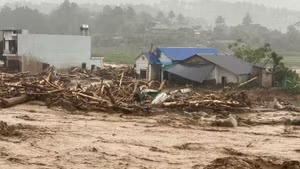
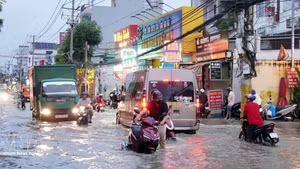
Climate change is identified as one of the biggest challenges to the environment and sustainable development, directly impacting both natural ecosystems and socio-economic systems. According to Associate Professor, Dr. Pham Thi Thanh Nga, Head of the Viet Nam Institute of Meteorology, Hydrology and Climate Change (Ministry of Agriculture and Environment), Viet Nam is one of the countries that is most severely affected by climate change, with multifaceted impacts on the economy, society, and environment.
Viet Nam is one of the countries that is most severely affected by climate change, with multifaceted impacts on the economy, society, and environment.
Associate Professor, Dr. Pham Thi Thanh Nga
Head of the Viet Nam Institute of Meteorology, Hydrology and Climate Change under the Ministry of Agriculture and Environment)
The Viet Nam 2045-Growing Greener report (World Bank, 2025) emphasises that climate change is threatening food security and degrading biodiversity, while also impacting public health; especially prolonged heatwaves increasing the risk of cardiovascular disease and infectious diseases such as dengue fever.
According to the United Nations, in 2024, Viet Nam lost about 0.15% of its GDP due to the impacts of climate change; while the Country Climate and Development Report (World Bank, 2022, updated 2025) shows that, without action, Viet Nam could lose up to 24% of its GDP by 2100 in a high-emission scenario.
Along with climate change, environmental pollution is also causing serious socio-economic losses. According to Associate Professor, Dr. Tran Trong Phuong (Faculty of Resources and Environment, Viet Nam National University of Agriculture), Viet Nam generates more than 25 million tons of solid household waste each year, but only about 15% is treated with hygienic technology; at the same time, it generates about 3 billion cubic metres of industrial wastewater and 1.3 million tons of hazardous waste, but the rate of treatment meeting standards remains low.
Furthermore, air pollution in major cities such as Ha Noi, Ho Chi Minh City, and Thai Nguyen frequently exceeds safe levels, with PM2.5 concentrations many times higher than World Health Organisation (WHO) recommendations. While Viet Nam's average per capita CO2 emissions are approximately 3.4 tons/year, lower than the world average level of 4.6 tons/person/year, with an economy and population exceeding 100 million people, emissions are projected to increase rapidly without strong policies to control and restructure the economy towards a green, circular, and sustainable direction.
For Viet Nam, green growth will promote a shift in the growth model from extensive to intensive, helping to enhance competitiveness, leapfrog ahead, catch up, and surpass others to realise the aspiration of prosperous and inclusive development.
Faced with the challenges of climate change and environmental pollution, Viet Nam needs decisive policies and strong, proactive actions to effectively adapt, reduce vulnerability, losses, and damage caused by climate change; and promote science and technology as a crucial driving force, reaching new heights in the coming period, becoming a decisive factor in adaptability and sustainable development. Specifically, green growth is becoming an inevitable trend and a goal for many countries worldwide to achieve economic prosperity, environmental sustainability, and social equity.
For Viet Nam, green growth will promote a shift in the growth model from extensive to intensive, helping to enhance competitiveness, leapfrog ahead, catch up, and surpass others to realise the aspiration of prosperous and inclusive development.
Associate Professor, Dr. Dang Hoai Bac (Posts and Telecommunications Institute of Technology) said that the Party and state have clearly defined the strategic orientation to make Viet Nam a developed, high-income country by 2045, while simultaneously fulfilling the important international commitment of achieving net zero emissions by 2050, as announced at COP26. The crucial legal foundation for this goal is the "National Strategy on Green Growth for the 2021-2030 period, with a vision to 2050," approved by Decision No. 1658/QD-TTg. This key orientation aims to harmonise economic development goals with environmental protection requirements, affirming Viet Nam's determination in the process of sustainable development and global integration.
According to some experts, to realise the goal of growth in association with green and sustainable development, Viet Nam needs to implement a system of comprehensive solutions, combining institutional perfection, technological innovation, human resource development, financial mobilisation, and enhanced international cooperation. This includes a shift in development planning thinking, with environmental criteria considered as a mandatory component of economic growth, while national development indicators should incorporate factors such as emissions, resource use, and environmental quality.
Notably, the state needs to promote green finance tools such as carbon taxes, carbon credits, and emission fees, along with incentive mechanisms for businesses investing in clean technologies, and establish a legal framework for the circular economy, creating a foundation for sustainable production and consumption. Furthermore, it is necessary to improve mechanisms and policies on carbon credit trading and offsetting, and complete the national green criteria set as a basis for identifying and classifying economic activities. In enacting mechanisms and policies, it is necessary to perfect regulations and guidelines on technical standards and norms to accelerate the implementation of the circular economy, and improve policies that integrate climate change response, promote green job creation, and develop institutions, policies, and tools for monitoring and evaluating the development of green, smart, and climate-resilient urban areas.
Along with the promulgation of mechanisms and policies, with the rapid development of science and technology today, the orientation of artificial intelligence (AI) development and digital transformation for sustainable management in Viet Nam will also have strategic significance and is an urgent requirement to fulfil international commitments on climate change. If solutions on data, infrastructure, human resources, institutions, and international cooperation are implemented in a synchronous manner, AI will become a strategic tool that not only enhances forecasting and warning capabilities but also makes a significant contribution to sustainable governance, ensuring environmental security, and developing the country in a green and sustainable direction.


![[In Pictures] Bridge columns and underpasses in Ha Noi begin to turn green](https://en-cdn.nhandan.vn/images/nyM650OGFWrOVWc-xajqN-rTZ68Rlmc1fiGJOhBRYHH_N-Xs0TE8Psnfce7ORTs-KVfoJaEblqjNufFrgeF3e2xFkGtLQVaXm04VcmMKBEkANUyiOkpz4zAuIKgydVrrfBxmGez0E_YJIag0u_Uil0E7jpuJXsIxeMmGjoY1-W4/1791863309074-2994714492692222878-2994714492692222878-adb9ff3f4175c70066ed8bb80cfbead9.jpg.avif)