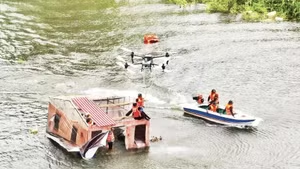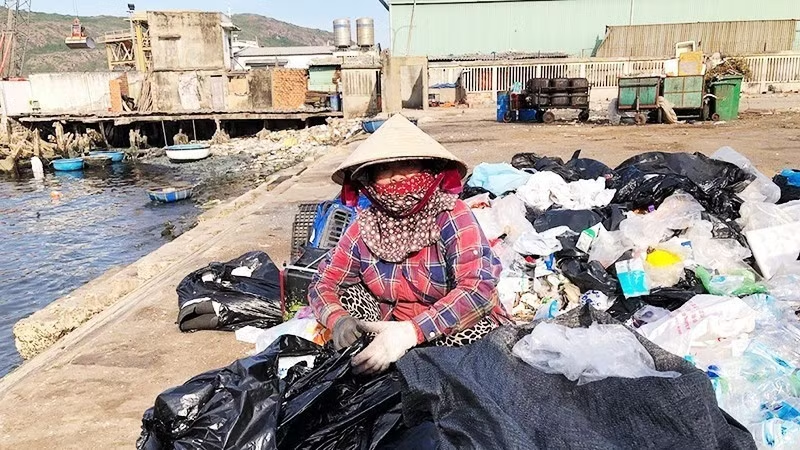
Among marine litter, discarded fishing gear waste is considered particularly hazardous due to its persistence and destructive impact. It refers to gear that is abandoned, lost, or otherwise discarded during fishing activities, including nets, lines, buoys, anchors, and related materials.
According to the Food and Agriculture Organization of the United Nations (FAO), pollution from discarded fishing gear has environmental, economic, and social consequences. Environmentally, lost gear threatens marine species and habitats. Economically, fishers face risks of gear loss due to entanglement, time spent resolving snags, recovery costs, and reduced income as fish stocks decline. Socially, declining catches affect employment, maritime traffic safety, and opportunities for recreation and tourism.
In Viet Nam, pressure from marine litter remains significant, while fisheries continue to provide livelihoods for much of the coastal workforce. The capture fisheries sector produces around 3.9 million tonnes annually and creates jobs for approximately 4 million people. However, Viet Nam is among the five countries generating the largest volumes of marine plastic waste, estimated at 0.28–0.73 million tonnes per year. The country is also facing challenges from resource depletion, climate change, and environmental pollution.
According to Quach Thi Khanh Ngoc of the Faculty of Economics at Nha Trang University, the impacts could be mitigated through appropriate onshore mechanisms for the retrieval and reception of discarded fishing gear. Surveys conducted in Quang Ninh, Khanh Hoa, and Kien Giang show that fishing gear debris is relatively common at sea: 43% of fishers reported encountering it occasionally, 28% rarely, and 12% frequently. The figures indicate that lost gear is present across many fishing grounds.
The volume of lost or discarded gear varies by fishing method, suggesting that solutions should be tailored to specific fisheries rather than applying a uniform approach.
Survey data show that the average quantity of gear lost or discarded per vessel each year is substantial. In Quang Ninh, this includes 136kg of netting and lines, 32kg of rope, and 2,229 buoys. In Khanh Hoa, the figures are 313kg of netting and lines and 2,455 buoys. In Kien Giang, vessels lose 382kg of netting and lines, 139kg of rope, and 892 buoys annually.
Notably, the losses are directly reflected in fishers’ operating costs. Survey findings show that annual expenses for repairing fishing gear average around 52 million VND, equivalent to 6.7% of revenue, while losses resulting from nets that are lost or entangled amount to approximately 29 million VND per year, or about 4% of revenue.
However, survey assessments in several localities reveal a noteworthy level of willingness among fishers to participate: around 57% are prepared to bring discarded fishing gear back to shore, and more than 90% of vessels have designated space onboard to store damaged gear. Yet, appropriate onshore reception facilities for such waste remain largely unavailable.
Currently, only 62% of fishing ports and landing sites are equipped with waste collection facilities. In the absence of designated reception points, bringing waste ashore can entail additional time, effort, and costs. Economic incentives are therefore a decisive factor in sustaining regular collection.
Survey results also indicate that 59% of fishers prefer buy-back schemes, while 41% favour exchange-for-new arrangements; tax exemptions are rarely chosen. This suggests that mechanisms must be direct, transparent, and readily implementable at port level.
To effectively address discarded fishing gear, priority should be given to investing in and upgrading ports and landing sites with proper collection facilities, while standardising reception points. Each port should designate a separate area for damaged gear, provide basic collection equipment, establish clear handover procedures, and assign a responsible authority for operations.
When reception infrastructure is designed to be accessible and convenient, discarded fishing gear can be returned to shore instead of continuing to remain at sea.
At the same time, mechanisms should be developed to establish buy-back or exchange-for-new schemes tailored to different material types. Clear pricing regulations based on material categories should be introduced, with designated exchange points set up at ports or partnerships formed with fishing gear suppliers to create a circular system.
Local authorities should organise collection, classification, and recycling along value chains linked to fishing communities, aiming to reduce production losses, protect the environment, and improve the economic efficiency of the fisheries sector.

![[In Pictures] Bridge columns and underpasses in Ha Noi begin to turn green](https://en-cdn.nhandan.vn/images/nyM650OGFWrOVWc-xajqN-rTZ68Rlmc1fiGJOhBRYHH_N-Xs0TE8Psnfce7ORTs-KVfoJaEblqjNufFrgeF3e2xFkGtLQVaXm04VcmMKBEkANUyiOkpz4zAuIKgydVrrfBxmGez0E_YJIag0u_Uil0E7jpuJXsIxeMmGjoY1-W4/1791863309074-2994714492692222878-2994714492692222878-adb9ff3f4175c70066ed8bb80cfbead9.jpg.avif)