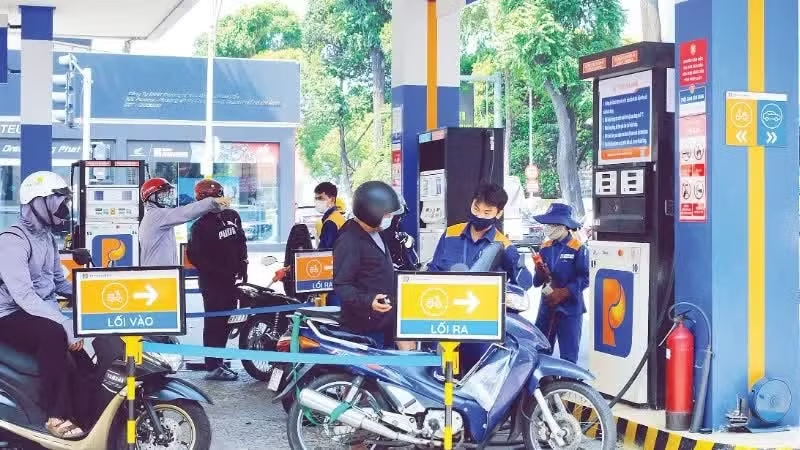
Petrol companies have prepared supplies, upgraded technical infrastructure, and accelerated public communication campaigns to ensure readiness for the transition.
By May 27, many petrol stations in Ha Noi had switched to selling E10 petrol. At a Petrolimex station on Thuy Khue Street, all pumps were selling E10 exclusively.
Station manager Tran Ngoc Anh said customer numbers remained stable. Lai Van Tam, a resident of Tay Ho Ward, said: “I heard that E10 petrol is environmentally friendly, so I wanted to try it. The price is also lower than some older petrol grades, which helps cut costs.”
According to the Ha Noi Department of Industry and Trade, more than 400 petrol retail outlets across the city have upgraded their storage tanks, fuel pumps, and technical procedures to meet E10 trading standards.
Kieu Dinh Canh, Deputy Head of the Ha Noi Market Surveillance Department, said that from June 1, market surveillance authorities would step up the inspection and monitoring of origin and quality of petrol supplies.
Petrol companies in Lang Son Province have also completed system conversions for E10 distribution. Petrolimex Lang Son began selling E10 petrol in late April. Nong Van Hon, Head of the company’s business department, said: “By May 8, all Petrolimex stations in Lang Son had switched to selling E10 petrol.”
Petrolimex Lang Son currently operates 40 petrol stations, supplying around 45% of the province’s fuel demand. Other fuel retailers in the province have likewise completed system conversions for E10 distribution.
Hoang Minh Tam, a resident of Ky Lua Ward, said that after using E10 petrol for some time, he found his vehicle ran smoothly; he considers the switch to environmentally friendly fuel to be a sensible move.
In the southern region, the Nha Be Petroleum Depot under Petrolimex Sai Gon was granted a certificate of registration as an E10 blending facility on May 12, 2026.
Pham Anh Tuan, Director of Petrolimex Sai Gon, said: “The company’s current blending capacity stands at around 10 million litres per day, sufficient to meet demand in the south-eastern region. In early 2027, we plan to expand capacity further to keep pace with growing demand.”
Since August 2025, Petrolimex Sai Gon has piloted E10 petrol sales at 41 stations and received no quality complaints. By May 25, the company had completed the rollout of E10 petrol across all 138 stations in its network.
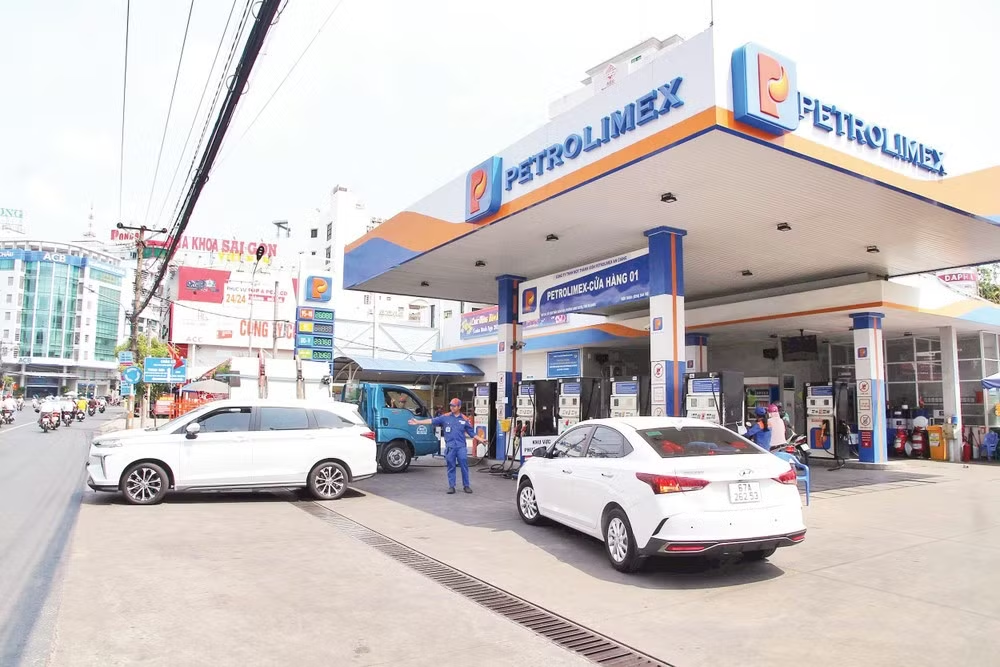
The Petrolimex network in An Giang Province has also largely completed preparations to switch to E10 trading from June 1. Dang Hong Toan, Chairman of the Kien Giang Petroleum Company, said fuel supplies had been reliably secured from major depots, while storage tank systems had been cleaned and upgraded to ensure compatibility with E10 petrol.
One of the biggest concerns among consumers is whether E10 petrol could affect engines and vehicle lifespan. The Ministry of Industry and Trade assessed the impact of E5 and E10 biofuels on engine performance and durability. Results from the Ha Noi University of Science and Technology and the University of Transport and Communications showed that E5 and E10 petrol have no significant negative impact on engine performance or component durability.
On May 26, the Ministry of Industry and Trade published assessments from the Viet Nam Association of Motorcycle Manufacturers (VAMM) and the Viet Nam Automobile Manufacturers Association (VAMA) on vehicle compatibility with E10 biofuel.
According to VAMM’s preliminary assessment, all motorcycle models currently in production are compatible with E10 petrol. Models produced by Honda, Yamaha, Piaggio, and SYM require no modifications to run on E10. For Suzuki, most models are compatible, with the exception of several older models whose compatibility has yet to be confirmed.
Dao Cong Quyet, a VAMA representative, said all car models currently in production are compatible with E10 petrol. However, some models manufactured before 2006 may not be compatible and could experience performance issues when using the fuel.
Older vehicles using carburettors or components made from natural rubber and non-alcohol-resistant plastics may be at risk. Due to ethanol’s strong cleansing and hygroscopic properties, these parts could deteriorate over time. VAMA recommends that owners of older vehicles inspect and replace components such as seals and fuel pipes at authorised dealerships before switching to E10 petrol.
Amid climate change, mounting pressure to reduce emissions, and the growing risk of fossil fuel depletion, the shift from mineral petrol to E10 biofuel represents an important step in Viet Nam’s energy transition.
Beyond reducing environmental pollution, E10 petrol helps to diversify energy supplies, reduce dependence on imported fuel, and support the domestic ethanol sector.