Among more than 22,000 agricultural cooperatives currently in operation, nearly 3,000 have established affiliated enterprises to provide input and output services for their members.
From agricultural production to an agricultural economy
Tuyen Quang is one of the largest orange-growing regions in northern mountainous Viet Nam. However, the province's orange brand has yet to establish a strong and sustainable market position as production still relies heavily on chemical fertilisers and plant protection products.
In response to increasingly stringent market requirements, Nguyen Thi Cam Ly, Director of the Son Nu Sanh Orange Cooperative in Na Hang Commune, took the lead in working with farmers to develop organic orange-growing areas. She lived alongside farmers, provided technical guidance, built trust, and gradually established production groups with mutual supervision mechanisms.
As the cooperative secured stable markets for its products, the farmers gradually changed their mindset and actively adopted the common production process. So far, Son Nu-branded sanh oranges have gained a steady foothold in the market. In addition to organic cultivation, the cooperative has adopted digital technologies for product promotion, traceability, and market expansion.
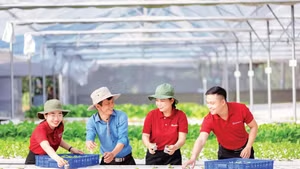
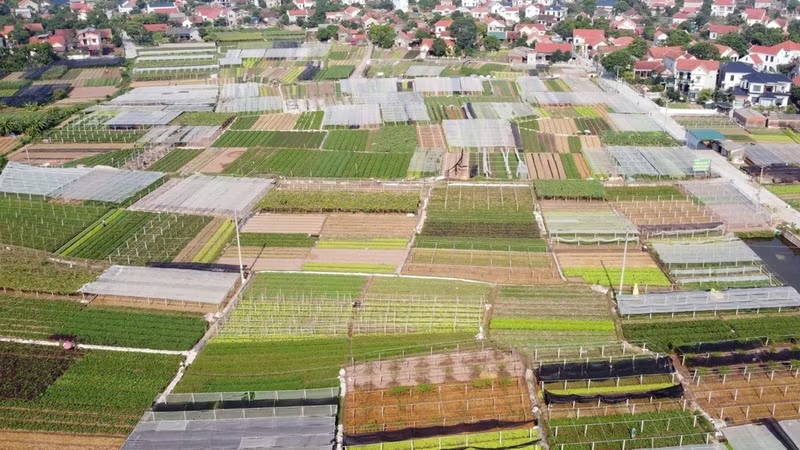
A similar shift from traditional agricultural production to an agricultural economy has been pursued by the Tu Xa Safe Vegetable Cooperative, established in Phung Nguyen Commune, Phu Tho Province, in 2015. The cooperative currently has more than 100 members and affiliated farming households cultivating over 20 hectares of VietGAP-certified vegetables.
By joining the cooperative, farmers receive technical training, use biological products, maintain production records, and comply with food safety procedures. Their produce is sold under contracts with schools, businesses, supermarkets, and retail outlets, fetching prices 1,500–2,000 VND per kilogramme higher than the market average.
According to Nguyen Van Nghia, the director of the cooperative, production linkages have transformed farming practices, improved farmers' awareness of the safe use of agricultural inputs, and ensured stable sales for around 80–90% of total output at consistent prices, thereby encouraging farmers to remain committed to safe vegetable production.
Smart farmers and sustainable agriculture
The business performance of these cooperatives demonstrates that production linkages are driving the formation of large-scale specialised farming areas capable of delivering consistent output and product quality. In practice, the market is the ultimate measure of every production model's effectiveness.
To make agricultural products more competitive, cooperatives must not only organise production but also act as the "conductor" by understanding market demand, developing production plans, ensuring quality standards, and connecting producers with markets.
At the same time, they need to apply science and technology and digital transformation throughout production, harvesting, processing, and product promotion, enabling farmers to move beyond experience-based farming to become technology users with a sustainable agricultural mindset.
According to Bui Duy Linh, Deputy Director of the Phu Tho Department of Agriculture and Environment, strengthening production and marketing linkages is a key solution for raising farmers' incomes, achieving sustainable poverty reduction, and advancing new-style rural development.
Following the implementation of the two-tier local government model, the department has focused on helping cooperatives and farmers apply science and technology and digital transformation across the entire value chain, from managing cultivation areas and quality control to trade promotion.
At the same time, specialised agencies provide direct technical guidance to help farmers access e-commerce platforms and expand their markets. This is considered an essential step towards strengthening production linkages, not only in Phu Tho Province but also across the agricultural sector nationwide.
According to Dr Dao The Anh, an agricultural policy expert, as agriculture shifts towards ecological and sustainable development, cooperatives are an indispensable link in bringing agricultural products to market.
They organise production in line with standards, reduce the use of chemicals, develop organic products, promote eco-labelling, and cooperate with processing enterprises.
Since businesses cannot efficiently purchase produce from individual farming households, cooperatives serve as focal points for consolidating raw material areas, reducing costs, and improving the efficiency of value chains.
Le Duc Thinh, Director General of the Department of Cooperative Economy and Rural Development, said cooperatives will serve as the core organisations in developing standardised raw material areas and linking farmers with businesses to produce in accordance with international standards.
From the State's perspective, the focus is no longer on broad-based support but on creating a favourable development ecosystem through investment in essential public services such as issuing planting area codes, quality certification, product traceability, developing databases for raw material areas, and supporting science and technology transfer. This approach helps reduce compliance costs, enhance competitiveness, and enable Vietnamese agricultural products to participate more deeply in global value chains.
Building production value chains that are strong enough to meet orders and respond to consumer demand is proving to be the right direction for sustainable agricultural development. This approach not only reduces risks but also expands production scale and improves the effectiveness of the cooperative economy in the new development period.