Pressure from capital structure
To participate more deeply in global supply chains, Vietnamese businesses need access to markets and financial resources to invest in technology, secure their own raw material supplies, upgrade production, and meet new standards. In the agricultural sector, businesses need capital not only for working capital but also to invest in project development, green transformation, digital transformation, and technological innovation.
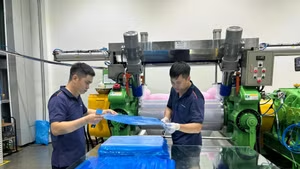
Nguyen Thi Dung, Director of Viet Thang Production, Trading and Services Company Limited, said that medium- and long-term loans from the Viet Nam Bank for Agriculture and Rural Development (Agribank) have strengthened the company's financial capacity, enabling it to invest in modern production lines that reduced fuel consumption and production costs while improving product quality. As a result, the factory's annual production capacity has doubled from 3 million to 6 million pairs of products, helping the company expand its domestic and export markets.
Manufacturers, exporters, supporting-industry businesses and those investing in digital and green transformation have different business cycles and capital requirements. Therefore, suitable medium- and long-term credit products are needed to enable businesses to invest in machinery, technology, innovation, digital transformation, and green transformation.
Do Van Ve, Chairman of the Hung Yen Provincial Business Association
Drawing on the experience of the local business community, Do Van Ve, Chairman of the Hung Yen Provincial Business Association, said that capital was essential for businesses. More importantly, however, they needed access to funding with appropriate maturities, at the right time and at reasonable costs, so that business opportunities could be translated into production capacity and genuine growth.
“Manufacturers, exporters, supporting-industry businesses, and those investing in digital and green transformation have different business cycles and capital requirements. Therefore, suitable medium- and long-term credit products are needed to enable businesses to invest in machinery, technology, innovation, digital transformation, and green transformation,” Ve stressed.
This is particularly evident in the rice industry. According to Pham Thai Binh, Chairman of the Board of Directors of Trung An Hi-Tech Agriculture Joint Stock Company, long-term loans to build and install rice dryers, silos, milling machines, and other equipment are indispensable for businesses throughout the rice value chain. Without such investment, they cannot operate, produce, or conduct rice export business.

Nguyen Ngoc Hoa, Chairman of the Ho Chi Minh City Business Association, said that capital constraints, particularly those involving medium- and long-term funding, were a common challenge facing the business community. Relying solely on bank credit mainly met working capital needs, while securing long-term investment capital for projects spanning five, 10, 15 or even 20-30 years remained a major challenge.
To achieve an average growth rate of around 10% by 2030, total social investment during the 2026-2030 period is projected to reach approximately 38.5 quadrillion VND. Of this, the domestic and foreign private sectors will need to contribute around 25.5 quadrillion VND.
Dr. Can Van Luc, BIDV Chief Economist
Looking at the economy as a whole, Dr. Can Van Luc, Chief Economist of the Joint Stock Bank for Investment and Development of Viet Nam (BIDV), said that achieving an average growth rate of around 10% by 2030 would require total social investment of approximately 38.5 quadrillion VND during the 2026-2030 period. Of this figure, the domestic and foreign private sectors would need to contribute around 25.5 quadrillion VND.
This scale of investment highlights the need to mobilise resources from multiple channels and improve capital allocation efficiency. However, the capital supply structure remains heavily skewed towards banks.
Businesses' dependence on banks stems partly from the structure of the financial system. Banks have simultaneously met a wide range of financing needs, from working capital to expansion and project implementation. Meanwhile, the stock and bond markets, along with the institutional investor base, have not developed commensurately, leaving businesses with limited options for long-term financing.
As alternative channels remain insufficiently developed, the demand for long-term funding continues to fall on banks. According to a report by S&I Ratings, medium- and long-term outstanding loans grew by 11.1% in the first half of 2026, compared with 6.9% for short-term credit. This marked the fifth consecutive quarter in which medium- and long-term credit grew faster than short-term credit. Of particular concern is that this shift in lending is taking place against a backdrop in which banks' funding sources remain predominantly short-term.
According to figures released by SSI Asset Management Company Limited (SSIAM), around 80% of bank term deposits have maturities of less than 12 months, while infrastructure projects require financing with a horizon of at least 10 years. “Long-term assets need long-term investors, not short-term lenders,” stressed Nguyen Ngoc Anh, Chief Executive Officer of SSIAM.
This mismatch puts banks under pressure to maintain liquidity while funds have already been disbursed to projects that take a long time to generate returns. Nguyen Xuan Bac, Deputy Director of the Credit Department for Economic Sectors at the State Bank of Viet Nam, acknowledged that bank credit played an important role but could not be the sole source of funding for long-term investment and infrastructure projects.
Resources need to be mobilised in a coordinated manner from the state budget, banks, official development assistance (ODA), loans from international institutions, and foreign investors. This is also a requirement for business growth: expanding operations must go hand in hand with diversifying funding sources.
Expanding the foundations of long-term capital
According to experts, reducing dependence on credit first requires the stock market to fulfil its core function of raising equity capital. This provides a foundation for long-term business investment, shares business risks with investors and eases pressure from scheduled debt repayments. Market development should therefore also be assessed in terms of its ability to channel new resources into businesses through share issuance. Dr. Jens Lottner, Chief Executive Officer of the Viet Nam Technological and Commercial Joint Stock Bank (Techcombank), said that long-term investment and infrastructure projects need more equity capital, alongside initial public offerings (IPOs) that genuinely raise equity.
In the bond market, businesses have the advantage of being able to structure maturities and repayment arrangements to better match their investment needs. However, the key challenge is to ensure consistency between fundraising maturities, investment schedules, and repayment capacity. Bond issuance still creates debt obligations, and its benefits are sustainable only when businesses use the proceeds for their intended purposes and generate actual cash flow to meet their obligations.
Drawing on business experience, a representative of Sun Group said that banks currently considered loans with maturities of more than seven years to be risky, while the nature of major projects such as Ba Na Hills and Fansipan required investment periods of 12-16 years. To address this challenge during the 2026-2030 period, Sun Group is looking towards the bond market. The company's representative also proposed mechanisms to “reinvigorate” the long-term bond market and ensure liquidity, giving investors the confidence to hold these bonds.
Viet Nam needs to develop its stock market, corporate bond market, investment funds, pension funds, insurance sector, and long-term investment institutions in a coordinated manner. At the same time, standards for corporate governance, information disclosure, auditing, and investor protection must be raised. Long-term capital will gravitate towards businesses with sound financial foundations, transparent governance, efficient capital utilisation, and sufficient growth capacity in a world where money is becoming increasingly expensive and investors more selective.
Mac Quoc Anh, Vice Chairman and Secretary-General of the Ha Noi Association of Small and Medium Enterprises (HANOISME)
Addressing the challenge of securing medium- and long-term capital, Mac Quoc Anh, Vice Chairman and Secretary-General of the Ha Noi Association of Small and Medium Enterprises (HANOISME), said that commercial banks could not be expected to shoulder the entire burden. Viet Nam needs to develop its stock market, corporate bond market, investment funds, pension funds, insurance sector, and long-term investment institutions in a coordinated manner.
At the same time, standards for corporate governance, information disclosure, auditing, and investor protection must be raised. Long-term capital will gravitate towards businesses with sound financial foundations, transparent governance, efficient capital utilisation, and sufficient growth capacity in a world where money is becoming increasingly expensive and investors more selective.
Businesses seeking to grow therefore need capital with sufficiently long maturities to pursue their strategies, while improving their governance standards to make effective use of these resources. When the stock and bond markets, investment funds, and long-term savings institutions develop in tandem, savings held within the banking system will have more channels through which to flow into production. This will provide a foundation for expanding business capacity, easing pressure on banks, and improving the quality of growth.