This will help enhance competitiveness and accelerate the shift from fragmented production to large-scale commodity production.
Today, cooperatives are no longer merely a collective economic model, but are becoming a bridge that guides farmers into the era of green production and sustainable agricultural exports.
Linking farmers with enterprises
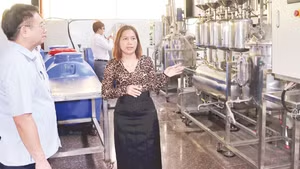
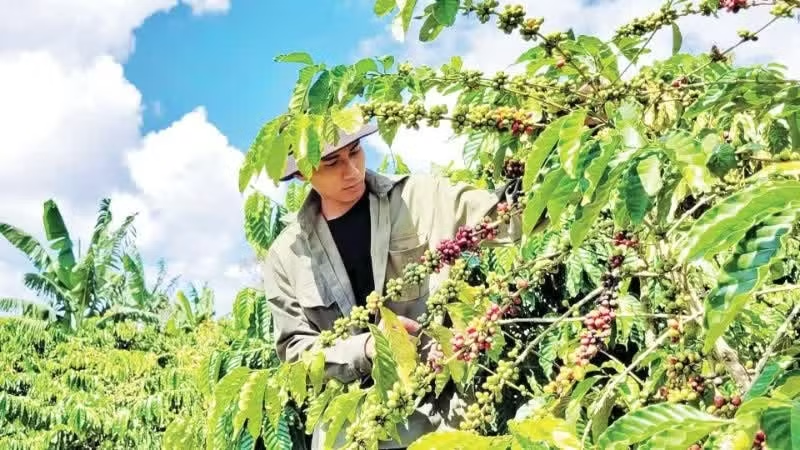
Since 2017, members of Truong Gia Phat Cooperative in Xuan Truong Ward, the former Da Lat City, have strengthened cooperation with many enterprises in Lam Dong Province to develop more than 60ha of organic coffee under VietGAP and UTZ standards. Through this linkage model, cooperative members have received guidance on circular farming practices, reducing chemical use and ensuring traceability. In return, enterprises have invested in modern machinery systems for harvesting and processing, helping control product quality from the input stage.
Truong Thi Minh Phuong, Deputy Director of Thai Chau Pure Coffee Co., Ltd., one of Truong Gia Phat Cooperative’s key partners, said the formation of a linkage chain has helped enterprises significantly reduce purchasing costs and time, while securing a stable source of raw materials through the cooperative’s connecting role. The parties share both benefits and risks for sustainable development.
Through linkage contracts, the cooperative’s coffee products are consumed steadily, helping increase the value of agricultural products and improve local people’s incomes. According to Bui Thi Kim Lien, Deputy Director of Truong Gia Phat Cooperative, farmers previously produced on a small scale, with each household following its own practices, resulting in unstable productivity and dependence on traders for outlets. The establishment of a value chain, with the cooperative acting as a connector, has brought clear changes in productivity, quality and value of products.
In the trend of globalisation, Vietnamese agricultural products are no longer competing only in terms of output, but are shifting strongly towards competition based on quality, green standards and sustainable value. Participating in the project on the sustainable development of 1 million ha of high-quality, low-emission rice cultivation linked with green growth in the Mekong Delta, Thien Phu Hoa Cooperative in Tan Hoi Commune, An Giang Province, is considered one of the units implementing the model effectively, initially bringing positive results for local people.
Nguyen Van Quynh, Director of Thien Phu Hoa Cooperative, shared: “After three crops, farmers have assessed that the model has helped them select better varieties, with stronger plants, fewer pests and diseases, less lodging and higher selling prices. As a result, costs have fallen and profits have increased, while a rice value chain has been formed and farmers have had opportunities to receive training and share production experience.”
The family of Nguyen Thanh Hong in Tan Hoi Commune, An Giang Province, is cultivating more than 1ha of rice under organic standards. From seed soaking and incubation to harvesting, he has received guidance from the cooperative and agricultural extension officers on production processes different from traditional practices. According to Hong, although the initial cost of organic fertiliser is higher, the amount of chemical fertiliser has fallen by about 30%. Rice plants are healthier, suffer fewer pests and diseases, require less spraying, and deliver higher productivity and profits.
Strengthening the resilience of linkage chains
Under the policy of promoting the development of the private economic ecosystem, cooperatives are expected to serve as a bridge between farmers and enterprises. However, while some cooperatives have effectively promoted their role in connecting and supporting farmers to participate in value chains, many others remain limited to supplying input services and have not truly become the “focal point” of linkage chains. Many cooperatives also remain weak in governance capacity and lack professionalism, making value chains unsustainable.
To support cooperatives and promote linkage chains, Tran Minh Hai, Vice Rector of the School of Public Policy and Rural Development, said appropriate legal and market support mechanisms are needed. For example, when participating in linkage chains, enterprises could have their raw material areas certified as a basis for bank loans, capacity dossiers or participation in carbon-neutral mechanisms. These are practical benefits that can give enterprises greater confidence to make long-term investments.
Cao Xuan Thu Van, President of the Viet Nam Cooperative Alliance, said that when cooperatives become strong enough and enterprises have sufficient trust, with regulation and support from the State, value chains can be formed in a sustainable manner.
“A fundamental principle is that linkages between cooperatives and enterprises can be sustainable only when they operate according to market mechanisms, with clear contracts, harmoniously shared benefits and risks, and transparently defined responsibilities. In this process, the state plays an enabling role and helps build market trust,” Van emphasised.
To improve rice quality, An Giang Province has adopted a policy of continuing to promote the formation of production linkage chains, the application of science and technology, and adaptation to climate change.
In Lam Dong Province, leaders of the Department of Agriculture and Environment have directed specialised divisions to actively support local people and cooperatives in training, building and developing local circular and organic economic models that meet export standards. Priority is given first to high-tech agriculture and smart agriculture projects in order to develop a modern agricultural economy that is sustainable in terms of the ecological environment.
To improve rice quality, An Giang Province has adopted a policy of continuing to promote the formation of production linkage chains, the application of science and technology, and adaptation to climate change. In particular, under the project on the sustainable development of 1 million ha of high-quality, low-emission rice cultivation linked with green growth in the Mekong Delta, the province has so far implemented nearly 60 demonstration models with a total area of more than 20,000ha of high-quality rice, producing positive results.
The model has helped reduce average costs by more than 4 million VND per ha, increase profits by 5-8 million VND per ha, and cut emissions by 7.56-8.11 tonnes of CO2 equivalent per ha. It has initially helped form specialised areas for high-quality, low-emission rice cultivation, while reorganising the province’s production system along value chains in a more effective and systematic way.
Results from the two localities show that for cooperatives to fully promote their role as a firm bridge between farmers and enterprises, the companionship of enterprises and policy support from the state are essential for shared sustainable development.
![[Infographic] VN-Index rises 0.34% on October 6](https://en-cdn.nhandan.vn/images/j0QNt7m_5iy1OXpnUKiwG61aYhTv_B140GWhfriF26IM-hJLr-YyB-igcHJ7cLRKshCXmgI3hJXGVRYJMfGPzA/chung610-8460.jpg.avif)