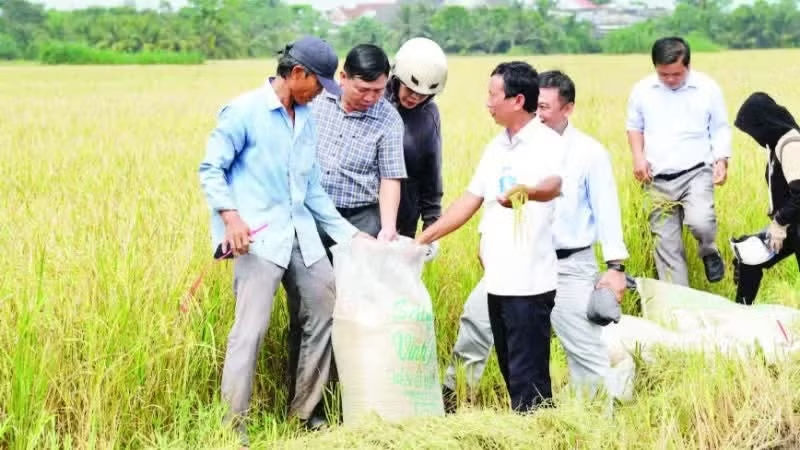
Amid vast rice fields stretching across the sun- and wind-swept land of Tay Ninh Province, the high-quality rice production linkage chain of Cay Trom Agricultural Service and Trading Cooperative in Khanh Hung Commune has opened a promising new direction for farmers. This is one of the few collective economic organisations in Tay Ninh participating in a project receiving support under the Government’s Decree No. 98/2018/ND-CP dated July 5, 2018, on policies encouraging cooperation and linkages in agricultural production and product consumption (Decree 98).
Building effective and sustainable production linkage chains has helped members reduce investment costs and increase incomes by 13–30% compared with before joining the cooperative. Despite these positive results, the cooperative’s Director Bui Van Tuan said that all units implementing Decree 98 are currently facing difficulties due to regulations on counterpart capital for infrastructure investment.
Specifically, cooperatives are required to contribute up to 70% of counterpart capital, while the State budget provides around 30%. For an agricultural cooperative, the 70% requirement is a heavy burden and that is difficult to meet; therefore, up to 99% of cooperatives have excluded infrastructure components from their proposals and linkage project plans.
Rach Lop Agricultural Cooperative in Hung Hoa Commune, Vinh Long Province, has also encountered many barriers in attempting to access support packages under the decree. Its Director Huynh Dang Khoa stated: “Overall, the policy is favourable, but the 30% infrastructure support level makes it difficult for cooperatives to have sufficient financial capacity to lead linkages. The post-investment support mechanism is also hard to access, as few cooperatives can advance capital in advance. A lack of capital is the main cause of broken linkage chains.”
In practice, Decree 98 requires cooperatives and cooperative groups seeking support to develop detailed plans, including production plans, linkage contracts, budget estimates, and commitments to provide counterpart capital. While this requirement is necessary to ensure investment efficiency, it poses a challenge for small-scale agricultural cooperatives. Conditions such as large production scale, strong linkages, and long-term off-take contracts are also major barriers to accessing support.
In addition, volatile markets and high technical standards make linkage chains less sustainable. Certification, packaging, and traceability costs are high, while agricultural product prices fluctuate and post-harvest infrastructure and logistics remain inconsistent, reducing competitiveness. Complicated administrative procedures also consume time, making it difficult for cooperatives to focus on production.
From a research perspective, Dr Tran Minh Hai, Vice Rector of the School of Public Policy and Rural Development, believes that Decree 98 reveals several limitations and needs to be amended and supplemented. At present, support is still mainly focused on production rather than markets and linkages, quality standards, sustainable production, access to green finance, or encouraging other actors to participate in the chain, including enterprises and traders.
Le Duc Thinh, Head of the Department of Cooperative Economy and Rural Development, said that the unit is advising the Ministry of Agriculture and Environment to submit revisions and amendments to Decree 98 to the Government to align with the new development stage. It is hoped that, once revised, linkages between cooperatives and enterprises, as well as between farmers, cooperatives, and enterprises, will become more sustainable. The governance capacity of value chains will improve, promoting green and digital production within these chains.
According to Deputy Minister of Agriculture and Environment Tran Thanh Nam, major markets all require traceability; therefore, building well-structured raw material areas is the foundation of linkage chains. For such chains to develop sustainably, the key factor remains funding. It is necessary to clearly plan key crops and livestock associated with raw material zones, thereby creating a basis to attract enterprise investment and establish stable production linkages.
In the current context, amending Decree 98 is not merely a policy adjustment but a necessary step to unlock linkages, mobilise resources, and shape a modern, sustainable agricultural sector.