When young people take control
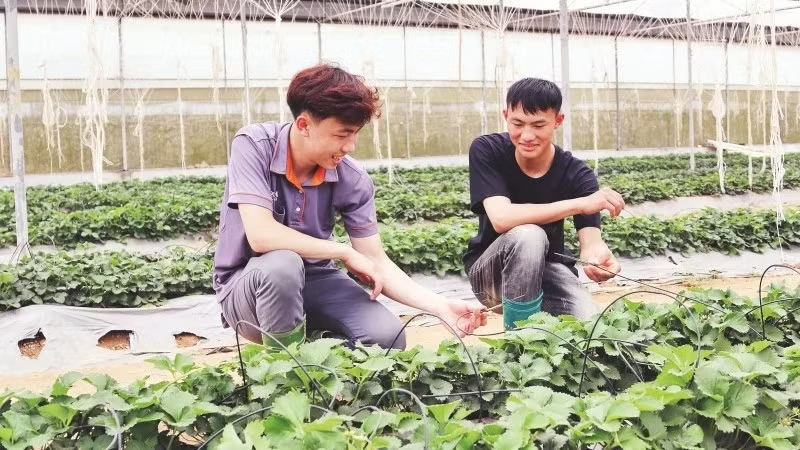
Visiting the medicinal herb and chicken farm of Ha Minh Nguyen in Bim Son ward, Thanh Hoa province, we were surprised by the green agricultural model implemented by him and his friends. Although he graduated with a bachelor’s degree in electrical engineering, Nguyen’s passion for agriculture arose from field trips, and he and his friends established the Nam Tang Agricultural Cooperative.
Recalling the early days of his business, Nguyen said that due to a lack of land and capital, the investment process faced many difficulties. Not to mention, there were times when epidemics broke out, almost wiping out the farm, and he thought he would have to give up. But thanks to the efforts and perseverance of each member, all difficulties were overcome.
Nguyen added: “I always thought that to succeed, the cooperative itself must be self-reliant and not rely too much on external support. Therefore, the cooperative members unanimously agreed to mobilise resources from members, combined with loans from policy funds and the youth union to develop production.”
Initially, the cooperative had 2,000 square meters of land for growing medicinal herbs and 5,000 broiler chickens raised on herbal feed. The feed was prepared with a balanced nutritional regime, mixing natural herbs in appropriate proportions for each stage of the chickens’ development. As a result, the flock developed well, had high resistance, and experienced very few diseases. Along with high-quality breeding stock and carefully controlled herbs, these were the decisive factors in the cooperative’s success.
Initially, the cooperative supplied broiler chickens to various units, but due to high transportation and storage costs, the units switched to raising egg-laying chickens. At the end of 2023, the cooperative specialised in egg production, enabling year-round sales, better customer access, and a stable income stream. The herbal chicken farming process does not use antibiotics, resulting in eggs with large yolks, rich flavour, high nutritional value, and safety, highly appreciated by consumers.
The herbal chicken eggs from the Nam Tang Cooperative have established a strong market position, selling well in supermarkets and bakeries, supplying approximately 1 million eggs annually with a profit of around 3 to 4 billion VND. In addition, the cooperative also guides local farmers on herbal chicken farming techniques and guarantees the purchase of products from dozens of households.
In Son La, in October 2024, the Moc Chau Youth Cooperative was established with seven members, including agricultural engineers and masters, a marketing officer, and other members who are young people with experience in agricultural production in Moc Chau. It is considered a successful startup model.
The director of the cooperative, Phung Van Kha, said that the cooperative currently owns 16 hectares of cultivated land; of which, 10 hectares are planted with plum trees and 6 hectares with vegetables. All vegetable crops are grown in greenhouses, applying sprinkler and drip irrigation technology and an automatic fertilisation system.
Thanks to this, in the first vegetable harvest, the cooperative connected with a Son La enterprise to export over 100 tonnes to the Republic of Korea. In 2025, the cooperative aims to sell over 1,000 tonnes of vegetables and over 500 tonnes of plums, providing higher and more stable income for its members compared to traditional production methods.
Trinh Viet Tuong (Thao Nguyen ward), an agricultural worker in Moc Chau ward, said: “Besides supporting farmers with planting and care techniques, the Moc Chau Youth Cooperative also guarantees the purchase of products from vegetable growers in the area. Farmers like us can now work with peace of mind, without worrying about market outlets, and no longer experiencing the ‘bumper harvest, low prices’ situation as before.”
A solid foundation for rural economy
According to Le Duc Thinh, Director of the Department of Cooperative Economics and Rural Development, the Ministry of Agriculture and Environment, cooperatives play a crucial role in changing agricultural production mindsets and improving people’s economic conditions. Many cooperatives have young, dynamic management teams that are quick to apply science and technology, embrace digital transformation, and grasp market trends, thus improving production efficiency.
Therefore, in recent years, the agricultural sector has implemented numerous training programs to enhance the capacity of cooperative managers and to bring educated young people to work in agricultural cooperatives. These programmes have yielded clear results, with many cooperatives operating profitably and creating livelihoods for the people.
In Son La province, 660 agricultural and agricultural service cooperatives have created regular employment for over 10,000 workers, with an average revenue of approximately 2 billion VND per cooperative per year. Chairman of the Son La Provincial Cooperative Union, Mui Anh Tien, shared that the entrepreneurship movement within agricultural cooperatives is receiving attention, with about 75 cooperatives established each year.
The province has many policies supporting capital and credit from state programmes, the Social Policy Bank, and other production development support programmes. In addition, there are policies to support insurance and mitigate production risks, and to address damage caused by natural disasters and epidemics, aiming to strengthen cooperatives.
In Thanh Hoa, to promote entrepreneurship in agricultural cooperatives, with young people as the core, the Thanh Hoa Provincial Youth Union has coordinated with relevant agencies to organise training courses on transferring scientific and technical advancements for over 5,000 union members and young people; 30 training sessions on entrepreneurship knowledge for 4,500 union members and young people; and support local businesses in registering trademarks annually.
According to the Secretary of the Provincial Youth Union, Le Ngoc Anh, the capital entrusted to the Youth Union by the Social Policy Bank has increased to 2.973 trillion VND. Of this, over 3.1 billion VND is borrowed from the National Employment Fund through the Central Youth Union channel and managed by the Provincial Youth Union. With this funding, the Provincial Youth Union has supported 100 youth projects with loans to expand and develop their businesses, creating jobs for nearly 200 workers.
The Provincial Youth Union also advised the provincial leadership to approve the “Preferential Credit Programme to Support Youth Entrepreneurship,” with a budget of 100 billion VND, supplemented annually. Through this funding, many youth union members have borrowed capital to invest in science and technology for production and business, yielding high economic efficiency. Some projects have achieved revenues of up to 50 billion VND per year, attracting and creating jobs for many unemployed people in the locality.
Along with local efforts, Resolution No. 20-NQ/TW dated June 16, 2022, of the Politburo on continuing to innovate, develop, and improve the efficiency of the collective economy in the new period, and Resolution No. 57-NQ/TW dated December 22, 2024, of the Politburo on breakthroughs in the development of science, technology, innovation, and national digital transformation, are identified as strong supporting resources for young people to choose to start agricultural cooperatives. In reality, driven by their own determination to get rich and with the support of the government, agricultural cooperative startups have proven to play a core role in the current rural economic development.