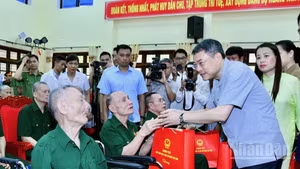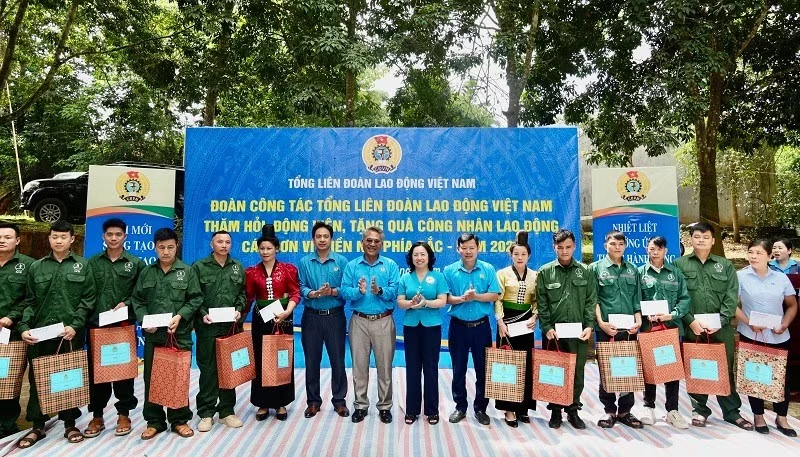
Lo Van Muoi, a Thai ethnic worker who received gifts, was deeply moved by the warm care shown by the leaders.
“Most of the workers at the company are ethnic minorities, facing many difficulties in life. But thanks to Dien Bien Rubber Joint Stock Company’s support, stable employment and guaranteed monthly wages and income, our hardships have eased considerably,” he said.
“On holidays and Tet, the company’s representatives visit and offer gifts to us. These actions are an immensely meaningful comfort, because we feel the care, solidarity and heartfelt sharing,” he added.
Sharing the same joy, Giang A Si, another worker at the company, said that on holidays and Tet, the trade union and company leaders visit, encourage and give gifts to workers, strengthening his affection and attachment to the company. “I will strive to work well to contribute to the company’s development and not let down the trust and care the company’s leaders have shown us,” he pledged.
Despite operating in a mountainous province with many challenges, affected by weather and climate change, the company’s leadership has consistently upheld the principle that “workers are at the centre of development”.
Nguyen Ngoc Cam, General Director of Dien Bien Rubber Joint Stock Company, explained that the company was founded in 2007 and currently manages nearly 3,718 hectares of rubber across ten communes and wards in Dien Bien Province, all in mountainous terrain. The company employs 888 people, of whom more than 91% are unskilled workers from ethnic minority communities in Dien Bien.
Despite operating in a mountainous province with many challenges, affected by weather and climate change, the company’s leadership has consistently upheld the principle that “workers are at the centre of development”.
Accordingly, the company pays close attention to both material and spiritual welfare, implements full regimes and policies for workers, supports those in difficulty, provides health check‑ups, builds housing, and organises cultural and sporting activities to ensure workers feel secure and remain committed to the company long term.
In 2025, the average monthly income of workers reached 6.97 million VND per person. In the first four months of 2026, as plantations shed leaves and harvesting was temporarily suspended, workers’ incomes fell due to reduced labour demand. In response, the company proactively allocated welfare funds to supply rice and essential foodstuffs to more than 700 workers, amounting to 1.05 billion VND.
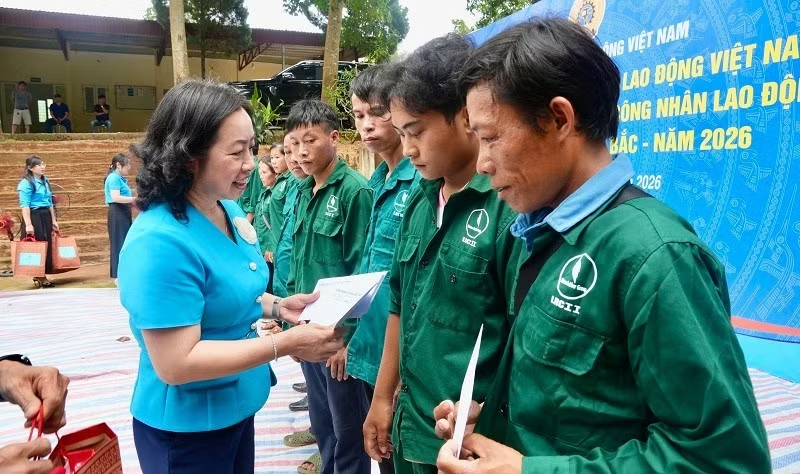
Notably, during Workers’ Month and the Month of Action for Occupational Safety and Health (May 2026), the company paid bonuses totalling nearly 5.7 billion VND to 771 direct workers and contract labourers.
The company has also partnered with local authorities in numerous charitable activities, thereby strengthening ties with local communities and building a positive image of rubber workers in Dien Bien province.
Thai Thu Xuong, Permanent Vice‑President of the Viet Nam General Confederation of Labour, praised Dien Bien Rubber Joint Stock Company for its great efforts in effective management and business operations while comprehensively caring for workers’ livelihoods and employment.
Trade union must act as the “common home”, while the company must remain the vital pillar of support for workers.
Thai Thu Xuong, Permanent Vice‑President of the Viet Nam General Confederation of Labour
In the face of many difficulties and market fluctuations, the company has maintained stable production, guaranteed jobs and income, and paid attention to improving working conditions and the material and spiritual lives of workers — achievements she described as highly commendable.
“I highly appreciate the effective coordination between the company’s trade union and leadership in caring for workers’ material and spiritual lives, by implementing many practical and effective activities that contribute to building harmonious, stable and progressive labour relations,” she affirmed.
Emphasising the principle that “workers are the company’s most valuable asset”, she urged Dien Bien Rubber Joint Stock Company to continue giving greater attention to workers in all circumstances, reinforcing their firm belief that behind every worker stands the trade union and the company accompanying them.
She stressed that the trade union must act as the “common home”, while the company must remain the vital pillar of support for workers.