Refurbishing and upgrading war cemeteries
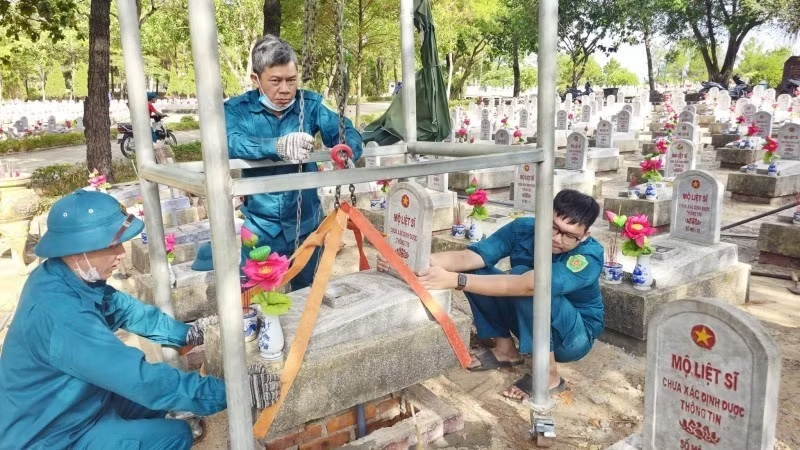
Over time, many structures and graves at the Truong Son and Road 9 National Martyrs’ Cemeteries have developed cracks and severe weathering due to the harsh weather conditions.
In response, the central government, provinces and cities nationwide, and organisations and businesses, together with Quang Tri Province itself, have mobilised resources to restore and upgrading the cemeteries.
The project to renovate and upgrade the Ha Noi martyrs’ section at the Truong Son National Martyrs’ Cemetery is being implemented jointly by Ha Noi and Quang Tri Province, with a total investment of more than 70 billion VND (2.6 million USD) from the state budget.
The project includes renovating the memorial monument, memorial house, and 1,573 martyrs’ graves serving the Ha Noi and Ha Tay sections, which merged more than 17 years ago.
It also entails improvements to infrastructure, paving, and boundary walls for both sections; the construction of a new shared memorial house combined with a ceremonial space; and the installation of a memorial stele bearing the names of the fallen.
The ceremonial courtyard in front of the memorial has been expanded to provide a more dignified setting for delegations paying tribute and offering incense.
The access road to the Ha Tay section has also been widened to six metres. Landscaped green spaces have been redesigned to connect the two sections, creating a harmonious and tranquil memorial complex.
The former Ha Nam Ninh and Binh Tri Thien martyrs’ sections have likewise been refurbished.
Meanwhile, Phu Tho Province is collaborating with Quang Tri to carry out a project to renovate and upgrade the sections of the former Vinh Phu and Hoa Binh Provinces at the Truong Son and Road 9 National Martyrs’ Cemeteries.
The work includes expanding the cemetery grounds, constructing new memorial houses and ceremonial areas, restoring more than 1,000 graves, refurbishing commemorative structures, repaving courtyards, upgrading technical infrastructure, planting trees and updating commemorative plaques.
The projects are being expedited to ensure completion in time for the 52nd anniversary of the Liberation of the South and National Reunification in April 2027.
Each restoration project not only beautifies the graves of the fallen heroes but also helps preserve the solemnity and sanctity of the martyrs’ cemeteries across Quang Tri Province.
Racing against time
As part of the 500-day campaign to identify unidentified fallen soldiers, Quang Tri Province recently organised a workshop to authenticate information concerning a collective martyrs’ grave in Cau Nhi area, Nam Hai Lang Commune.
After examining and cross-checking domestic historical records, declassified US military documents, previous records of the recovery of martyrs’ remains in Cau Nhi, field surveys, and information provided by historical witnesses and local residents, the workshop concluded that the area near Cau Nhi Bridge is the burial site of soldiers from the 6th Battalion, 88th Regiment, 308th Division, who were killed during the assault on the bridge on May 26, 1972.
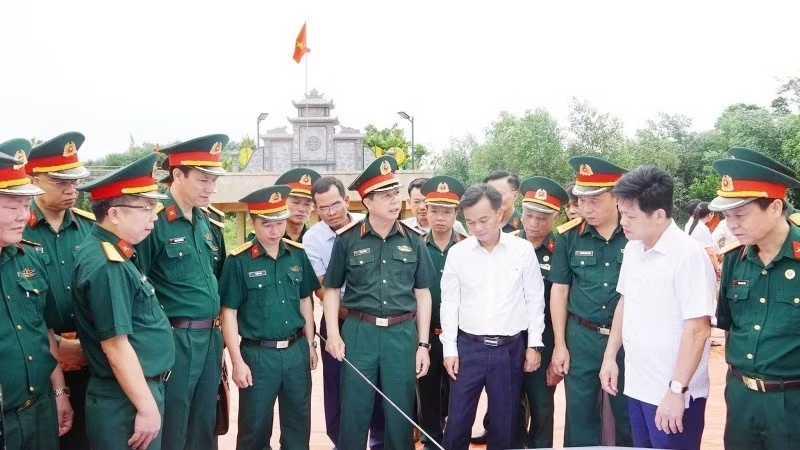
To date, the remains of 29 martyrs have been recovered from the site during previous searches, including one whose identity was fully established. It is estimated that the remains of at least 26 to 54 more soldiers are still awaiting recovery.
The next phase of the search will extend into nearby rice fields and melaleuca plantations stretching to the banks of the Cau Nhi River, with priority given to abandoned paddy fields that have already been surveyed by a ground-penetrating radar team.
For more than half a century, residents of Cau Nhi Village have tended to the place where the soldiers fell, despite not knowing the exact location of their burial site. Recently, a local family donated nearly 1,000 square metres of land for the construction of a temple dedicated to the martyrs who died in the battle.
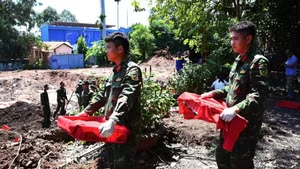
A martyrs’ remains recovery team under the Quang Tri Military Command, known as Team 584, is now coordinating urgently with the Nam Hai Lang Commune militia to excavate the identified sites in search of the missing remains.
Lieutenant Colonel Ngo Thanh Liem, commander of Team 584, stated that alongside the recovery work in Cau Nhi, the team is also collecting DNA samples from the remains of unidentified martyrs buried at the Truong Son and Road 9 National Martyrs’ Cemeteries.
At the Road 9 National Martyrs’ Cemetery, seven working teams comprising 76 members of Team 584 painstakingly carry out every step of the DNA sampling process.
Amid the quiet surroundings and intense heat, every procedure is performed with precision, solemnity and meticulous care, reflecting the utmost respect for the fallen while ensuring strict compliance with scientific preservation standards.
The cemetery still contains 5,929 unidentified martyrs’ graves.
So far, Team 584 has collected samples from more than 2,000 graves and aims to complete sampling at the cemetery by mid-August 2026. Earlier, the team had finished collecting samples from 93 graves at the Truong Son National Martyrs’ Cemetery.
The Quang Tri Military Command reported that from the campaign’s launch to June 30, search teams recovered the remains of 119 martyrs. Of these, Team 584 recovered 63 sets of remains within Viet Nam and 28 in Laos.
As of July 11, teams had exhumed 3,470 graves at martyrs’ cemeteries across the province, obtaining 2,123 biological samples. The province has transferred 1,788 samples to the National Institute of Forensic Medicine for the next stages of analysis.
At the same time, authorities have expedited the collection of 2,771 maternal-line reference samples from relatives of 2,138 unidentified martyrs.