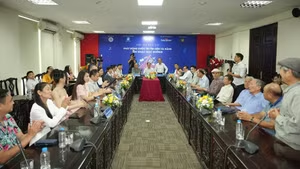
The findings were unveiled at a workshop hosted by the Ministry of Education and Training on July 14 to launch Viet Nam's National Report on the 2024 SEA-PLM.
SEA-PLM is a regional large-scale learning assessment programme jointly conducted by the Southeast Asian Ministers of Education Organisation, United Nations Children's Fund, and development partners to evaluate learning outcomes among primary school students and provide evidence to support the formulation and improvement of education policies.
Before the start of the new five-year SEA-PLM assessment cycle, all 11 Southeast Asian countries were invited to participate as members.
The 2024 SEA-PLM cycle involved seven participating countries: Cambodia, Timor-Leste, Laos, Myanmar, Malaysia, the Philippines and Viet Nam.
According to Pham Quoc Khanh, Deputy Head of the Quality Management Department under the Ministry of Education and Training, Viet Nam has participated in SEA-PLM since its inaugural cycle and has consistently viewed the programme as an important mechanism for objectively assessing the quality of general education.
Viet Nam conducted the 2024 SEA-PLM survey in April 2024 at 152 primary schools across provinces and cities nationwide, involving 152 principals, 1,074 teachers, more than 6,000 Year 5 students and their parents. The entire sampling process was managed by international partners.
According to the National Report on the 2024 SEA-PLM released at the workshop, Viet Nam's primary education system continued to secure encouraging results while providing an important foundation for elevating quality, equity, and sustainable development in the years ahead.
The report also revealed that 95.4% of students reached the minimum proficiency level in Mathematics and 85.5% met the minimum proficiency level in Reading. Meanwhile, 64.9% of students achieved advanced proficiency in both Mathematics and Reading simultaneously — the highest proportion among the participating countries.
According to the Ministry of Education and Training, these results demonstrate that Viet Nam is well positioned to achieve the United Nations Sustainable Development Goal 4 on quality education.
Alongside these positive outcomes, the report noted that disparities in learning achievement continue to stem mainly from families' socio-economic conditions, students' places of residence, and the language spoken at home.
Based on the survey findings, the report proposes five key policy directions, including continuing to elevate the teaching of Reading, Writing, and Mathematics; prioritising support for disadvantaged students; strengthening teacher training; narrowing the digital divide between regions; and continuing to use SEA-PLM findings alongside domestic education data to monitor education quality, formulate evidence-based policies, and develop a high-quality workforce.