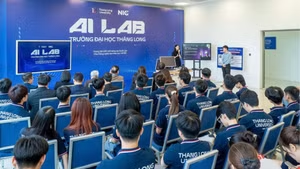
According to Minister of Education and Training Hoang Minh Son, higher education in Viet Nam continues to expand rapidly in both scale and quality. The country's higher education system now serves nearly 2.8 million students at all levels, including more than 130,300 postgraduate students, who account for around 5% of total enrolment. The structure of higher education is also shifting towards a greater focus on strategic and critical technology disciplines while strengthening scientific research.
To develop a workforce capable of meeting the demands of scientific and technological advancement, the Ministry of Education and Training has submitted a draft higher education development strategy to the Prime Minister. The strategy proposes breakthrough and comprehensive reforms centred on building world-class flagship universities, modernising and enhancing education and research capacity, adapting to the impacts of digital technologies and artificial intelligence (AI), and delivering substantial improvements in the quality of higher education.
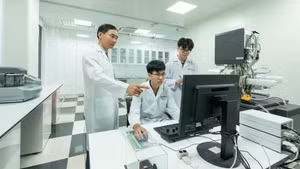
Notably, in developing high-quality talent for priority sectors, the ministry has approved 90 training programmes for talented engineers and master's degree students, along with 59 programmes specialising in semiconductor integrated circuits, with the aim of supplying highly skilled graduates from the 2026–2027 academic year.
Alongside higher education, greater emphasis is also being placed on attracting, nurturing and making effective use of talented individuals, experts and scientists in key science and technology fields in order to strengthen the country's knowledge base and human capital for science, technology and innovation.
According to the Ministry of Science and Technology, to cultivate the next generation of researchers, it has launched a programme supporting outstanding doctoral candidates, offering funding of up to 1 billion VND (38,000 USD) per person per year for around 100 doctoral students. In addition, the ministry has introduced the outstanding basic research programme for 2026–2035, which aims to establish 30 leading research groups by 2030 and expand the number to 50 by 2035.
Efforts to develop high-quality science and technology talent are not confined to central ministries. Local authorities have also actively introduced initiatives to strengthen their scientific workforce.
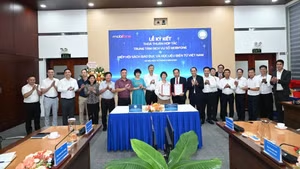
Ha Noi, for example, has directed the development of mechanisms and policies to identify, train, attract, utilise and retain highly qualified personnel to support science and technology, innovation and digital transformation. Key initiatives include a scholarship programme for 1,000 doctoral candidates, a high-tech workforce development programme in cooperation with Arizona State University in the US, an accelerated semiconductor talent pipeline spanning general education to engineering training, and the transformation of key laboratories into industrial-scale shared research infrastructure.
These significant advances in developing science and technology human resources have laid an important foundation for establishing a new growth model. However, significant challenges remain in meeting the country's evolving development requirements.
Postgraduate education remains relatively small compared with demand for highly qualified professionals. Research capacity and technology transfer capabilities vary considerably among institutions, while collaboration between universities, research institutes and businesses remains superficial in some areas.
Associate Professor Dr Bui Quang Tuan, Vice Chairman of the Viet Nam Economic Science Association, noted that Viet Nam has a workforce of more than 52 million people with a strong tradition of valuing education. However, the quality of human resources in disciplines critical to the country's new development model—including STEM, AI, semiconductors, biotechnology, advanced materials and technology management—remains a major challenge.
The number of researchers and high-tech engineers also falls short of the requirements of a new generation of industrialisation. He described this as a major bottleneck that must be addressed through breakthrough education, training and talent attraction strategies.
To build a science and technology workforce capable of meeting the country's future development needs, experts recommend that the Ministry of Education and Training develop national smart education platforms incorporating AI, virtual reality and augmented reality technologies. The ministry should also complete a national AI workforce development programme, establish regulatory sandbox mechanisms for the education sector, and strengthen collaboration among universities, research institutes, local authorities and businesses under the triple-helix model.
The education sector should also assess the capabilities of universities and research institutes to determine which institutions should take responsibility for AI talent development and which should lead the development of digital learning resources.
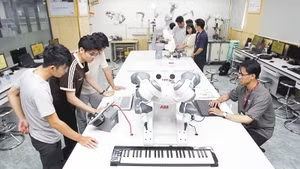
Professor Dr Nguyen Khac Quoc Bao and colleagues from the University of Economics Ho Chi Minh City argued that Viet Nam should identify and develop strategic talent pools by prioritising experts in core technologies such as AI, semiconductors, Big Data, cybersecurity, robotics, biotechnology and new energy technologies.
At the same time, greater efforts should be made to improve the quality of technology engineers and the digital workforce to ensure they can adapt to automation and AI. They stressed that education and training should undergo fundamental reform so that curricula are more closely aligned with strategic technologies and practical industry needs.
The Government recently issued Decree No. 179/2026/ND-CP on scholarship policies for students pursuing basic sciences, critical engineering disciplines and strategic technologies. The policy is expected to play an important role in attracting talented students to STEM fields, thereby contributing to the development of a high-quality workforce to support the country's industrialisation and modernisation.
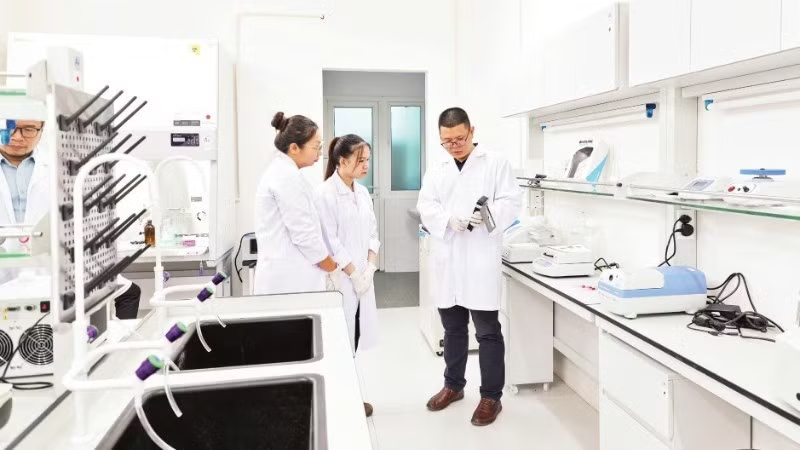
Many experts also believe that scholarship schemes alone are not sufficient. Policies to attract and retain talent should be accompanied by a professional research environment that provides researchers with institutional autonomy, access to data and laboratory facilities, and opportunities to commercialise research outcomes. They also recommend developing regional high-tech talent ecosystems, expanding international cooperation and accelerating the commercialisation of scientific research.