From initial results…
In science, technology and innovation, Viet Nam has identified 10 strategic technologies associated with 30 strategic technology products and 20 major national challenges. Research institutes, universities and scientists at home and abroad have actively engaged in basic and applied research, while the “three-way linkage” model has initially proved effective in bringing research products into practice.
Some Vietnamese enterprises have begun to master technologies, launch products on the market and export products to regional and global markets. E-commerce, cashless payments and the application of artificial intelligence in several fields have generated tangible socio-economic benefits.
However, Party General Secretary and State President To Lam noted that many limitations remain in institutions, infrastructure, human resources, data, cybersecurity, information security and capital disbursement. Actual results have not matched the resources or political determination, while few concrete strategic products have been created. “The weakest link at present is implementation,” the conclusion stated.
Party General Secretary and State President To Lam called on agencies and units to fully recognise that science and technology, innovation and digital transformation are key drivers of the renewal of the development model, the establishment of a new growth model and the realisation of the country’s two centenary goals. Accordingly, tasks under Resolution No. 57-NQ/TW should be completed only when there are operational products, verifiable data, actual users and measurable results
…to bottlenecks that need to be removed
To turn initial results into substantive capacity, experts say efforts should focus on removing key bottlenecks: disruptions in the innovation value chain, shortages of high-quality human resources and limited conditions for deploying new technology products.
First, the gap between research and the market remains a major bottleneck. The rate of patent commercialisation in Viet Nam currently stands at only about 0.1%, compared with a global average of 5% and 10% in developed countries. This gap also reflects a lack of continuity between basic research, prototype development, verification, testing and market expansion. Many projects have progressed beyond the scope of scientific research assignments but are not yet sufficiently developed to attract large-scale business investment.
To address this issue, funding mechanisms need to cover the entire technology lifecycle instead of ending at the project acceptance stage. Prof. Dr Tran Hong Thai, President of the Viet Nam Academy of Science and Technology, proposed restructuring science and technology funds around three pillars: funding basic research and high-risk pre-competitive technologies; providing “seed capital” for commercialisation and technology transfer; and supporting the attraction and retention of talent to establish strong research groups.
Alongside funding, mechanisms for assigning rights and sharing benefits from intellectual property need to be improved. Intermediary organisations capable of technology valuation, verification and transfer should be developed, while scientists should be enabled to establish and manage spin-off companies. Policy effectiveness should be measured by the number of commercialised products and the revenue generated, rather than merely by the number of enterprises established.
In fact, research institutes are gradually shifting from carrying out separate assignments to developing product chains linked to application environments. The Institute of Physics under the Viet Nam Academy of Science and Technology has developed autonomous mobile robots for specialised fields such as nuclear technology and healthcare. The robots have been tested at the Da Lat Nuclear Research Reactor and several nuclear medicine facilities, including Military Hospital 103, demonstrating stable operation and potential applications in radiation safety, nuclear technology and industry.
In the business sector, one notable initiative is FPT’s establishment of the Quantum AI & Cyber Security Institute (QACI). It is among the first high-tech research institutes founded by a Vietnamese enterprise to focus on artificial intelligence, cybersecurity and quantum technology.
“As technology becomes increasingly closely linked to sovereignty, security and national self-reliance, FPT considers long-term investment in core technologies not only a strategic business choice, but also a responsibility towards the country’s sustainable development,” said Truong Gia Binh, Chairman of the FPT Corporation Board of Directors.
Research activities at QACI are geared towards addressing Viet Nam’s practical challenges in these key fields, thereby narrowing the gap between research and the market and reducing the number of research projects that fail to find practical applications—one of the main causes of disruption in the innovation value chain.
The second bottleneck is the shortage of high-quality human resources in key fields such as artificial intelligence, semiconductors and cybersecurity. Assoc. Prof. Dr Nguyen Hai Dang, Vice Rector of the University of Science and Technology of Ha Noi, said the greatest challenge in human resource training stems from the rapid development of emerging technologies, while training capacity at many higher education institutions has failed to keep pace in terms of curricula, organisational methods and quality assurance conditions.
The solution, therefore, is not simply to open more academic programmes. Curricula need to be updated more rapidly and linked with laboratories, research assignments and real-world challenges faced by State agencies, localities and enterprises. In line with the key task of developing high-quality science and technology human resources, the Ministry of Science and Technology has approved a programme to support outstanding doctoral candidates for the 2026-2030 period. The programme is expected to provide internationally competitive financial support to around 1,000 doctoral candidates by 2030.
Higher education institutions have adjusted their curricula to better connect training with research and emerging workforce needs. For example, the University of Engineering and Technology under Viet Nam National University, Ha Noi has adopted a coordinated approach covering education, scientific research and business cooperation. In the 2026-2027 academic year, Viet Nam National University, Ha Noi will introduce 15 talent training programmes in STEM fields related to strategic technologies.
Some technology enterprises have also proactively begun training human resources from an early stage. Since the 2024-2025 academic year, the FPT Education system has introduced AI into the curriculum from Grade 1, enabling pupils to develop early familiarity with technological thinking, data, algorithms and the responsible use of technology. Teachers have also received training in applying AI to develop learning materials, design lessons and assess learners.

In emerging fields such as quantum technology, preparations for human resources need to begin even earlier. Prof. Dr Nguyen Ngoc Tu, a professor at Kennesaw State University in the US, praised several domestic technology enterprises, including FPT, for proactively investing in research, human resource training and links with institutes and universities in the quantum field. He said these efforts would help create an sufficiently attractive environment to draw Vietnamese experts back from abroad and retain them, thereby developing the domestic quantum workforce community.
The third bottleneck is the lack of deployment environments and initial markets for enterprises to refine their technologies. For products such as AI cameras, autonomous robots, unmanned aerial vehicles (UAVs) and dual-use technologies, prototypes can only become market-ready products when they are operated in real-world conditions, supported by data, users and feedback for further improvement. Although many enterprises have invested in research, they still lack testing sites, first orders and mechanisms for the adoption of new products.
Hoang Anh Tu, Deputy Director of the Department of Science, Engineering and Technology under the Ministry of Science and Technology, said technology products would be difficult to perfect and commercialise unless they were deployed in practice. The State’s role as the “first customer” by placing orders for strategic technology products would therefore encourage enterprises to invest in core technologies and gradually reduce dependence on imports.
Under this model, management agencies set out needs and deployment conditions; enterprises provide solutions, equipment and operational capacity; and residents, cooperatives or specialised units directly use the products and provide feedback.
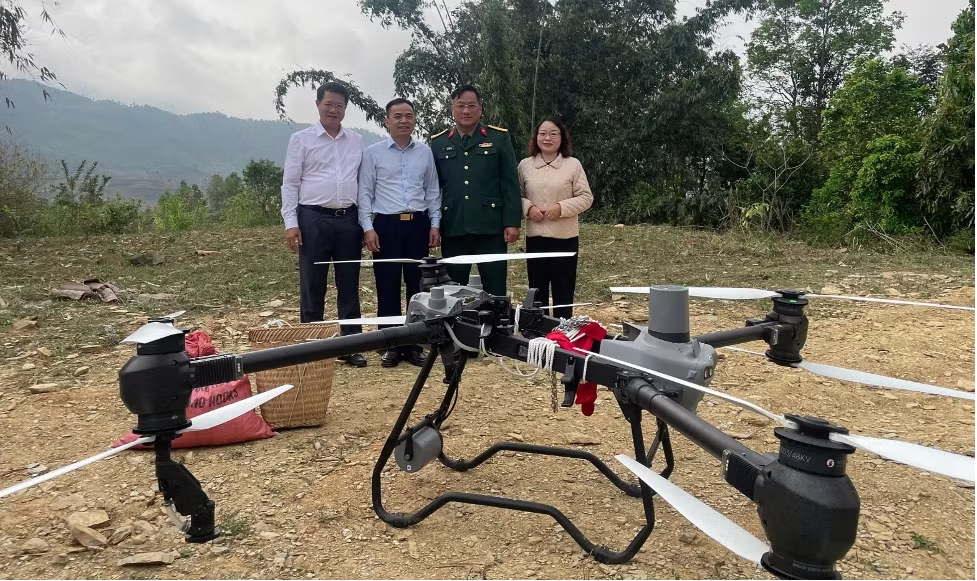
The UAV pilot programme in Dien Bien is an example of how a local challenge can be turned into a specific technology assignment. Based on demand for transporting medicines and agricultural products, supporting agricultural production and conducting topographical surveys, the Dien Bien Provincial People’s Committee authorised a controlled pilot programme for unmanned aerial vehicles. Running until the end of May 2027, the programme aims to conduct around 6,000 flights in four fields—agriculture, logistics, healthcare and digital mapping—with a safety rate of more than 99%.
Vietnam Post is responsible for organising the implementation and trials. FPT and other UAV manufacturers are in charge of technical work and provide equipment, technology solutions and flight-control software systems. Service enterprises participate in operations, repairs and maintenance, while local organisations, cooperatives, enterprises and residents use the technology, benefit from it and assess its effectiveness. The Dien Bien Department of Science and Technology takes the lead in coordinating with other departments and sectors in inspection and guidance.
This approach should be expanded to other strategic technology products. While 2025 was regarded as the “start-up and acceleration preparation” stage, 2026 requires the entire system implementing Resolution No. 57-NQ/TW to “accelerate” under the motto “Breakthrough action, widespread results”.
The initial results show that domestic technological capacity is gradually taking shape across the research, education and business sectors. Coordination among the State, research institutes, universities and enterprises will help translate the spirit of Resolution No. 57-NQ/TW into practice, thereby enhancing the country’s technological self-reliance, productivity and competitiveness.