This is a prerequisite for Viet Nam to participate more deeply in global value chains during the new stage of development.
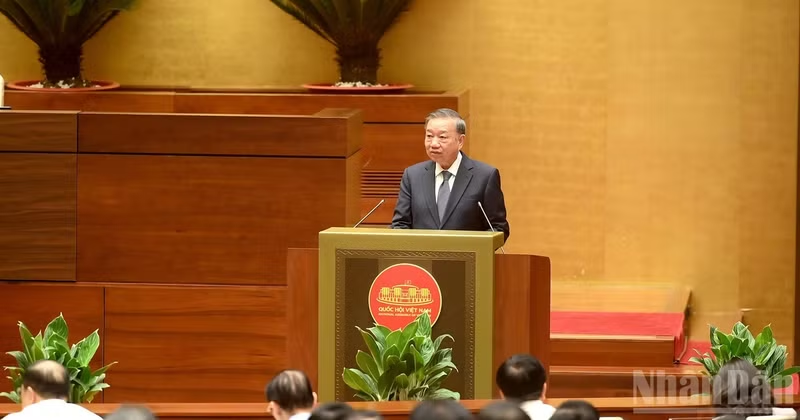
Speaking at the National Conference reviewing one year and six months of the implementation of Resolution No. 57-NQ/TW, dated December 22, 2024, issued by the Politburo on breakthroughs in the development of science and technology, innovation and national digital transformation, General Secretary and State President To Lam, Head of the Steering Committee, stressed that science, technology, innovation and digital transformation are the primary driving forces of the new development and growth model. This is not a matter of choice, but the only path to achieving the country's development goals.
In his keynote address, the General Secretary and State President expressed deep concern over the human resources required for the development of science and technology, particularly highlighting the fundamental and long-term task of preparing the workforce for Resolution 57 from the very beginning of the new academic year.
According to the General Secretary and State President, if the country wishes to have a team of science and technology professionals in ten years' time, it must start this year by determining what disciplines should be studied, which fundamental sciences should be prioritised and how training should be organised. Human resources do not emerge naturally; investment must begin now.
Resolution No. 57-NQ/TW identifies science, technology, innovation and digital transformation as the driving forces behind the development of modern productive forces. As artificial intelligence (AI) is becoming a new engine of economic growth, AI capability has therefore become a fundamental requirement for the modern workforce.
With only 19 years remaining until the 2045 target, it is essential to calculate immediately how education and training will contribute to the country's development process. The General Secretary and State President requested that, from the new academic year, the education and training sector, higher education institutions and vocational education institutions review their training programmes, prioritise the application of strategic technologies, accelerate the development of digital skills, transformation capability, innovation and AI application, and regard today's human resource preparation as tomorrow's national competitiveness. This is a responsibility of the entire political system, not solely of the education sector.
Referring to Finland's Aalto University model, the General Secretary and State President shared his admiration for a leading educational institution where students are able to work, conduct experiments, carry out research and innovate around the clock, transforming knowledge acquired at university into tangible products. From this, he emphasised the need to foster creativity and closely connect investment in universities with production, society and everyday life.
In the new context, educational institutions must become places that prepare the country's technological capabilities; places where learners gain early exposure to fundamental sciences, strategic technologies, data, AI, information security and practical development challenges faced by government agencies, local authorities and businesses.
This requirement also calls for changes in teaching and learning methods. Whereas education previously focused mainly on curricula, credits and qualifications, the coming period requires learners to develop practical competence, self-learning ability, data-driven thinking, the ability to work alongside emerging technologies and a strong sense of responsibility in the digital environment.
In recent years, several educational institutions have begun moving in this direction. Many universities and academies have started adjusting their programmes towards high-demand fields such as artificial intelligence, data science, information security, semiconductor integrated circuit design, digital transformation and digital public administration, including Hanoi University of Science and Technology, the University of Engineering and Technology under Viet Nam National University, Hanoi, the Academy of Cryptography Techniques and several other technology training institutions.
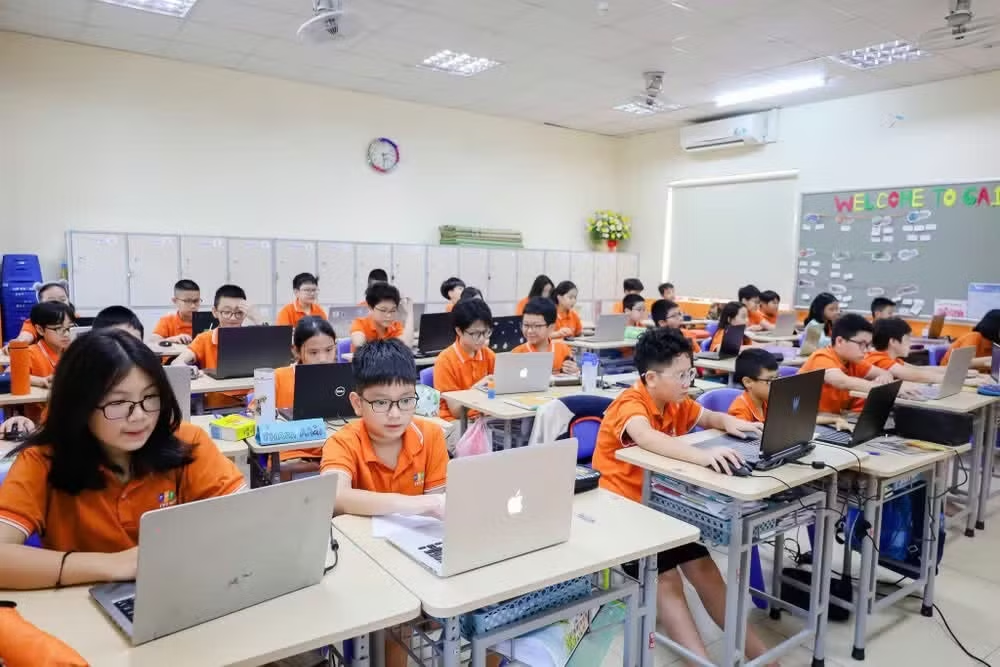
Within the business sector, FPT is one of the pioneering organisations in training talent for strategic technologies, particularly AI. At primary and secondary school level, FPT introduced AI into its curriculum from Year 1 starting in the 2024–2025 academic year, enabling pupils to become familiar with technological thinking, data, algorithms and the responsible use of technology from an early age. On the teaching side, educators across the FPT education system receive training in applying AI to lesson design, teaching materials, feedback and learner assessment. This helps reduce time spent on administrative tasks while increasing direct interaction between teachers and students.
At university and post-secondary level, FPT focuses on strategic technology programmes aligned with emerging workforce demands, including AI, data science, software technology for digital automobiles, unmanned aerial vehicles (UAVs) and semiconductor integrated circuit design. To date, more than 3,300 students across the FPT education system are studying semiconductor integrated circuit design, demonstrating both the strong shift among learners towards strategic technology disciplines and the institution's commitment to preparing high-quality human resources for national development.
Notably, immediately after Resolution 57 was issued, FPT, together with many leading universities, proactively established the Strategic Human Resources Alliance for the Implementation of Resolution 57, aiming to train a new generation of "Resolution 57 personnel". These are outstanding technology students possessing practical capabilities in implementing digital transformation, mastering science, technology and innovation, and ready to meet the country's development requirements in the new era.
In early 2026, student groups participating in the programme supported several localities in Quang Ninh Province, Son Tay Commune and Van Dinh Commune in Ha Noi in standardising data, developing chatbots, assisting the operation of digital government and carrying out digital transformation tasks at the grassroots level.
FPT is also promoting initiatives to identify and attract talent in strategic technologies through competitions and programmes that seek out and honour Vietnamese intelligence, including the Au Lac AI Grand Prize. With prize money of 1 million USD, the programme targets AI products and solutions developed, mastered and applied by Vietnamese people. Participants include not only technology companies, but also students, engineers, scientists, research teams, start-ups and Vietnamese experts both at home and abroad.
The proactive investment by educational enterprises in these fields not only helps meet labour market demand but also provides additional social resources alongside the State in achieving the goal of developing high-quality human resources.
This is also a way for the business sector to invest resources in education, attract experts, connect Vietnamese knowledge worldwide and prepare a workforce capable of mastering technology, thereby contributing to the objectives of Resolution No. 57-NQ/TW on rapidly developing modern productive forces, enhancing national competitiveness and enabling the country to achieve breakthrough development in the new era.