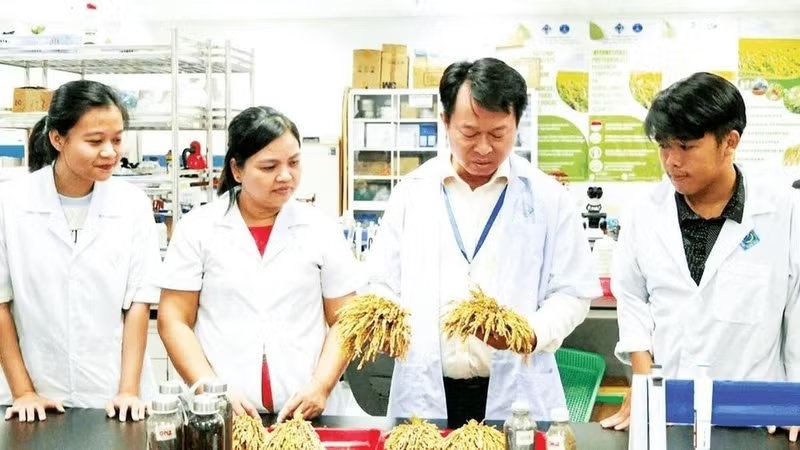
However, to realise this ambition, the city will need bold and transformative measures to build an innovation ecosystem capable of generating new momentum for development.
According to Nguyen Van Khoi, Vice Chairman of the Can Tho People's Committee, science and technology form the foundation of the digital era, innovation serves as the strategic pillar guiding development, while digital transformation acts as the engine of economic growth. The city has identified the implementation of Resolution No. 57-NQ/TW on the development of science, technology, innovation and digital transformation, together with Resolution No. 68-NQ/TW on private sector development, as key priorities for enhancing competitiveness and building a knowledge- and technology-based growth model during the 2026–2030 period.
Assessing the city's current position, Assoc. Prof. Dr. Vu Van Tich, Deputy Director of the Academy of Strategy for Science and Technology under the Ministry of Science and Technology, noted that Can Tho’s innovation index has improved steadily in recent years, reflecting positive progress in administrative reform, institutional development and investment in innovation. To achieve a breakthrough during the 2026–2030 period, he proposed establishing a Regional Innovation Centre in Can Tho to coordinate science and technology programmes, integrate data resources and mobilise funding from national initiatives.
He also recommended creating a regional innovation fund, strengthening collaboration among universities, research institutes and businesses, and promoting science and technology enterprises together with the innovation start-up ecosystem.
In addition, the city should develop innovation clusters based on its comparative advantages in high-tech agriculture, aquaculture, logistics, biotechnology, renewable energy and eco-tourism. The objective is not merely to improve its ranking in the Provincial Innovation Index (PII), but more importantly to build an innovation-driven economy and position Can Tho as the regional centre for coordinating innovation activities across the Mekong Delta.
The model adopted by Minh Anh Agricultural and Commercial Services Cooperative in Long Binh Ward, Can Tho, clearly demonstrates the benefits of applying technology to agricultural production. The cooperative grows greenhouse melons using clean cultivation methods. An automated Israeli drip irrigation system supplies water and nutrients according to each stage of plant development.
By maintaining strict control over growing conditions, the model reduces pests and diseases, minimises the use of crop protection chemicals and enhances both productivity and product quality. The cooperative currently cultivates around 1.2 hectares, with nearly 15,000 melon plants each season. It produces almost four crops annually, achieving yields of 4–5 tonnes per 1,000 square metres.
Alongside technological applications, the cooperative is progressively adopting VietGAP and OCOP standards, enabling its products to enter supermarkets, e-commerce platforms and wider consumer markets. Nguyen Thanh Dat, a member of the cooperative, said that greenhouse cultivation combined with automated irrigation technology has significantly reduced expenditure on crop protection chemicals and labour.
Many experts believe that in the coming period Can Tho should invest in developing a regional data and artificial intelligence ecosystem, including data centres, open-data platforms, computing infrastructure and digital twin models. At the same time, stronger links between universities, research institutes and businesses are needed to accelerate the commercialisation of research outcomes and foster technology enterprises and deep-tech start-ups.
Developing decision-support systems based on real-time data is also regarded as an important tool for monitoring innovation performance and improving governance.
Dr Nguyen Thanh Nhan of the Institute for Circular Economy Development under Viet Nam National University Ho Chi Minh City argued that public-private partnerships (PPPs) are essential for encouraging private-sector investment in science, technology and innovation. He noted that the success of PPP projects depends on effective knowledge transfer, selecting technologies suited to local conditions and establishing evaluation mechanisms to assess project outcomes and guide timely policy adjustments.
Following the expansion of its development space, Can Tho is now better positioned to capitalise on the comparative strengths of its constituent areas. The city itself serves as the regional centre for trade, services, education, science and technology, while the former Hau Giang Province has strengths in processing industries and the former Soc Trang Province has strong potential in the marine economy. Together, these advantages provide a favourable foundation for developing a region-wide innovation ecosystem, provided institutional reforms continue and business capabilities are further strengthened.
According to Associate Prof. Dr. Phan Anh Tu of Can Tho University, becoming the innovation hub of the Mekong Delta will require the city to make more effective use of its highly skilled workforce through closer cooperation among government, businesses and educational institutions. Sharing research infrastructure, designing training programmes based on business needs, and encouraging students and postgraduate researchers to undertake research and internships within enterprises will strengthen technological absorption capacity and accelerate the commercialisation of research outcomes.
Commenting on the city's prospects, Huynh Van Tung, Head of the Southern Representative Office of the Ministry of Science and Technology, said that Can Tho possesses many favourable conditions for developing an innovation ecosystem, including its position as the regional centre, an extensive network of universities and research institutes, a highly qualified workforce and increasingly modern infrastructure. After more than two years of implementation, the Provincial Innovation Index (PII) has become an important tool enabling local authorities to assess innovation capacity and formulate more effective development policies.
According to the Ministry of Science and Technology, Can Tho recorded a Provincial Innovation Index (PII) score of 46.21 in 2025, ranking first in the Mekong Delta and 10th among the country's 34 provinces and centrally governed cities. This provides a solid foundation for the city to further strengthen its competitiveness, advance science and technology, foster innovation and digital transformation, and move towards its goal of becoming the innovation hub of the region in the years ahead.