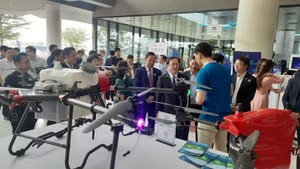
The Central Steering Committee for the Development of Science, Technology, Innovation, and Digital Transformation has set a target to establish at least three internationally recognised innovation and start-up centres by 2030, including one in Da Nang.
Integrating into global technology value chains
In 2026, Da Nang ranked 554th in StartupBlink's Global Startup Ecosystem Index. By 2030, the city strives to enter the world's top 300 innovation-driven start-up ecosystems.
For Da Nang, the challenge now extends beyond merely enhancing the effectiveness of its start-up movement. It must actively integrate innovation-driven entrepreneurship into global technology value chains.
In practice, founders of innovative start-ups in Da Nang comprise not only university students but also senior and middle managers from foreign technology companies.
However, the number of enterprises capable of achieving rapid growth, joining global value chains, and expanding into international markets remains modest. Simultaneously, venture capital and highly skilled human resources are still insufficient, while linkages among ecosystem stakeholders remain insufficiently robust.
The implementation of the Politburo's Resolution No. 57-NQ/TW, issued on December 22, 2024, on breakthroughs in science, technology, innovation, and national digital transformation, together with the rapid pace of technological change, demands an environment capable of absorbing new products and technological solutions from start-ups at an accelerated pace.
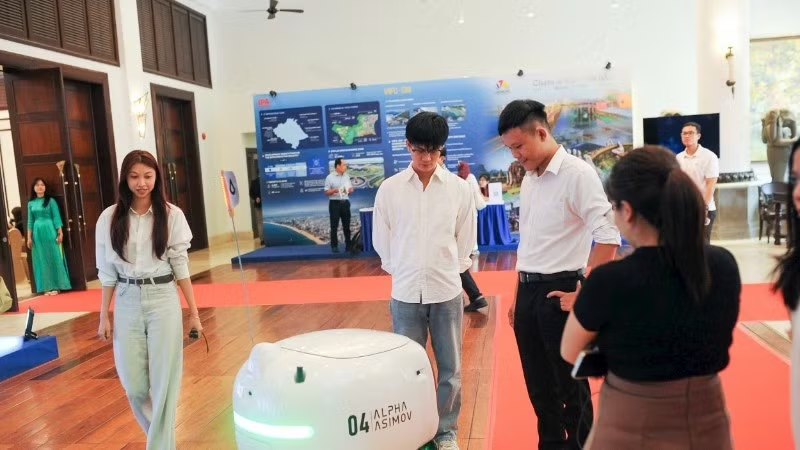
Nguyen Tuan Anh, co-founder and Chief Executive Officer of Alpha Asimov Robotics, who previously served as founding Managing Director of Grab Viet Nam before embarking on his entrepreneurial journey, asserts that early real-world testing is pivotal for technology start-ups to demonstrate that their systems can operate reliably in the market.
Such technologies necessitate an extended cycle of research and testing before proving their ability to operate on a large scale.
"Developing a delivery robot start-up is a long-term process that requires constant trial and error, making fundraising extremely challenging. Only after proving the system can operate at scale will additional investors commit capital," he said.
In reality, start-ups are by nature pioneers, characterised by novelty, breakthrough, and a high degree of risk. In their early stages, many investors and regulators tend to adopt a cautious posture.
For start-ups, however, risk aversion generates significant delays, whereas time is a vital asset for optimising capital and securing market share ahead of competitors.
"A culture of risk acceptance is not something that is simply desirable to have. The real challenge is learning how to accept and manage risks in a controlled manner. Building such a culture must begin with all parties listening to one another. Start-ups need to understand the concerns and regulatory responsibilities of policymakers, while policymakers should understand, support, and share the perspectives of businesses," Nguyen Tuan Anh emphasised.
A historic development opportunity
As Viet Nam seeks to transform its growth model, the nation requires localities capable of spearheading piloting new development models, testing them in practice, refining institutions, and creating new drivers of growth.
Da Nang now stands at a decisive turning point in its development as special mechanisms and policies gradually shape its competitive advantages, while foreign investors are demonstrating increasing interest in new initiatives such as the International Financial Centre and the Free Trade Zone.
As the city pursues its ambition to become an innovation city, success will not be measured by slogans but by the extent to which its innovation and start-up ecosystem is nurtured within the new development space jointly forged by the central level and Da Nang.
At the recent Da Nang 2026 High-level Policy Dialogue, many experts, policymakers, and business leaders from Viet Nam and abroad agreed that the city can no longer be defined merely as "a liveable city", but should become a place worth working in, investing in, and launching innovative start-ups.
Realising this goal demands breakthroughs in policy implementation and coordinated execution.
According to many experts, the foremost requirement is to reform resource allocation mechanisms and strengthen decentralisation and delegation of authority to generate new momentum, resources, and capacity for development, while attracting highly qualified professionals to serve in the state apparatus and drive innovation.
According to Dr Nguyen Dinh Cung, former President of the Central Institute for Economic Management (CIEM), the shift from pre-inspection to post-inspection based on risk management has yet to yield comprehensive results, as "ask-give" practices still persist.
Experts at the dialogue also argued that state administrative agencies would continue to prioritise procedural safety over breakthrough initiatives unless institutional mechanisms are instituted to protect officials who dare to innovate, think creatively, take action, and assume responsibility for the common good, supported by transparent, objective, and data-driven evaluation systems.
In fact, the policies of the Party and the State have been paving the way for accepting and managing risks while promoting new development models, breakthroughs in science and technology, innovation, and digital transformation.
Nguyen Manh Hung, Chairman of the Da Nang People's Committee, stated that the Party Central Committee's approval of a range of special mechanisms and policies had unlocked a historic development opportunity for the city.
"Throughout the development process, many new models require pioneering localities to test them before they can be refined and replicated nationwide. Da Nang hopes to assume that role," he affirmed.
Initiatives such as the International Financial Centre and the Free Trade Zone effectively serve as institutional sandboxes. Da Nang therefore must capitalise on these advantages to create distinctive competitive strengths, develop new governance models, foster innovation, and attract investors.
Experts also stressed that the city must act decisively in translating policies into concrete execution through clearer and more specific regulations.