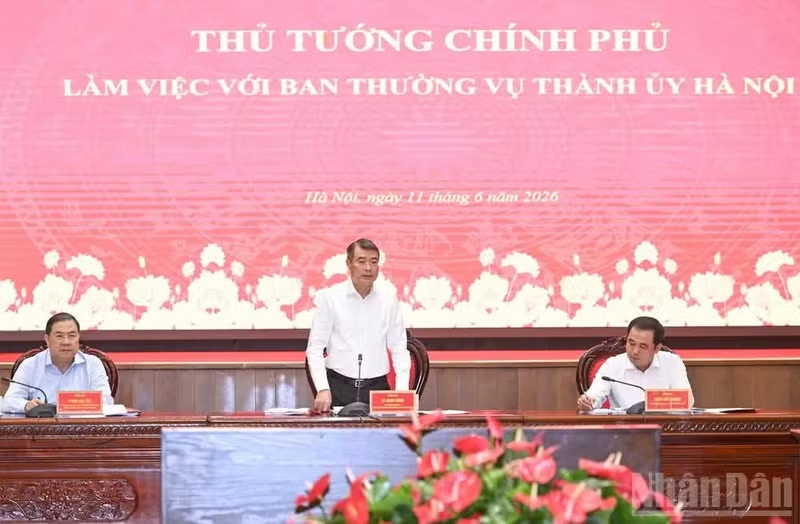
Prime Minister Le Minh Hung has called on Ha Noi to set higher development goals and standards commensurate with its role as the nation’s political and administrative centre, stressing that the capital must make greater contributions to the country’s double-digit growth target.
The leader made the request while chairing a working session with the Standing Board of the Ha Noi Party Committee on June 11, which focused on reviewing the city’s socio-economic development, public investment disbursement, the implementation of the two-tier local administration model, the enforcement of the Politburo's Resolution No. 57-NQ/TW on breakthroughs in science and technology, innovation and digital transformation, and measures to address long-standing stalled projects.
The PM acknowledged Ha Noi’s achievements and contributions to national development but pointed to several shortcomings.
Its GRDP growth in the first quarter of 2026 fell short of the planned scenario, while the consumer price index rose higher than the national average and the implementation of special mechanisms under the Capital Law still faces numerous difficulties, he said.
The mobilisation of private-sector investment has yet to meet requirements, he continued, noting many public investment projects and key infrastructure developments remain behind schedule due to obstacles related to land clearance, land availability, and resettlement housing.
Environmental pollution, traffic congestion, urban flooding, school overcrowding and shortages of highly skilled workers in digital technology, artificial intelligence (AI), big data and semiconductors also remain pressing issues, he said.
PM Hung urged Ha Noi to effectively implement resolutions and conclusions issued by the Party Central Committee, the Politburo, the Secretariat, the National Assembly, and the Government regarding capital development in the new era.
Ha Noi was also asked to accelerate the enforcement of the Capital Law, and strengthen linkage with localities in the Capital Region and the Red River Delta, particularly in transport infrastructure, environmental protection, water resource management, air pollution control, and the establishment of production and supply chains for goods and services.
The PM emphasised that Ha Noi must achieve its 11% growth target for 2026 through comprehensive solutions and regular reviews of growth scenarios. He called on the city to unlock growth potential in processing, manufacturing, trade, services, finance, banking, insurance, transport, logistics, construction and real estate, while controlling inflation and ensuring market stability.
The government leader placed strong emphasis on the need to mobilise and optimise all resources for development, urging Ha Noi to design sustainable solutions to boost budget revenue, practice thrift, and cut at least 10% of recurrent spending, with further reductions to free up resources for development investment and social welfare.
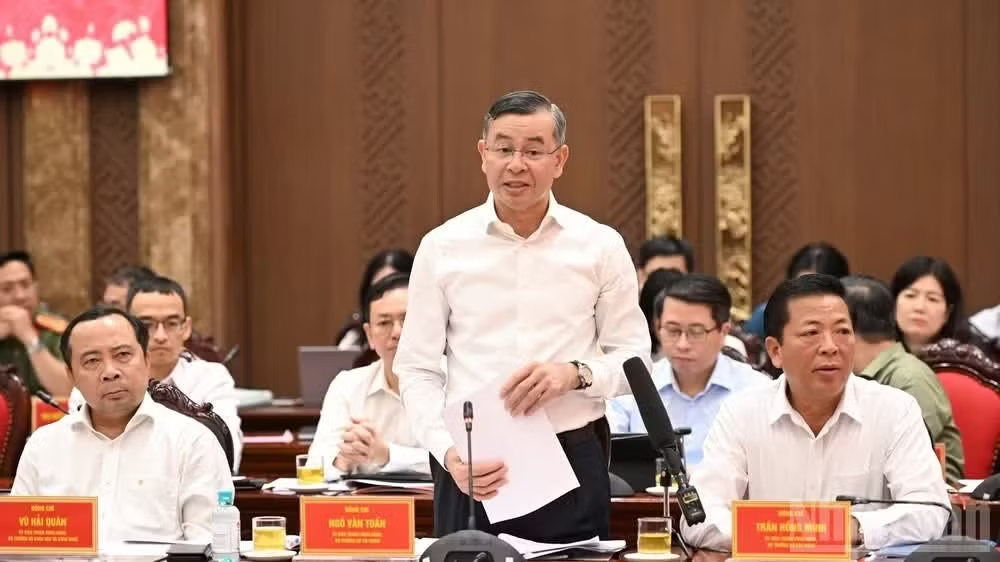
The city should make the best use of land resources, improve the efficiency of public investment, and channel capital toward high-impact, spillover projects. At the same time, it should step up efforts to crowd in private capital, targeting a ratio of one unit of public investment to five to ten units of off-budget funding.
Local authorities were also encouraged to strengthen attraction of FDI, ODA, and credit flows, while studying the issuance of capital bonds to finance key priority projects.
At the same time, the city should review its medium-term public investment plan for 2026–2030, with a focus on concentrated, non-fragmented spending, cutting the number of projects by at least 30% compared with the previous period. It should also strive to fully disburse 100% of public investment capital in 2026.
On public welfare issues, the PM urged Ha Noi to implement coordinated measures to address air and water pollution, traffic congestion, flooding, and waste management, aiming to fundamentally complete these tasks this year.
Regarding administrative reform, the city was instructed to immediately cut 50% of administrative procedures affecting citizens and businesses, strengthen data integration and interoperability with national databases, and accelerate digital processing of administrative dossiers. It must also ensure that 100% of eligible public services are delivered fully online by the third quarter of 2026.
For rental housing, the PM said Ha Noi’s preparation to break ground on several projects is highly commendable, but it is only a first step. More importantly, he stressed the need to refine institutions and policies to promote the sustainable and effective development of social housing.
Highlighting science, technology and innovation as strategic drivers, PM Hung said Ha Noi must become the country’s leading centre for science, technology and innovation with a recognised position in Asia. He called for accelerated development of strategic sectors such as AI, semiconductors, robotics, automation, aerospace, cybersecurity and quantum technology, while pushing ahead with smart city building and raising the digital economy’s share of GRDP to around 22% by the end of 2026.
The PM also urged the city to tackle environmental hotspots, improve air quality, develop modern waste and wastewater treatment systems, expand low-emission zones, and strengthen healthcare, education and social welfare services. He further stressed the importance of effectively operating the two-tier local administration model and fostering a supportive environment for innovative and responsible public officials.
A report presented by Chairman of the municipal People’s Committee Vu Dai Thang showed that Ha Noi’s GRDP expanded by 7.87% in the first quarter of 2026 compared to the same period last year, surpassing the national average of 7.83% but falling short of the city’s target scenario of 10.23%.
The city recorded positive economic indicators, with state budget revenue reaching nearly 57% of the annual estimate and public investment disbursement amounting to 48 trillion VND (1.82 billion USD), or nearly 40% of the yearly plan.