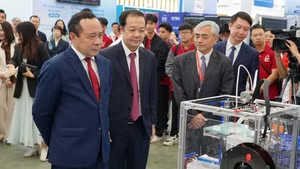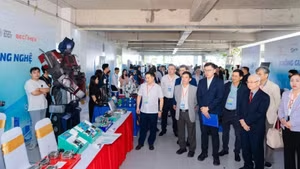
Distinguishing core technologies that need to be developed centrally from applications at the local level will help limit fragmented investment and expand opportunities for sharing research outcomes.
Distinguishing core technologies from application needs
AI-powered virtual assistants have been proposed by Thai Nguyen, Dien Bien, Nghe An, Can Tho, Ca Mau, Tay Ninh and Dak Lak. Many localities are also interested in unmanned aerial vehicles (UAVs) for forest monitoring, agricultural production, land management, urban management, search and rescue. Medical data, AI cameras, digital twins and spatial data also feature in numerous proposals. The demand for applications is clear, but if each locality builds a closed system of its own, resources and data will become fragmented.
At a coordination meeting on September 18, Minister of Science and Technology Vu Hai Quan called for urgent action to address duplication and clearly distinguish between research, development, application and technology procurement tasks. Tasks must stem from practical needs, place businesses at the centre and involve research institutes and universities. For needs shared by multiple localities, the Ministry of Science and Technology plans to establish large-scale tasks to pool resources.
The review found that proposals using the same type of technology could nevertheless have different content and objectives. Regarding AI cameras, Ha Noi proposed researching and developing a multipurpose platform, while several other localities focused on applications for security, traffic management or urban management.
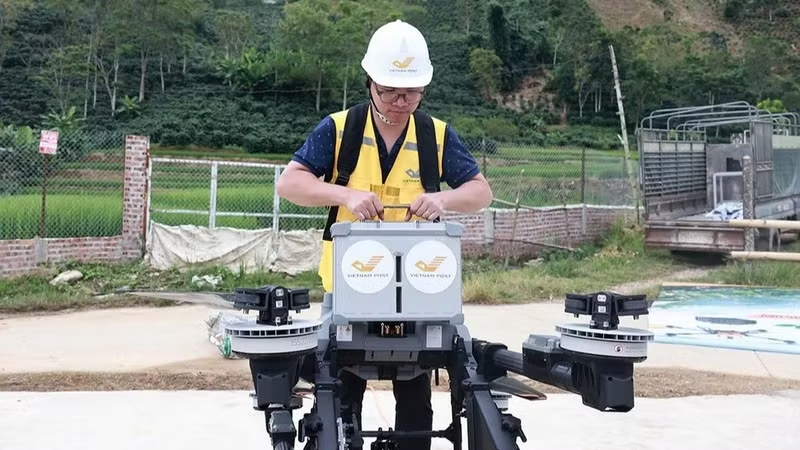
For UAVs, most proposals aim to use commercially available equipment fitted with sensors for image capture and processing, while some focus on developing core technologies. Identifying duplication therefore requires a specific examination of the technological content, products and scope of use of each task.
Dien Bien has opted for controlled trials of three to five UAV application models in agriculture, logistics, healthcare and digital mapping, with approximately 6,000 flights planned. Through these trials, the province will assess the effectiveness of the technology in addressing specific needs, providing a basis for considering wider deployment.
In healthcare, several localities have proposed building image databases, training computer vision models and deploying electronic medical records. If data remain isolated within individual hospitals or provinces, the ability to pool samples for training and validating AI models will be limited. A suitable solution is to standardise data standards and establish an interoperable, shared data environment, while allowing each locality to select priority healthcare challenges in diagnosis and treatment.
Some localities have linked their proposals to their own advantages and capabilities. Quang Tri aims to develop a technology chain from quartz to silicon materials, Ninh Binh is interested in digital twins of national heritage sites, while Bac Ninh is focusing on microchip packaging and testing. These proposals need to be considered within broader value chains to identify the tasks that each locality can undertake, opportunities for cooperation with businesses and the intended product outputs.
According to the Ministry of Science and Technology, before approval, it is necessary to clarify whether similar technologies and products already exist and whether they can be purchased, leased, acquired through technology transfer or shared. Appraisal must identify the products, technical specifications, level of localisation, intended recipients and commercialisation plans. These requirements will help ensure that funding is allocated to genuine research needs rather than the development of technologies for routine applications.
Concentrating research resources and facilitating local implementation
Based on the 113 proposals submitted by localities, the Ministry of Science and Technology has proposed organising tasks into three tiers. The first tier covers national and inter-regional challenges, as well as difficult core technologies, which need to be consolidated into national-level tasks. The second comprises common technologies validated in multiple locations and coordinated by ministries and sectors. The third covers applications of mature technologies, which localities can decide on and implement independently.
Under this arrangement, resources will be concentrated on developing and validating core technologies in real-world conditions, while individual localities can add data, procedures and functions suited to their needs.
The development of a shared data repository in Nghe An also demonstrates how a unified platform can be combined with the responsibilities of individual units. The repository is being developed in line with the national and provincial data architectures and connected to the iNgheAn operational handbook, the real-time operations platform and the open data portal.
To date, eight of the ten sectors have established unit-level data repositories containing 158 datasets, while the provincial repository records 138 datasets across 31 categories. The province has standardised its architecture and technology platform, while the units that create the data are responsible for updating it and ensuring its quality.
Nguyen Minh Duc, Chairman of the Cybersecurity Services Club under the National Cybersecurity Association and Chief Executive Officer of CyRadar, said that the commissioning process needed to distinguish clearly between core technologies and extended applications. Platforms should be designed with open architectures and application programming interfaces that allow localities to integrate functions tailored to their specific needs. Contracts should stipulate the ability to transfer data in open standard formats, enabling user agencies to avoid dependence on a single provider.
According to Duc, a unified architecture must go hand in hand with a clear division of data governance responsibilities. Systems must ensure information security in accordance with their designated security levels from the design stage, with measures in place to limit the spread of incidents between applications. New proposals should be compared with existing national platforms to make use of shared components and reserve resources for functions that remain lacking.
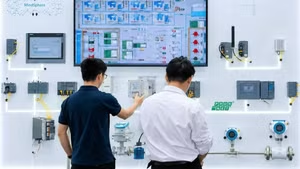
At the National Digital Transformation Forum, Tran Duy Ninh, Director General of the National Digital Transformation Department, noted that compliance with the National Digital Architecture Framework still leaves room for localities to innovate and develop solutions suited to their specific characteristics. Developing shared technologies also requires research groups and businesses to have access to adequately equipped testing infrastructure.
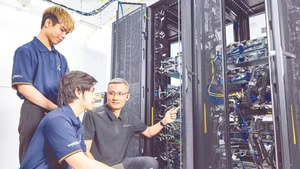
Under the implementation plan for Decision No. 1483/QD-TTg, the target for 2030 is to upgrade existing facilities, make new investments and bring into operation at least eight national key laboratories and four national research and testing centres. The Ministry of Science and Technology plans to develop a digital platform for managing information, facilitating connectivity and supporting the shared use of these systems, with operations scheduled to begin in the second quarter of 2027.
The management mechanism is shifting towards work packages and evaluation milestones. Each package specifies its objectives, outputs, funding and deadline. Results at each milestone will serve as the basis for allocating funding for the next phase. Tasks that fail to meet requirements must be considered for adjustment or termination, with resources reallocated as appropriate.
Deputy Minister of Science and Technology Le Xuan Dinh stressed that tasks should be monitored using indicators covering technology readiness, intellectual property, localisation rates, non-state funding and revenue. Programme outcomes should be assessed in terms of mastery of core technologies, market adoption of products, the establishment of technology businesses, the replacement of imported technologies and the resolution of practical challenges, rather than the number of research projects or the level of budget disbursement.
A shared-use model needs to define the responsibilities of each stakeholder from the outset. Ministries and sectors select the challenges to be addressed and organise open calls for proposals. Localities identify their needs, facilitate trials and use the resulting products. Businesses, research institutes and universities participate from an early stage to clarify expected outputs, core technologies, resources and intended applications. Common needs can be consolidated into national or inter-regional tasks, while localities select and implement specific applications themselves. This approach helps concentrate research resources while making it easier for localities to use products that have been validated.