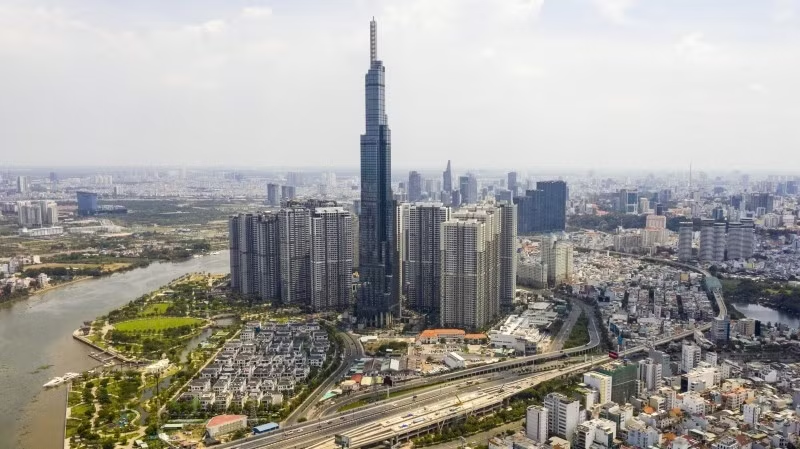
In recent years, Ho Chi Minh City has achieved many positive results in economic development, improving the investment environment and promoting science, technology and innovation. The city has also demonstrated a strong spirit of dynamism and pioneering action, showing readiness to experiment with new models and apply technology to address challenges arising in the development of a major urban centre.
Experts say that with its large economic scale, dynamic innovation ecosystem, strong business community and numerous large-scale practical challenges, the city has favourable conditions to become a “Living Lab” – a large-scale real-world testing ground for new technologies. This would not only provide a setting for testing technologies under real-life conditions, but could also become an environment for refining solutions, assessing their effectiveness and gradually scaling up suitable models.
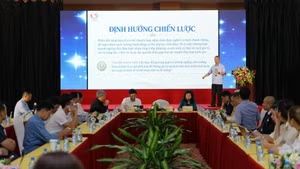
Nguyen Dinh Thang, a founding council member of the Viet Nam Software and IT Services Association (VINASA), said Ho Chi Minh City is entering a new stage of development with a growth target of more than 10%. This is an ambitious objective, requiring the city not only to expand the scale and pace of development, but more importantly to create new growth drivers and new modes of development.
To pursue sustainable growth, according to Nguyen Dinh Thang, the city is giving an increasingly important role to science, technology, innovation, digital transformation and the digital economy within its growth model. This opens up significant room for technology to become more deeply integrated into economic sectors, business operations and urban governance.
To translate this objective into reality, the city needs to clearly identify major development challenges and priorities. Technology enterprises should be involved from an early stage in jointly researching and designing solutions, while new models can be tested through sandboxes, pilot projects and public-private partnerships. Following the testing phase, mechanisms are needed to evaluate, refine, commercialise and scale up solutions that prove effective.
If a favourable environment can be created for testing, evaluation, commercialisation and scaling up, the city will not only be able to address its own development challenges effectively, but can also create “Make in Viet Nam” technology products, platforms and models with the potential to expand into domestic, regional and international markets.
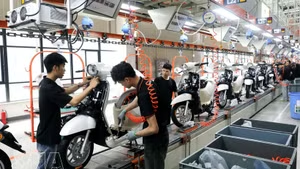
According to experts, the growth model based on labour-intensive production, low-cost outsourcing and resource exploitation has fulfilled its historical role and is reaching its limits. To move forward, the city can no longer rely solely on optimising existing spaces, but must open up entirely new development spaces.
These new spaces are not about expanding land area, but lie in digital space, data space, computing capacity and, in particular, airspace. For this reason, the city has identified science and technology and innovation, with artificial intelligence and core technologies (DeepTech) at the centre, as among the key drivers of growth.
It should be acknowledged that the capacity of Vietnamese engineers and enterprises to master core technologies is by no means weak, yet the application of DeepTech remains slow or is still largely confined to the experimental stage. Ho Chi Minh City therefore needs to make stronger efforts to build key pillars, including institutions and testing mechanisms, digital data space and digital infrastructure.
Addressing the question of how a large-scale metropolis can still operate in a unified, seamless, efficient and intelligent manner, Vo Thi Trung Trinh, Director of the Ho Chi Minh City Digital Transformation Centre, said that from a digital transformation perspective, the answer lies in three elements: digital infrastructure creates connectivity; data creates understanding; and artificial intelligence enables forecasting and supports decision-making.
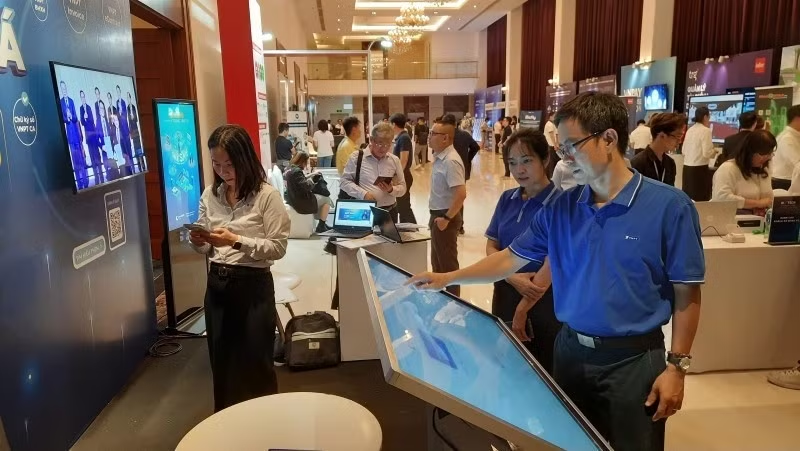
According to Vo Thi Trung Trinh: “If transport infrastructure is the ‘circulatory system’ of the city, then data and digital technology must become its ‘nervous system’. A nervous system enables us to see, understand, forecast and act. This is also the very foundation for building a Smart Mobility ecosystem.”
In addition, AI is expanding analytical and forecasting capabilities in urban governance. Based on connected data, AI can identify trends, detect anomalies, develop scenarios and provide information to support management and administration. The technology does not replace the role of people, but provides officials and leaders with an additional basis for assessing situations, considering options and making decisions that are more timely and better aligned with practical realities.
With a growth target of more than 10% and aspirations to reach new heights, Ho Chi Minh City is clearly affirming a development direction based on science, technology, innovation and digital transformation, with artificial intelligence and core technologies at the centre. Building digital space, data space and computing capacity is how the city is opening up new room for growth and moving beyond the limits of the traditional development model.