Unlocking resources and creating additional growth drivers
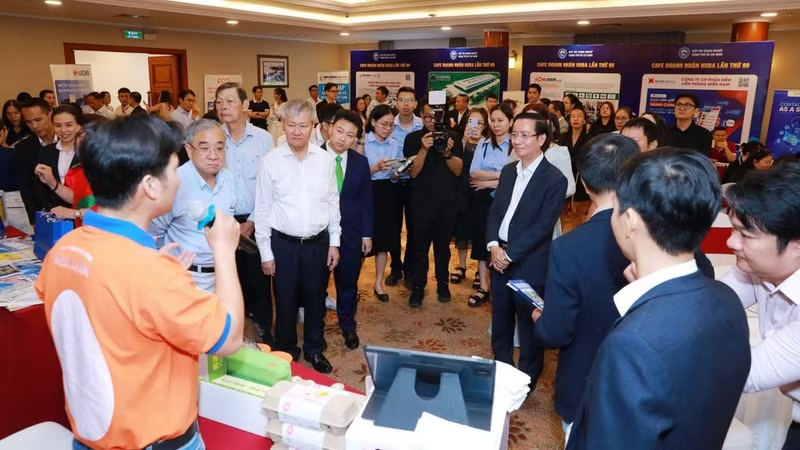
At the Business Coffee programme organised by the Ho Chi Minh City Business Association (HUBA) under the theme “Businesses joining forces for double-digit growth”, many experts asserted that new growth drivers need to be harnessed alongside traditional ones such as investment, consumption, and net exports.
Dr Can Van Luc, an economist, noted that five new drivers — science, technology, and digital transformation; administrative procedure reform; development of growth poles and regional linkages; green transformation; and the resolution of stalled projects—could collectively contribute around three percentage points to economic growth if implemented effectively.
For Ho Chi Minh City, there is still considerable room for growth, but the need to accelerate in the final months of the year remains acute. According to Dr Can Van Luc, the city's GRDP grew by 8.55% in the first six months of 2026, ranking 18th among the 34 provinces and centrally governed cities. If the city is to achieve an annual growth of 10–11%, it needs to accelerate significantly.
In the first seven months of the year, total retail sales of goods and services increased by around 13%, investment capital rose by 10%, and exports grew by 9%. To move towards double-digit growth, the city needs to raise investment growth to around 13–15%, while also boosting consumption and exports.
Ho Chi Minh City's growth momentum depends on its ability to improve five key pillars simultaneously: science, technology, and innovation; human resources; infrastructure; mobilisation and allocation of financial resources; and the quality of institutions and effectiveness of implementation.
Furthermore, the industrial and construction sectors still need to improve, accounting for around 36.5% of GRDP in 2025. Meanwhile, the services sector continues to play a major role, contributing more than half of overall growth.
Enterprises must shift from volume-based growth to value-based growth
It is not only the State that needs to provide a boost; the business community also faces the imperative to change its approach to growth. Nguyen Ngoc Hoa, Chairman of HUBA, noted that the double-digit growth target is both an opportunity and a major challenge for the business community. Achieving this target requires joint efforts from businesses, the State, and society as a whole.
According to Hoa, one of the major bottlenecks at present is resources, particularly capital for growth. Therefore, policies are needed to enhance attractiveness and mobilise additional sources of capital. Accelerating equitisation and selling the State's stakes in certain enterprises could create opportunities to attract investors and bring new cash flows into the economy.
Businesses also hope that the transition to a two-tier local government model will be expedited, with responsibilities clearly divided between the city, ward, and commune levels. Once procedures, processes, and access to land and resources are streamlined, businesses will find it easier to implement projects.
Conversely, businesses must also adjust their strategies, strengthen workforce training, and proactively pursue digital transformation and green transformation to adapt to new market requirements.
Le Huu Nghia, General Director of Le Thanh Construction Trading Company Limited, asserted that to achieve the double-digit growth target, Ho Chi Minh City has considerable untapped potential beyond mere business growth.
According to Nghia, these solutions need to be implemented immediately to generate results during 2027–2028. Businesses also expect the business environment to improve from now until the end of the year.
In the tourism sector, Nguyen Quoc Ky, Chairman of the Board of Directors of Vietravel, noted that the potential lies not only in increasing visitor numbers but, more importantly, in amplifying the value generated by tourism activities. The city needs to invest more heavily in tourism products, tours and routes, entertainment, the night-time economy, and the exploitation of local cultural and culinary resources.
According to Ky, the night-time economy is expected to generate significant value, but so far no locality has clearly demonstrated its effectiveness. Many places still lack the resources needed to develop professional cultural and culinary products, leaving activities fragmented and unstable.
Turning the trade deficit into production capacity
Another issue underscored by Dr. Can Van Luc is pressure from interest rates and the ability to mobilise capital. According to him, interest rates are currently relatively high and a significant reduction is unlikely. Businesses need to adapt to the new interest-rate environment while diversifying their sources of capital instead of relying too heavily on bank credit.
Businesses must pivot from a mindset of mere scale expansion to one focused on amplifying added value, thereby investing more heavily in technology, data, artificial intelligence (AI), research and development, deeper processing, and the creation of new products.
At present, a mere 5% of Vietnamese enterprises invest in R&D, compared with approximately 15–20% in the broader ASEAN region. It is imperative that businesses integrate more deeply into global value chains, forge stronger linkages with the FDI sector, and aggressively promote the exports of goods and services.
The trade deficit represents another notable concern. According to Dr. Luc, the goods trade deficit reached 20.6 billion USD in the first seven months of the year, while the services trade deficit stood at 5.54 billion USD. Nevertheless, approximately 90–93% of Viet Nam's imports consist of machinery, equipment, raw materials, and other vital inputs destined for production and business activities, rather than mere consumer goods.
Consequently, the economy cannot be evaluated solely through the lens of the trade deficit. An imported production line will not generate immediate revenue; however, once put into operation, it serves as an engine for creating products, generating employment, and driving added value. These products can subsequently be consumed domestically or channelled into export markets.
For Ho Chi Minh City to achieve its ambitious double-digit growth target, the paramount requirement is not merely to mobilise additional resources, but to actively turn those resources into tangible production capacity and competitive advantage. The city must sustain robust goods exports while simultaneously expanding service exports in high-value areas such as logistics, tourism, and finance; vigorously develop supporting industries; elevate the localisation rate; and systematically reduce its dependence on external supply chains.