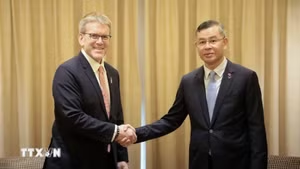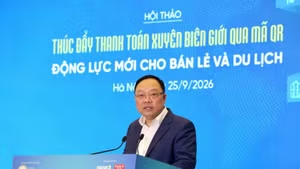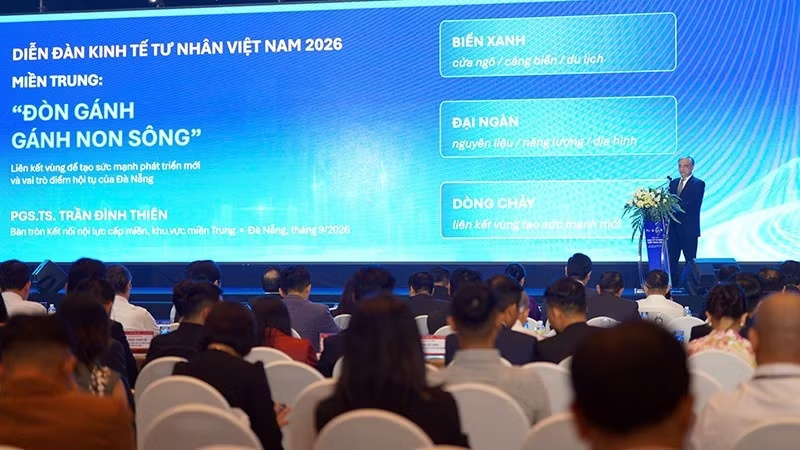
The VPSF’s roundtable session brought together representatives of the business community in central Viet Nam to identify common bottlenecks, explore opportunities for regional connectivity, and propose solutions to help the private sector make a breakthrough in the new development period. The event was attended by US Ambassador to Viet Nam Jennifer Wicks.
After nine local dialogues under the framework of the VPSF 2026, the Viet Nam Young Entrepreneurs Association Central Committee had collected more than 400 opinions, recommendations, and initiatives. More than 43% of the issues had been addressed, clarified, or given directions for handling during the sessions. Recurring concerns in many localities included institutions and implementation, infrastructure and logistics, markets and supply chains, technology and data, green transition, capital, human resources, and governance.
Opening the roundtable session, Dang Hong Anh, Chairman of the Viet Nam Young Entrepreneurs Association and Chairman of VPSF 2026, said central Viet Nam had a distinctive economic structure, combining the sea, ports, industry, and coastal cities with the Central Highlands, material-producing areas, agriculture, energy, and East-West economic corridors.
The key issue, he said, was no longer what resources the region had, but how those resources were connected. Based on nine local dialogues held in the region, the Viet Nam Young Entrepreneurs Association identified three gaps that needed to be narrowed: between policy and implementation; between infrastructure and economic corridors; and between local growth and the capacity to grow of businesses.
Assoc. Prof. Dr. Tran Dinh Thien, a member of the National Financial and Monetary Policy Advisory Council, said central Viet Nam has considerable advantages but accounted for only 19.26% of the country's total GDP. Its infrastructure remains fragmented according to the expectations of individual localities, while the region lacks a complete expressway axis linking the coastal areas with the Central Highlands, and its business base remain relatively small.
He proposed shifting from administrative-boundary-based cooperation to value-chain-based connectivity, with businesses as the main actors and Da Nang serving as the region's service hub. He also proposed three immediate measures: establishing regional and inter-regional coordination mechanisms; assigning roles among seaports and logistics systems; and establishing a permanent institution representing central Vietnamese businesses in Da Nang.
Representing the central region and Central Highlands, Vu Hong Quan, a member of the 16th National Assembly, Vice Chairman of the Viet Nam Young Entrepreneurs Association and Chairman of the Gia Lai Young Entrepreneurs Association, proposed three groups of solutions: building a shared regional database and business-capability profiles; developing suppliers based on the demands of projects and lead businesses; and establishing a cross-provincial network to connect businesses with capital, technology, standards, and markets.

After the roundtable session, the forum “Viet Nam's Private Economy 2026: Institutional Breakthroughs – Public-Private Cooperation”, delegates discussed institutional bottlenecks, business environment, resource connectivity, and the need to strengthen public-private cooperation.
Closing the session, Mai Minh Vuong, Chairman of the Da Nang Young Entrepreneurs Association and head of the Central region roundtable session, stressed the need to turn regional connectivity and public-private cooperation into substantive coordination mechanisms that can create new momentum for the region's development. Cooperation should focus on supply chains, markets, logistics, technology, data, human resources, and investment, with clear focal points and criteria for assessing results.