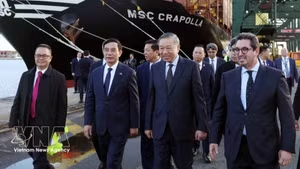
Total import-export turnover in 2025 reached 930.1 billion USD, a year-on-year increase of 18.2%. In the first eight months of 2026, the figure continued to rise sharply, reaching 770.14 billion USD, up 28.7% over the same period last year.
Logistics costs erode business profits
As import-export turnover continues to set records, the issue facing businesses is not only revenue but also the profits they actually retain. Logistics costs are among the factors directly affecting Vietnamese exports.
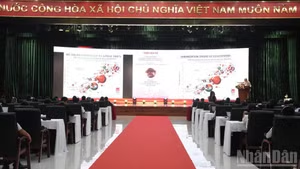
At a conference on solutions to reduce logistics costs to promote exports, Truong Van Cam, Vice Chairman and Secretary General of the Viet Nam Textile and Apparel Association, said domestic businesses mainly have to bear logistics costs from factories to seaports. From the seaports onwards, the costs are borne by customers. Businesses have been less affected by the major fluctuations in the international transport chain in recent times.
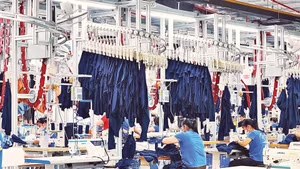
However, as part of the supply chain, businesses must still share some costs with customers when congestion occurs on sea transport routes. For domestic transport, logistics costs currently account for around 9-10% of import-export turnover. Meanwhile, the textile and garment industry “makes profits from labour”, with profit margins of only around 3-5%.
Logistics costs remain a major issue for the economy as a whole, not just the textile and garment sector. According to the Viet Nam Logistics Report 2025, these costs currently account for around 16-17% of GDP. Although this is lower than previously, it remains significantly higher than the global average of around 11%.
A shipment also incurs port, warehousing, container storage, customs clearance, inventory, capital, and other costs arising from late delivery, waiting, or reprocessing. Costs arise at every stage of the chain, pushing up the final price of goods.
The Vietnamese logistics industry has a scale of around 45-50 billion USD, equivalent to about 10% of GDP. The continued heavy reliance on road transport, with connections between roads and railways, waterways, and sea routes still being unsynchronised, makes it difficult for businesses to optimise transport modes.
This reality is particularly evident in the food industry. According to Tran Son Ha, Vice Chairman of the Viet Nam Food Association, most rice exporters have their factories in the Mekong Delta. However, the region still lacks specialised ports and deep-water ports capable of receiving large vessels. Many businesses must transport goods from their factories to Ho Chi Minh City for export.
“Recently, inland waterway transport costs have at times increased by up to 50%, while road transport costs have risen two- to threefold. For the food industry, which has relatively low profit margins, fluctuations in transport costs have placed significant additional pressure on export operations,” Ha said.
According to the Viet Nam Association of Seafood Exporters and Producers, most exported products are frozen goods, so in addition to freight charges, businesses also must bear the costs of cold storage, containers, and related services. Changes to vessel schedules, problems with paperwork, or containers not being loaded onto vessels as planned can all result in additional storage, container detention, and other related costs for businesses.
International transport costs are currently high and difficult to predict. In some cases, businesses have secured orders and booked vessels, but when the containers are due to be loaded, they are unable to transport them as planned.
Logistics pressures stem not only from high freight rates but also from the stability and predictability of the entire process. For sectors with low profit margins, a single additional cost or delay at any stage can significantly reduce the efficiency of an export order.
From removing individual bottlenecks to restructuring the entire chain
To reduce logistics costs, associations have called for a focus on infrastructure, transport modes, and procedures. The Viet Nam Textile and Apparel Association has proposed continuing to improve port operations and customs procedures, while expanding the list of businesses eligible for the customs priority regime to include large-scale enterprises that operate stably and maintain good compliance. At the same time, rail, inland waterway, and sea transport connections need to be strengthened to reduce reliance on roads.
The Viet Nam Association of Seafood Exporters and Producers has proposed establishing a mechanism for determining container transport costs, with forecasts to enable businesses to proactively calculate costs when signing contracts with partners, while at the same time accelerating the digitalisation and interconnection of paperwork procedures. For major production areas, the Viet Nam Food Association has proposed investing in more deep-water ports and logistics warehousing systems in the Mekong Delta, thereby facilitating direct exports from production areas and reducing transshipment.
From a management perspective, Bui Ba Nghiem, a senior specialist at the Import-Export Department under the Ministry of Industry and Trade, said reducing logistics costs should not stop at removing individual bottlenecks but requires solutions for the entire chain.
In this regard, the Ministry of Industry and Trade should take the lead and coordinate with the Ministry of Finance, the Ministry of Construction, the General Statistics Office of Viet Nam, localities, and logistics associations to develop a national logistics cost measurement system.
The set of indicators should include costs per tonne, container, or shipment; total journey time and waiting time; the on-time delivery rate; the number of days in inventory; the empty-running rate; container and yard storage costs; the proportion of electronic documents; and the number of times data has to be re-entered. Each indicator must have a baseline, a data owner, and a responsible agency.
The Ministry of Construction, together with localities, transport businesses, and cargo owners, should review high-volume corridors, prioritising routes to ports, waterways, freight stations, transshipment yards, and short-haul connections. On routes with sufficient cargo volumes, barges, coastal vessels, and scheduled freight services should be developed with all-inclusive prices and a single point of responsibility.
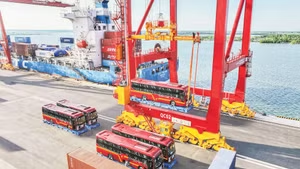
The parties should coordinate cargo consolidation, organise two-way cargo flows, and share empty containers, while measuring efficiency based on total costs and the reliability of the entire corridor. Seaports, airports, border gates, and warehouses need to apply booking systems, coordinate vehicles, extend operating hours when needed, exchange data before goods arrive, and make processing statuses public. Seaports must coordinate vessel schedules, yard plans, trucks, and barges, and quickly handle idle containers and empty equipment.
The Ministry of Finance and specialised management ministries should map procedures for major export goods, identify duplicate documents and stages that generate additional costs. Agencies should apply the principles of providing data once, processing information before goods arrive, risk management, post-clearance inspection when conditions permit, sharing pilot results, and making processing times public.
Import-export businesses need to manage based on total costs to market, standardise order data, forecast volumes, optimise packaging and stowage factors, control inventory, and select delivery terms and alternative routes. Contracts must clearly specify freight charges, surcharges, timelines, and responsibilities.
Domestic logistics businesses need to form partnerships to provide integrated services, invest in transport and warehouse management systems, develop overseas agents, and enhance multimodal and cold-chain logistics capabilities. Associations should support cargo consolidation, training, and the development of service standards, but they should not replace businesses in making commercial decisions.
“When each bottleneck has someone responsible, each solution has a baseline and each result is quantified, the goal of reducing logistics costs can become a tangible outcome, helping retain orders, expand markets, and promote sustainable exports,” Bui Ba Nghiem stressed.