Identifying new growth drivers
Economists and experts suggest that, following the merger, Quang Ngai possesses five new growth drivers: high-tech industry and deep processing; energy and the energy industry; the marine economy and logistics; the digital economy and innovation; and tourism and high-quality services.
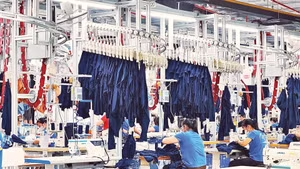
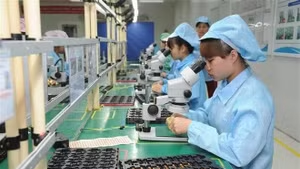
Regarding high-tech industry and deep processing as growth drivers, Associate Professor Dr. Vu Tuan Hung—Director of the Institute of Social Sciences in the Southern Region—argued that the province should build upon the traditional industrial foundation established at the Dung Quat Economic Zone.
He advocates for upgrading industrial value chains and shifting from basic manufacturing and assembly toward high-tech industries and deep processing. This involves creating an ecosystem for supporting industries and deep processing—covering steel, chemicals, downstream petroleum products, new materials, and industrial components. Such a strategy helps increase the share of value-added components within the industrial structure and mitigates risks associated with over-reliance on a few intermediate products.
Concurrently, the province should proactively attract high-tech projects linked to the green transition and boost deep processing industries—particularly for Ngoc Linh ginseng—to create branded, high-value-added products capable of participating in international export supply chains.
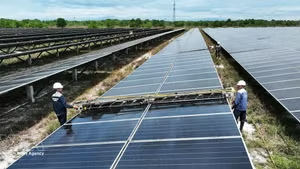
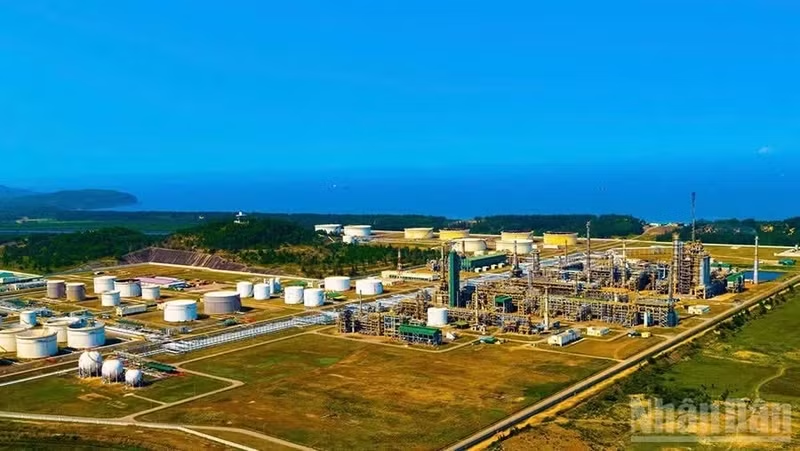
Regarding energy and the energy industry—Quang Ngai’s growth driver with the greatest potential—the Prime Minister has directed the development of a national petrochemical refining and energy hub within the Dung Quat Economic Zone.
This hub follows a sustainable, multi-sector model integrating oil refining, gas, LNG, power generation, renewable energy, and low-carbon industries. The foundation for this direction lies in the Dung Quat Oil Refinery alongside projects such as LNG-fired power plants, LNG terminals, and solar power, opening up opportunities to form a regional-scale “energy complex.”
“Developing the energy industry not only serves local economic growth but also positions Quang Ngai as a key link in the national energy security framework. This is particularly significant given that the Politburo’s Resolution 26-NQ/TW has designated the central coastal region as a hub for the robust development of the marine economy, the energy industry, and logistics,” emphasised Associate Professor Dr. Vu Tuan Hung.
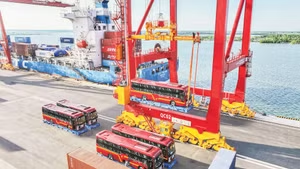
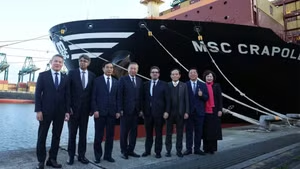
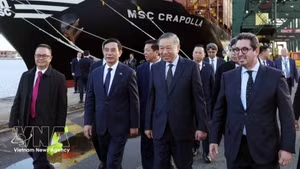
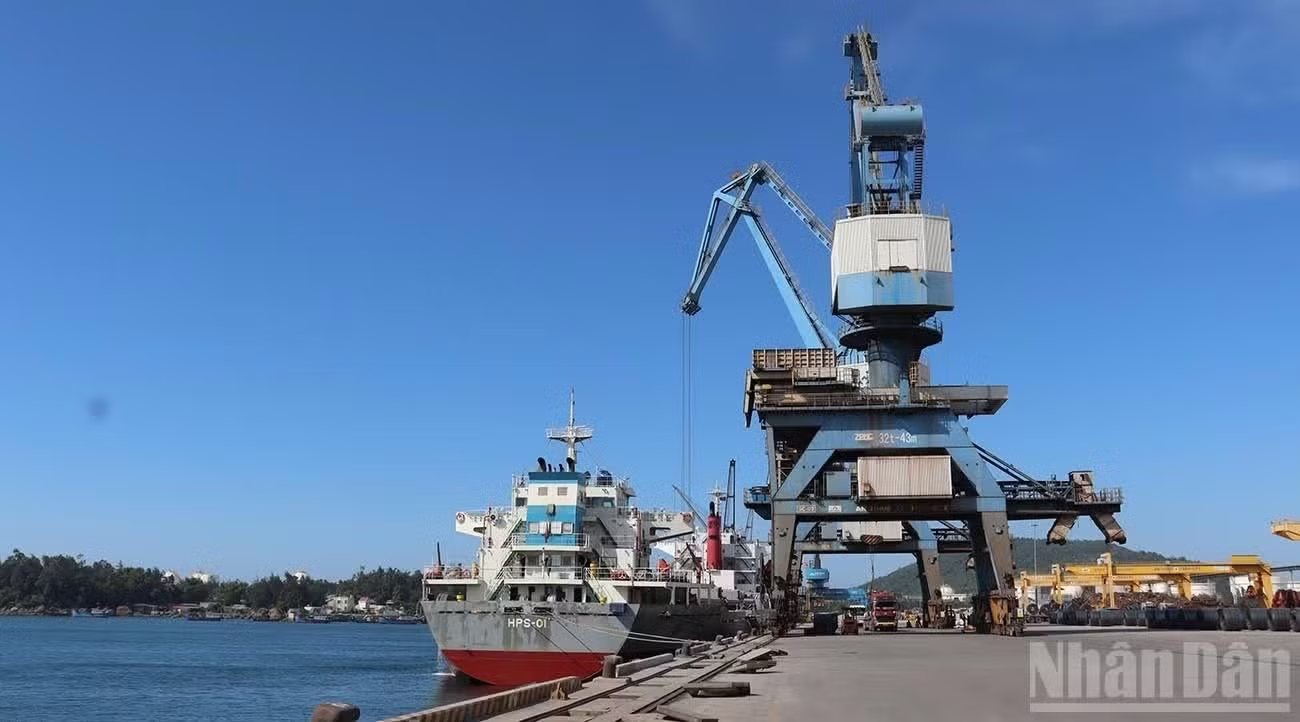
Regarding the marine economy and logistics, Quang Ngai possesses a coastline stretching over 130 km, the Dung Quat deep-water port (capable of accommodating 100,000 DWT vessels), and the Ly Son special zone, along with a dense network of estuaries; consequently, the marine economy and logistics serve as a structural growth driver for the province.
This driving axis comprises four components: developing the Dung Quat deep-water port and satellite ports into a cluster capable of serving not only local industries but also the Central Highlands, the East-West Economic Corridor, and parts of southern Laos and northeastern Cambodia; developing inter-regional logistics services; maritime economy, maritime transport, and high-tech marine aquaculture—linked to areas for farming marine fish, seaweed, and marine medicinal resources—while combining sustainable exploitation with biodiversity conservation.
Regarding the digital economy and innovation, Quang Ngai needs to view them as a cross-cutting driving force—one that extends beyond the information technology sector to permeate industry, energy, agriculture, services, and public administration.
The province’s advantage in accelerating the digital economy lies in the fact that the marginal cost of boosting the productivity of existing industrial and service sectors through digital technology is relatively low compared to the cost of new investments. Integrating digital upgrades with traditional growth drivers—particularly industry, energy, logistics, and tourism—can generate a multiplier effect on Gross Regional Domestic Product (GRDP) and labour productivity, helping the province gradually move away from a growth model reliant on a few large-scale industrial projects.
As for tourism and high-quality services, Quang Ngai possesses a highly complementary portfolio of tourism products: coastal and island tourism; cultural and historical tourism; eco-resort tourism linked to the Central Highlands; and community-based and high-tech agricultural tourism.

Alongside tourism, high-quality services must be developed in tandem to cater to both local residents and the experts and highly skilled workers employed in major industrial and energy projects. This serves as a foundation for Quang Ngai to evolve beyond a mere “manufacturing hub” and gradually become a “service hub” for the Central Coast and Central Highlands sub-region.
“The five aforementioned growth drivers do not exist in isolation; they share clear, mutually reinforcing relationships. The challenge lies in implementing a robust set of solutions to unlock each driver and integrate them into a cohesive development model,” stated Associate Professor Dr. Vu Tuan Hung.
Solutions to unlock growth drivers
According to experts and researchers, unlocking new growth drivers requires Quang Ngai to implement a comprehensive system of solutions, including: radically transforming development mindsets and refining institutional frameworks—particularly by establishing specific mechanisms for the Dung Quat Economic Zone and the national petrochemical and energy hub; developing integrated strategic infrastructure (transport, energy, and digital systems) aligned with energy security and the green transition; accelerating advancements in science, technology, innovation, and digital transformation in accordance with Resolution 57-NQ/TW; strengthening East-West and Central-Central Highlands regional linkages alongside international integration; and developing a high-quality workforce while significantly improving the investment and business environment.
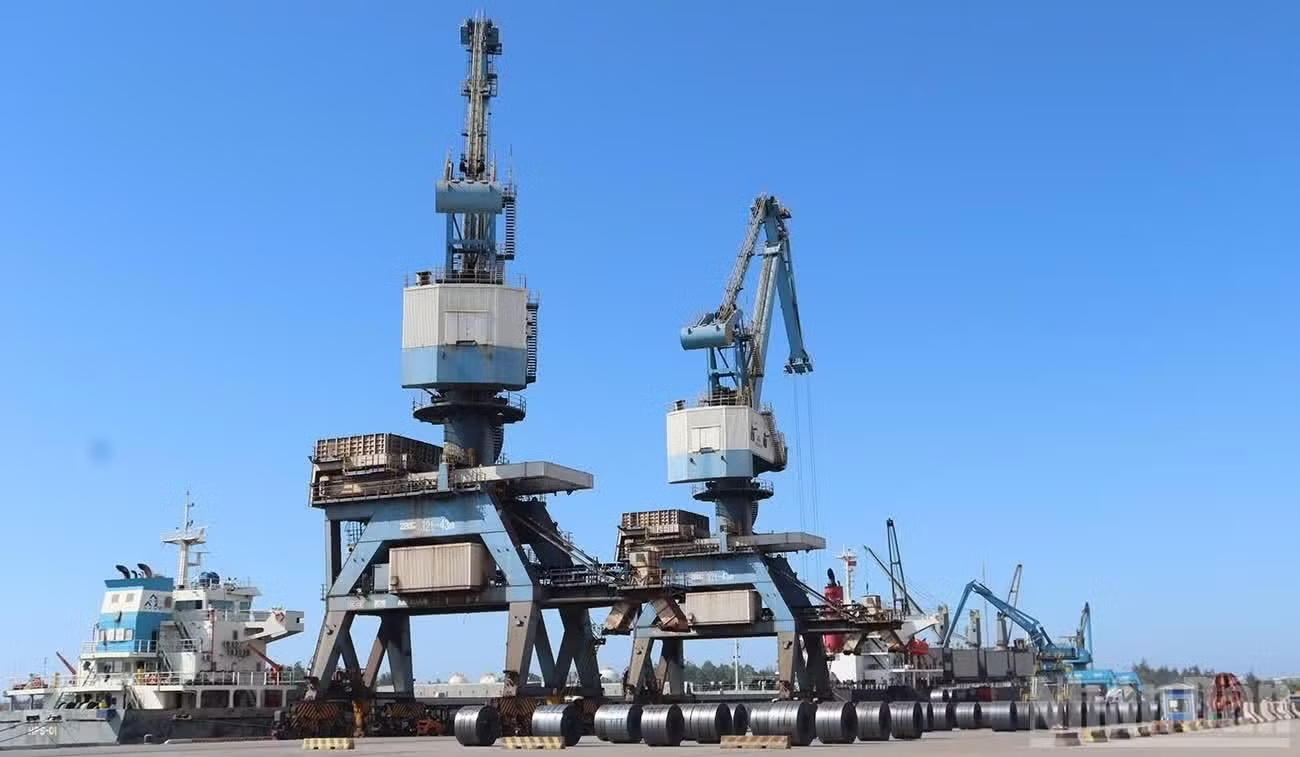
Crucially, the fundamental solution lies in a decisive shift from an extensive growth mindset to an intensive one, and from management based on administrative boundaries to governance centred on value chains and development corridors. The post-merger territory should be viewed as an integrated system linking east to west, coast to highlands, and sectors ranging from industry and agriculture to tourism and services.
At the same time, the province must proactively transform its growth model to rely more heavily on productivity, technology, and human resource quality, gradually reducing its dependence on a handful of mega-industrial projects.
It should also intensify strategic, selective investment promotion targeting world-leading corporations in technology, energy, logistics, and tourism, while prioritising the development of the private sector—particularly innovative firms, tech startups, and local enterprises with the potential to expand into international markets.
Successfully unlocking new growth drivers will not only enable Quang Ngai to achieve a breakthrough and become a relatively developed province but also establish it as a key growth pole in the Central Highlands region in the coming years.