Localities creating a new growth momentum
Dr Can Van Luc, BIDV Chief Economist and a member of the National Financial and Monetary Policy Advisory Council, said major international financial institutions such as Goldman Sachs and Morgan Stanley have offered positive assessments of Viet Nam’s economic outlook.
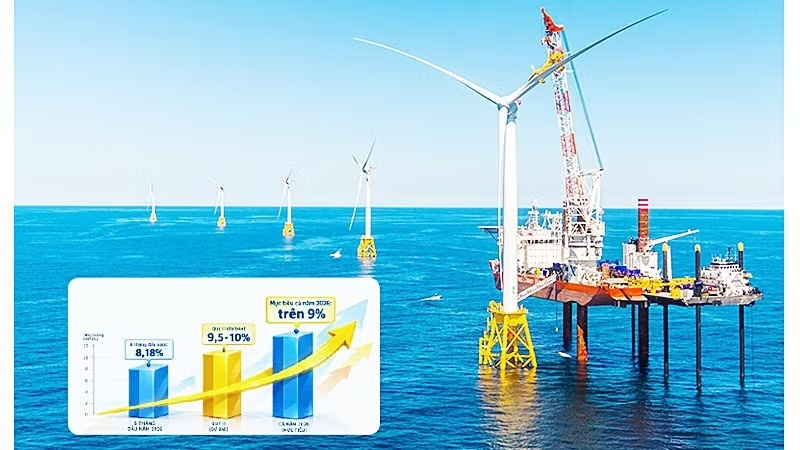
He said this is a time for Viet Nam to seize opportunities and create a new breakthrough. Positive developments in key economic regions, together with the transformation taking place in many localities, are creating new growth momentum and adding impetus to the economy. This provides a basis for him to believe that achieving GDP growth of over 9% in 2026 is entirely feasible.
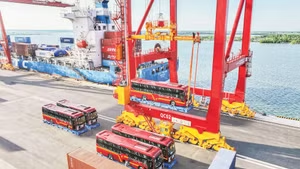
Looking at the drivers of growth, Dr Chu Tuan Linh, Dean of the Faculty of Banking and Finance at Nguyen Trai University (NTU), said investment in infrastructure development has delivered positive results, helping expand development space and improve the economy’s connectivity.
According to him, there remains substantial room for growth, as resources such as the private sector, capital markets, land, knowledge, data and FDI have yet to be fully tapped and can continue to be converted into productive capacity.
Dr Tran Xuan Luong, Director of the Viet Nam Institute for Economic and Real Estate Research, said economic growth can be driven by four main components: consumption, investment, government spending and net exports.
In recent years, the Government has implemented various measures to boost these drivers, from stimulating consumption and supporting businesses to accelerating public investment and expanding exports, thereby generating positive changes in the economy.
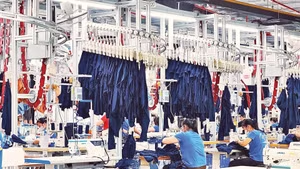
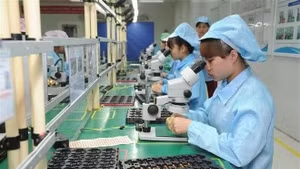
Investment and exports remain important growth drivers. The FDI sector also has considerable room for expansion as Viet Nam can capitalise on global supply-chain shifts, free trade agreements (FTAs) and its labour force advantages to attract more resources, expand production capacity and boost exports.
Changing the way growth is generated
However, Dr Tran Xuan Luong stressed that most domestic enterprises remain small, while their capacity to participate in supporting industries is limited. To increase the spillover effects of FDI, Viet Nam needs not only to continue attracting investment and improve its efficiency, but also to strengthen the production capacity of domestic businesses, enhance linkages between the two sectors and enable Vietnamese enterprises to participate more deeply in production chains, particularly in higher value-added stages.
He said policy effectiveness depends not only on policy design but also on implementation. Business support policies should take into account differences in the scale and capacity of different groups of enterprises, thereby improving their ability to access and benefit from such support in practice.
Regarding policies to help businesses access land and production premises, Dr Tran Xuan Luong said the issue has received attention but implementation needs to be further improved, particularly for small and medium-sized enterprises. Reducing the cost burden of premises would give businesses more resources to invest in machinery and technology and expand production.
Nguyen Quoc Anh, Deputy Director of the Institute of Economic and Financial Strategy and Policy under the Ministry of Finance, said the scope for some traditional growth drivers is narrowing, while international competition is increasingly dependent on technology, productivity, human-resource quality and the ability to participate in high value-added value chains.
Therefore, the goal of double-digit growth requires not only a higher growth rate but also a change in the way growth is generated. The economy needs to gradually shift from a model heavily reliant on increased inputs towards one driven more by productivity, technology, innovation and efficient resource utilisation.
To achieve average annual growth of over 10% during 2026-2030, Nguyen Quoc Anh said Viet Nam needs to restructure investment, the financial system and the business sector, thereby laying the foundation for a new growth model. At the same time, the role of the private sector should be strengthened, the quality of FDI improved, and linkages between FDI and domestic enterprises enhanced.
Five groups of solutions for high and sustainable growth
Dr Can Van Luc said Viet Nam should focus on five groups of solutions to lay the foundation for high and sustainable growth.
First, institutions for new growth drivers should be improved. Party resolutions, laws passed by the National Assembly and Government action programmes need to be translated into concrete policies and practical action as soon as possible. The growth model should be open and flexible, while promoting traditional drivers and creating room for new ones such as the digital and green economies.
Second, growth drivers should be tapped simultaneously and effectively. Alongside strengthening existing drivers, Viet Nam needs to accelerate new ones to create additional momentum for the economy and sustain growth over the long term.
Third, the stability of key markets should be maintained. Dr Can Van Luc said Viet Nam needs to maintain stability in the exchange rate, energy market and financial system. Monetary policy should be managed flexibly to stabilise interest rates, while appropriate measures should be taken to reduce lending rates for priority sectors.
Fourth, the focus should shift towards improving the quality of growth. Viet Nam needs to continue restructuring the economy, improve labour productivity, enhance resource efficiency and control the incremental capital-output ratio (ICOR). Dr Can Van Luc has set a target of reducing ICOR to around four and raising the contribution of total factor productivity (TFP) to growth to over 55%.
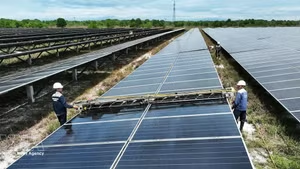
Alongside improving economic efficiency, Viet Nam needs to promote a green, inclusive and sustainable growth model and strengthen its capacity to adapt to climate change, while proactively addressing increasingly pressing urban problems such as flooding and land subsidence.
Fifth, Viet Nam needs to strengthen security in four areas: energy, food, supply chains, and cybersecurity and data security. Energy deserves particular attention, Dr Can Van Luc said, noting that the development of national energy reserves has not kept pace with rapid and complex changes in the global geopolitical situation.
“We are making efforts to transition to green energy, but months have passed since the conflict broke out and we still have not taken sufficiently strong action to strengthen national energy reserves,” Luc warned.